
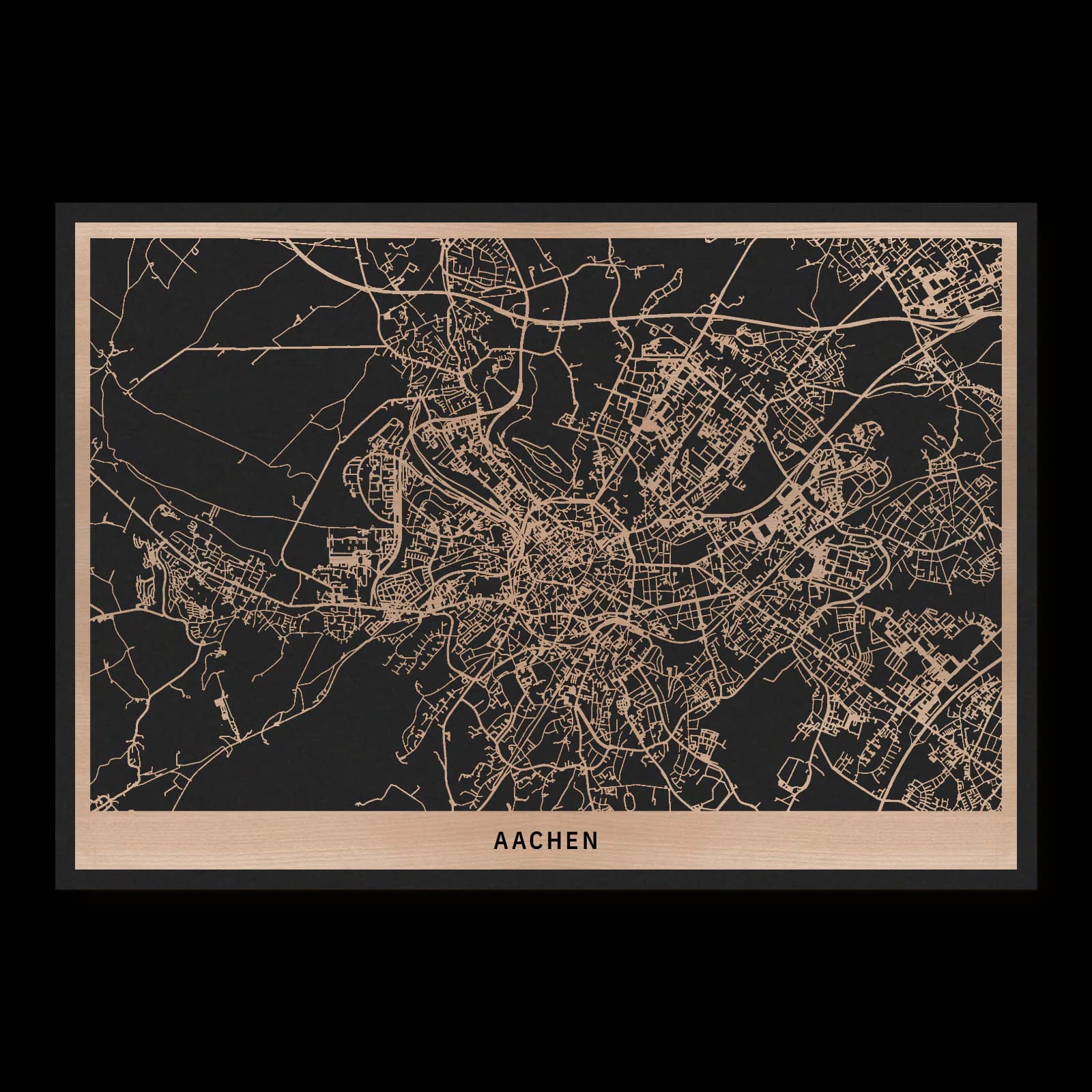
Aachen.City overview
A landscape beech city map connecting Aachen's cathedral, campus and neighbourhoods in two wooden layers.
About the product
Aachen extends well beyond the compact streets around its cathedral. Campus Melaten, the Carolus thermal baths, Tivoli and the main station all lie within this overview. Their connecting routes bring university life, bathing and transport into the same urban portrait. The landscape format is cut from oiled beech in two layers, with a black back plate defining the street network across the wider city.
What does the map show?
- Aachen Cathedral
- Carolus Thermen
- Aachen main station
- Campus Melaten
- Two wooden layers with a black back plate
- Precisely cut and engraved
- Fine laser details with clear depth
- Carefully inspected and securely packed
- Handmade in Germany
Configuration
Shape: Rectangular · Design: Layered · Material: Beech · Sizes: 20 × 30 cm, 35 × 50 cm, 50 × 70 cm
The configuration shown in the cart and at the time of ordering is authoritative. The preview is not a dimensioned technical drawing.
Availability & production
- Availability
- Made to order
- Production time
- Ships in 3-5 business days
Production starts after successful payment and complete product configuration.
Materials & care
Depending on the variant, lacquered or oiled MDF or oiled real-wood veneer on MDF; optional stainless-steel mounting screws. Acrylic lacquer spray, hard-wax oil and white glue are used in production.
Wood is a natural material. Grain and color may vary slightly from the product images.
Clean with a dry, soft cloth and protect from prolonged moisture and direct heat.
Included & installation
The selected product in the ordered configuration, securely packed and prepared for installation.
- Maximum dimensions 50 × 70 cm and maximum product weight 2 kg.
- Wall-fixing screws and wall plugs are not included. Use fixings suitable for the wall type, substrate and product weight.
- Installation must be carried out by an adult. Keep optional mounting screws and other small parts away from children until installation.
Shipping & returns
Securely packed shipping. Return and cancellation information is available in the legal section.
Shipping costs and delivery options depend on the destination and format. The published cancellation right applies to non-personalised standard goods; it may be excluded for individually made products.
Manufacturer & product identifier
- Manufacturer
- Benjamin Nöst - Lightworks
Rorichmoorer Str. 76
26802 Moormerland, Deutschland
kontakt@lightworks.de - Product identifier
- LW-CAT-9AD0D04349A9-S, LW-CAT-9AD0D04349A9-M, LW-CAT-9AD0D04349A9-L
Together with the order or production batch, the relevant SKU enables traceability. Safety questions and incidents can be reported to the email address shown above.
Product safety
- Decorative product for dry indoor use only; not a toy and not intended for children.
- Protect from moisture, high heat and open flames.
- Do not continue to hang the product after a fall, breakage or visible damage. Keep damaged parts away from children.
Aachen from the cathedral to its university district
Aachen's cathedral provides a historic anchor for a city that extends into very different settings. Campus Melaten, the Carolus thermal baths, the Tivoli stadium and the main station introduce research, bathing, sport and transport. Their positions reveal a connected urban area with more than one architectural scale.
Beginning with the cathedral
Aachen's association with Charlemagne gives its cathedral an exceptional historical position. The surviving core of his palace chapel dates from around the year 800 and connects the city with Carolingian rule. Yet this major monument is also part of a closely built urban centre. Surrounding streets place it within the daily structure of a city that developed far beyond the original imperial setting.
Following the directions away from the cathedral helps establish a broader understanding of Aachen. The main station lies to the south, the Carolus Thermen to the northeast, Campus Melaten to the west and Tivoli farther north. Their distribution provides a useful set of reference points. Each introduces a different function and a different relationship between buildings, open ground and the connecting street network.
Research changes the urban scale
Campus Melaten belongs to the development of RWTH Aachen University. Its research and university buildings occupy an environment quite unlike the compact streets around the cathedral. Larger sites and more extensive spaces between buildings reflect the requirements of modern institutions. This western district makes Aachen's identity as a place of science physically apparent in the organisation of the city.
The transition between the historic centre and Melaten is therefore an important part of the urban story. The university is not simply an institution associated with Aachen in name. Its buildings and grounds establish a substantial presence, influencing the relationship between districts and the routes that connect them. Comparing these areas reveals how different activities produce different kinds of urban space.
Baths, stadium and railway
Northeast of the centre, the Carolus Thermen continue the city's association with thermal water. Here water matters through a particular site and its function, rather than through a broad river visible across the urban landscape. This distinction gives Aachen a distinctive geographical character. Its bathing tradition is rooted in specific places within the city.
Tivoli and the main railway station provide further contrasts. The stadium is a large enclosed destination in the north, while the station belongs to an extended railway corridor in the south. Both have a scale and arrangement different from the small blocks of the historic centre. Their positions help explain the reach of the central city and the distances between its principal activities.
The resulting portrait holds several versions of Aachen together. Imperial history remains concentrated around the cathedral, research has a strong western presence, and bathing, sport and transport contribute their own recognisable spaces. Understanding the connections between these places gives the historic centre a wider and more informative urban setting.
Sources
- Deutsche Zentrale für Tourismus – Aachen — https://www.germany.travel/en/cities-culture/aachen.html
- Wikipedia – Campus Melaten — https://de.wikipedia.org/wiki/Campus_Melaten
- Wikipedia – Tivoli (Aachen) — https://de.wikipedia.org/wiki/Tivoli_%28Aachen%29
- Wikipedia – Aachen Hauptbahnhof — https://de.wikipedia.org/wiki/Aachen_Hauptbahnhof
- Wikipedia – Carolus Thermen — https://de.wikipedia.org/wiki/Carolus_Thermen

Still deciding?
Configure your motif in the studio and see how your city map will look in your space.