
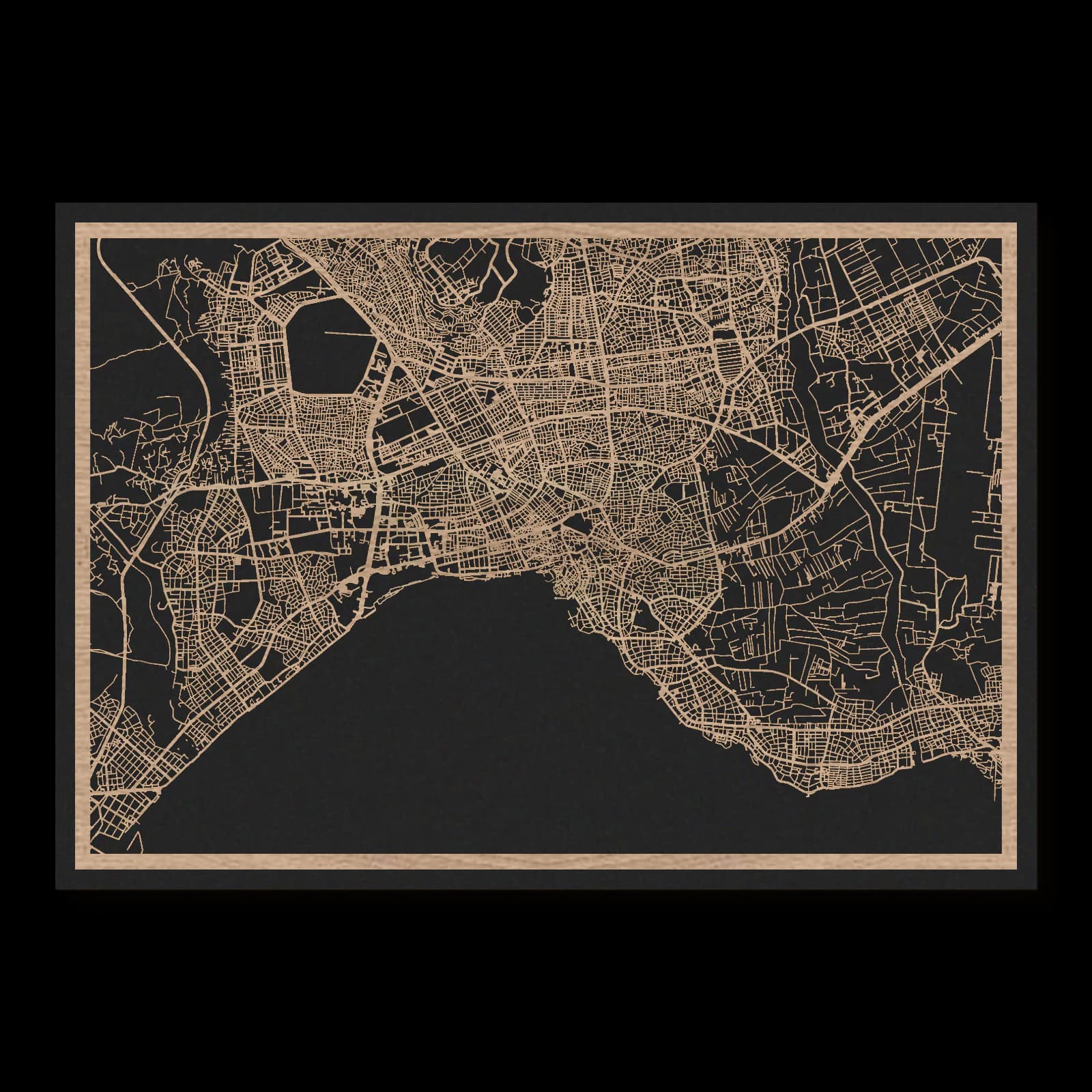
Antalya.Old town, coastline and Düden
Rectangular wooden city map made from oiled oak – two layers with a black back plate.
About the product
Antalya stretches between the historic centre, a western beach curve and the lower Düden’s coastal outlet. Hadrian’s Gate, the museum location and Konyaaltı provide distinct references. Wood gives the connected streets, green spaces and shoreline a warm material presence. The map follows an urban landscape where ancient remains, established neighbourhoods and the steep coast meet through different relationships between settlement and sea.
What does the map show?
- Kaleiçi
- Hadrian’s Gate
- Antalya Museum
- Konyaaltı
- Lower Düden
- Mediterranean coastline
- Precisely cut and engraved
- Fine laser details with clear depth
- Carefully inspected and securely packed
- Handmade in Germany
Configuration
Shape: Rectangular · Design: Layered · Material: Oak · Sizes: 20 × 30 cm, 35 × 50 cm, 50 × 70 cm
The configuration shown in the cart and at the time of ordering is authoritative. The preview is not a dimensioned technical drawing.
Availability & production
- Availability
- Made to order
- Production time
- Ships in 3-5 business days
Production starts after successful payment and complete product configuration.
Materials & care
Depending on the variant, lacquered or oiled MDF or oiled real-wood veneer on MDF; optional stainless-steel mounting screws. Acrylic lacquer spray, hard-wax oil and white glue are used in production.
Wood is a natural material. Grain and color may vary slightly from the product images.
Clean with a dry, soft cloth and protect from prolonged moisture and direct heat.
Included & installation
The selected product in the ordered configuration, securely packed and prepared for installation.
- Maximum dimensions 50 × 70 cm and maximum product weight 2 kg.
- Wall-fixing screws and wall plugs are not included. Use fixings suitable for the wall type, substrate and product weight.
- Installation must be carried out by an adult. Keep optional mounting screws and other small parts away from children until installation.
Shipping & returns
Securely packed shipping. Return and cancellation information is available in the legal section.
Shipping costs and delivery options depend on the destination and format. The published cancellation right applies to non-personalised standard goods; it may be excluded for individually made products.
Manufacturer & product identifier
- Manufacturer
- Benjamin Nöst - Lightworks
Rorichmoorer Str. 76
26802 Moormerland, Deutschland
kontakt@lightworks.de - Product identifier
- LW-CAT-167BEACF7264-S, LW-CAT-167BEACF7264-M, LW-CAT-167BEACF7264-L
Together with the order or production batch, the relevant SKU enables traceability. Safety questions and incidents can be reported to the email address shown above.
Product safety
- Decorative product for dry indoor use only; not a toy and not intended for children.
- Protect from moisture, high heat and open flames.
- Do not continue to hang the product after a fall, breakage or visible damage. Keep damaged parts away from children.
Antalya’s historic city between beach and coastal cliffs
Central Antalya’s coastline includes several landscape forms. The historic quarter stands above the harbour, while Konyaaltı extends westwards along a longer beach curve. To the east, the lower Düden reaches the sea over a rocky edge. Hadrian’s Gate and the museum location add architectural and archaeological references within this connected coastal city.
Kaleiçi above the older harbour
Kaleiçi is Antalya’s historic urban quarter, with established streets linked to the older harbour setting. Its position above the coast places smaller developed areas close to the open sea. Several historical buildings belong to this neighbourhood, whose identity involves more than one isolated monument. Routes and houses occupy a different scale from the principal avenues continuing through the wider city. Their spatial arrangement matters to the overall portrait. It connects urban history with a specific physical setting where coastal position, changes in elevation and building patterns interact within a comparatively compact area of the central city.
A Roman gate with a later history
Hadrian’s Gate was erected in AD 130 in honour of the Roman emperor Hadrian. Later walls concealed parts of the structure for a period; removal of wall remains brought it into view again in 1882. Its history therefore involves both ancient construction and subsequent changes in the treatment of the building. The position beside the historic quarter establishes a relationship between older streets and adjoining urban areas. The gate represents a Roman layer within Antalya, while its connection with later fortifications and surrounding development gives that earlier architecture a wider historical and spatial context.
Archaeological knowledge towards the west
The Antalya Museum location stands west of the old town and connects the city with archaeological collections from the wider region. Sculptures and other finds introduce historical relationships beyond the individual buildings that survive within the streets. This institutional setting complements the directly visible traces in Kaleiçi. Farther west, Konyaaltı continues the coastal landscape through a longer beach stretch. Museum grounds, urban neighbourhoods and shoreline introduce a broader geographical scale together. The tightly arranged historic streets become part of a larger landscape of developed city, open coastal ground and connecting transport routes extending along the western urban edge.
The Düden at the eastern cliffs
The lower Düden reaches the Mediterranean east of the historic centre by falling over a high rocky edge. Flowing water creates a coastal relationship different from that of the western beach. The outlet also belongs to the eastern urban setting and its green spaces. Together with Konyaaltı, it demonstrates that Antalya’s shoreline does not have a single uniform form. Historic streets, further neighbourhoods and connecting avenues occupy the ground between these references. Ancient architecture, archaeological knowledge and landscape conditions consequently remain related within the wider city. Antalya’s coastal character appears through several distinct settings, shaped by both its developed fabric and the different boundaries where land meets sea.
Sources
- sehen Antalya - GoTürkiye Destination — https://goturkiye.com/de/antalya/see
- KALEİÇİ - Türkiye Kültür Portalı — https://www.kulturportali.gov.tr/turkiye/antalya/gezilecekyer/kaleici
- HADRİAN KAPISI - ANTALYA - Türkiye Kültür Portalı — https://www.kulturportali.gov.tr/turkiye/antalya/gezilecekyer/hadrian-kapisi-
- GoTürkiye: Antalya – Düden und Wasserfälle — https://goturkiye.com/de/antalya/listen
- Historical Centre — https://goturkiye.com/turkishriviera/historical-centre

Still deciding?
Configure your motif in the studio and see how your city map will look in your space.