
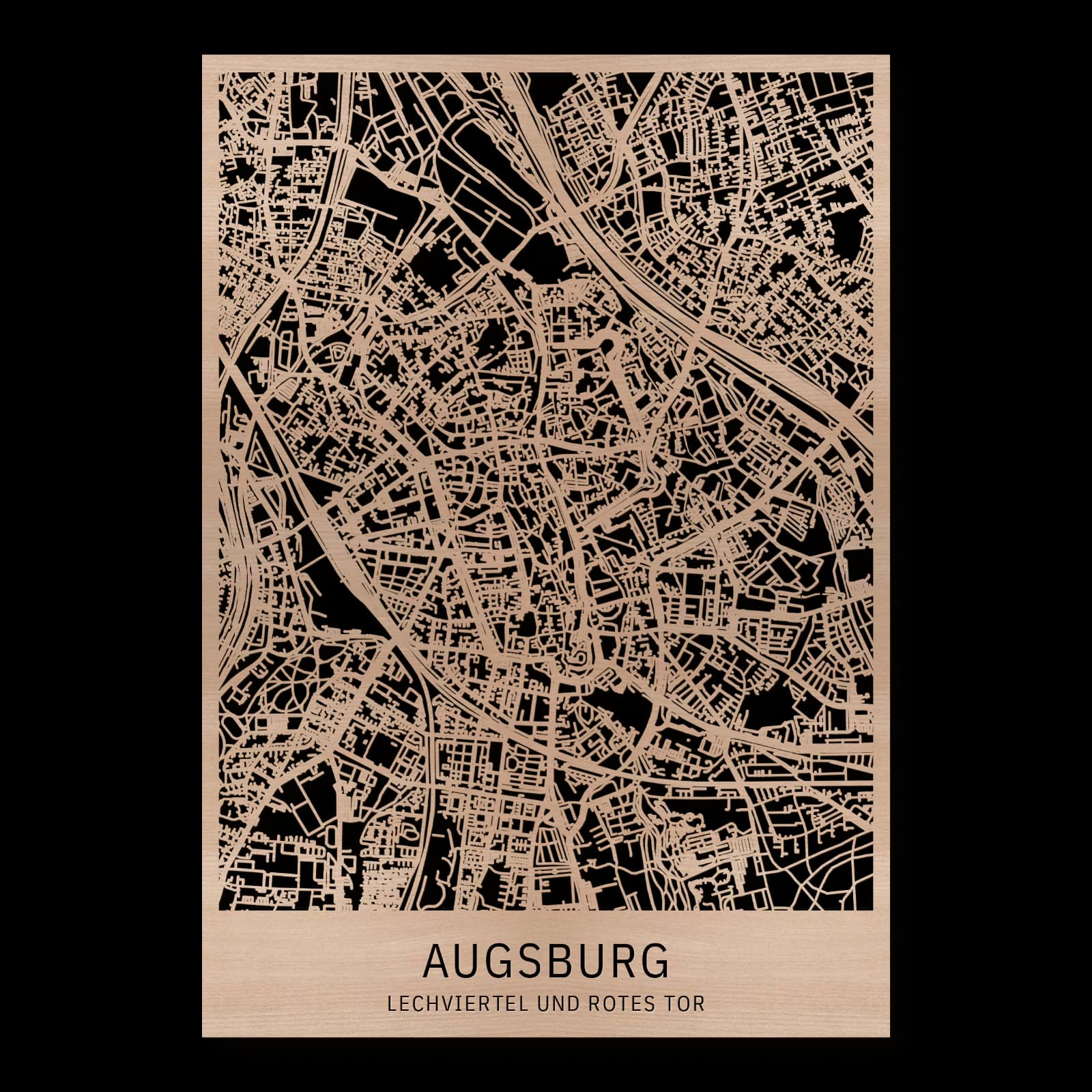
Augsburg.Lech Quarter and Red Gate
A single-layer Classic city map in oiled beech, focused on Augsburg's Lech Quarter and Red Gate.
About the product
Water channels run through the lived-in streets of Augsburg's Lech Quarter. This crop includes the Rathaus, Fuggerei and historic waterworks at the Red Gate, bringing civic life, housing and engineering into one compact setting. The map is cut from oiled beech using the single-layer Classic construction. Without a back plate, the openings between its wooden routes remain free.
What does the map show?
- Augsburg Town Hall
- Fuggerei
- Waterworks at the Red Gate
- Single wooden layer without a back plate
- Precisely cut and engraved
- Fine laser details with clear depth
- Carefully inspected and securely packed
- Handmade in Germany
Configuration
Shape: Rectangular · Design: Classic · Material: Beech · Sizes: 20 × 30 cm, 35 × 50 cm, 50 × 70 cm
The configuration shown in the cart and at the time of ordering is authoritative. The preview is not a dimensioned technical drawing.
Availability & production
- Availability
- Made to order
- Production time
- Ships in 3-5 business days
Production starts after successful payment and complete product configuration.
Materials & care
Depending on the variant, lacquered or oiled MDF or oiled real-wood veneer on MDF; optional stainless-steel mounting screws. Acrylic lacquer spray, hard-wax oil and white glue are used in production.
Wood is a natural material. Grain and color may vary slightly from the product images.
Clean with a dry, soft cloth and protect from prolonged moisture and direct heat.
Included & installation
The selected product in the ordered configuration, securely packed and prepared for installation.
- Maximum dimensions 50 × 70 cm and maximum product weight 2 kg.
- Wall-fixing screws and wall plugs are not included. Use fixings suitable for the wall type, substrate and product weight.
- Installation must be carried out by an adult. Keep optional mounting screws and other small parts away from children until installation.
Shipping & returns
Securely packed shipping. Return and cancellation information is available in the legal section.
Shipping costs and delivery options depend on the destination and format. The published cancellation right applies to non-personalised standard goods; it may be excluded for individually made products.
Manufacturer & product identifier
- Manufacturer
- Benjamin Nöst - Lightworks
Rorichmoorer Str. 76
26802 Moormerland, Deutschland
kontakt@lightworks.de - Product identifier
- LW-CAT-70C3A3C6AA31-S, LW-CAT-70C3A3C6AA31-M, LW-CAT-70C3A3C6AA31-L
Together with the order or production batch, the relevant SKU enables traceability. Safety questions and incidents can be reported to the email address shown above.
Product safety
- Decorative product for dry indoor use only; not a toy and not intended for children.
- Protect from moisture, high heat and open flames.
- Do not continue to hang the product after a fall, breakage or visible damage. Keep damaged parts away from children.
Augsburg's lower old town and the organisation of water
Narrow channels form part of the street pattern in Augsburg's lower old town. Between the Rathaus, Fuggerei and waterworks at the Red Gate, they connect technical history with civic and residential places. This compact setting reveals how the city organised water alongside the spaces of administration, work and everyday life.
Water within the street network
The waterways of Augsburg's old town belong to a technical system with a long history. They are associated with supply and industrial activity, making them part of the city's structure rather than decorative additions. In the Lech Quarter, water, streets and buildings occupy closely shared ground. The channels form an intricate network within the built area, quite different from a broad riverfront landscape.
The historical separation of drinking water from water used for other purposes is one of Augsburg's notable achievements. Different qualities had to be kept apart and directed towards different tasks. This required both engineering and civic organisation. The system influenced installations, routes and the relationship between lower watercourses and users situated on higher parts of the city.
Raising water at the Red Gate
The waterworks at the Red Gate occupy the southern end of this old-town area. Their towers and machinery belonged to the supply system that served Augsburg. The task involved more than receiving water: it also required moving it across changes in elevation. The site therefore explains an important relationship between engineering, terrain and the practical needs of an urban population.
The complex forms part of Augsburg's UNESCO World Heritage. Its significance depends on its place within the larger network. A water tower can be appreciated as an individual building, but its function becomes understandable through the waterways and districts to which it was connected. The Red Gate brings that wider technical history into one identifiable urban location.
Homes and civic places nearby
North of the waterworks, the Fuggerei brings social history into the same compact area. Housing follows a regular arrangement of homes and shared internal connections. The foundation connects Augsburg's economic and social history with a place that continues to be used for housing. Beside the smaller streets of the old town, it introduces another planned arrangement, serving a purpose quite different from that of the waterworks.
The Rathaus to the northwest adds a representative civic setting. Its surroundings belong to the central city above the lower old-town area. Between Rathaus, Fuggerei and Red Gate, the arrangement of buildings changes while streets and shared urban history keep the places connected. Different functions occupy close but recognisably separate settings.
This interdependence gives the Lech Quarter its particular interest. Technical supply did not stand apart from the inhabited city; it ran through it. The channels connect an everyday resource with considerable organisational achievement. Seen alongside housing and civic buildings, they reveal how many different requirements Augsburg brought together within the limited space of its historic centre.
Sources
- UNESCO – Water Management System of Augsburg — https://whc.unesco.org/en/list/1580/
- Fuggersche Stiftungen – Fuggerei — https://www.fugger.de/fuggerei
- Wikipedia – Wasserwerk am Roten Tor — https://de.wikipedia.org/wiki/Wasserwerk_am_Roten_Tor
- Wikipedia – Rathaus (Augsburg) — https://de.wikipedia.org/wiki/Augsburger_Rathaus

Still deciding?
Configure your motif in the studio and see how your city map will look in your space.



