
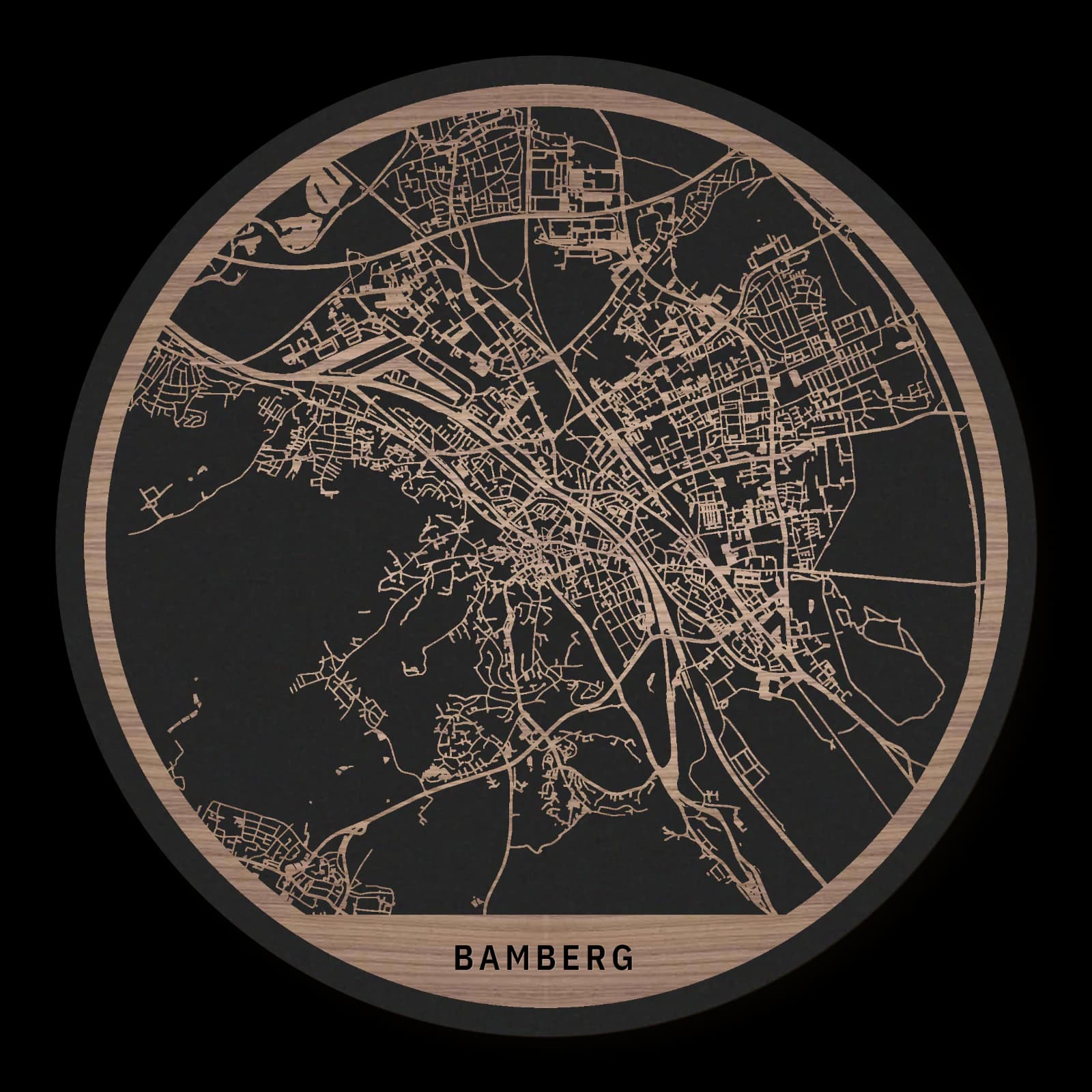
Bamberg.
Layered wooden city map in oiled walnut, round format.
About the product
Bamberg combines prominent hills with a closely woven city beside the water. The cathedral and Michaelsberg establish western landmarks, Altenburg extends the view southwest, and the railway station connects with the eastern districts. Between them, streets and river crossings form a recognisable urban pattern. A circular outline brings Bamberg’s hills and river districts into one view. Oiled walnut forms the cut street layer, raised above a backing panel to lend depth to routes between the cathedral, Michaelsberg and eastern city.
What does the map show?
- Bamberger Dom
- Altenburg
- Kloster Michaelsberg
- Bahnhof Bamberg
- Precisely cut and engraved
- Fine laser details with clear depth
- Carefully inspected and securely packed
- Handmade in Germany
Configuration
Shape: Round · Design: Layered · Material: Walnut · Diameter: Ø 23 cm, Ø 35 cm, Ø 50 cm
The configuration shown in the cart and at the time of ordering is authoritative. The preview is not a dimensioned technical drawing.
Availability & production
- Availability
- Made to order
- Production time
- Ships in 3-5 business days
Production starts after successful payment and complete product configuration.
Materials & care
Depending on the variant, lacquered or oiled MDF or oiled real-wood veneer on MDF; optional stainless-steel mounting screws. Acrylic lacquer spray, hard-wax oil and white glue are used in production.
Wood is a natural material. Grain and color may vary slightly from the product images.
Clean with a dry, soft cloth and protect from prolonged moisture and direct heat.
Included & installation
The selected product in the ordered configuration, securely packed and prepared for installation.
- Maximum dimensions 50 × 70 cm and maximum product weight 2 kg.
- Wall-fixing screws and wall plugs are not included. Use fixings suitable for the wall type, substrate and product weight.
- Installation must be carried out by an adult. Keep optional mounting screws and other small parts away from children until installation.
Shipping & returns
Securely packed shipping. Return and cancellation information is available in the legal section.
Shipping costs and delivery options depend on the destination and format. The published cancellation right applies to non-personalised standard goods; it may be excluded for individually made products.
Manufacturer & product identifier
- Manufacturer
- Benjamin Nöst - Lightworks
Rorichmoorer Str. 76
26802 Moormerland, Deutschland
kontakt@lightworks.de - Product identifier
- LW-CAT-6245E01CBDC1-S, LW-CAT-6245E01CBDC1-M, LW-CAT-6245E01CBDC1-L
Together with the order or production batch, the relevant SKU enables traceability. Safety questions and incidents can be reported to the email address shown above.
Product safety
- Decorative product for dry indoor use only; not a toy and not intended for children.
- Protect from moisture, high heat and open flames.
- Do not continue to hang the product after a fall, breakage or visible damage. Keep damaged parts away from children.
Bamberg: hills, river channels and connecting streets
Bamberg's form emerges from elevated religious sites, the Regnitz and the eastern city. The cathedral, Michaelsberg, Altenburg and railway station offer widely spaced reference points. Reading them together places the historic centre within its landscape and explains why nearby parts of the city can provide such different experiences of movement and space.
A city with several centres
Bamberg becomes clearer when hills, river channels and eastern neighbourhoods are considered together. Its historic areas have different functions and physical forms. UNESCO recognises the inherited urban structure as an important example of a central European town with a medieval foundation. That significance includes the relationship between neighbourhoods and landscape, rather than resting on churches alone.
The cathedral and Michaelsberg occupy elevated positions west of the Regnitz. Lower ground contains a denser network of streets and crossings. Farther east, the pattern changes again. Short distances can obscure how different these areas feel when experienced on foot.
Religious buildings on higher ground
Bamberg Cathedral has a long construction history. Earlier buildings were destroyed by fire before the present cathedral took shape in the thirteenth century. Its four towers define a major western landmark, and the cathedral square gives the building its own setting. The authority of a bishop's church combines here with a particularly effective topographic position.
The former Benedictine abbey on Michaelsberg establishes another elevated focus. Its buildings also belong to the historic urban ensemble. Although its position invites comparison with the cathedral, the institution has its own history. Together they demonstrate how religious establishments occupied separate parts of the higher city and jointly influenced Bamberg's image.
A castle and a later arrival point
Altenburg stands farther southwest on a high hill. First mentioned in records in 1109, it later became a fortified residence of Bamberg's prince-bishops. Its separation from the denser centre is essential to its character. It provides an outer reference point whose effect depends on its raised, comparatively open setting.
The railway station northeast of the historic centre represents a different kind of connection. Nineteenth-century rail transport introduced substantial infrastructure into the eastern city. Streets between station and centre mediate between this later arrival pattern and the older geography of rivers and hills.
Bamberg's hills cannot be separated from its waterways. From an elevated church site, the Regnitz belongs to a broader cityscape; on a bridge, it becomes an immediate boundary between two banks. Arrival from the station adds a flatter eastern perspective. Cathedral, Michaelsberg and Altenburg are therefore not equivalent points on a level surface. Their different relationships with terrain and surrounding development determine how they are approached and which parts of Bamberg come into view during each journey.
Sources
- UNESCO World Heritage Centre: Town of Bamberg — https://whc.unesco.org/en/list/624/
- Wikipedia: Bamberger Dom — https://en.wikipedia.org/wiki/Bamberg_Cathedral
- Wikipedia: Kloster Michaelsberg — https://en.wikipedia.org/wiki/Michaelsberg_Abbey,_Bamberg
- Wikipedia: Altenburg — https://en.wikipedia.org/wiki/Altenburg_(Bamberg)
- Wikipedia: Bahnhof Bamberg — https://en.wikipedia.org/wiki/Bamberg_station

Still deciding?
Configure your motif in the studio and see how your city map will look in your space.



