
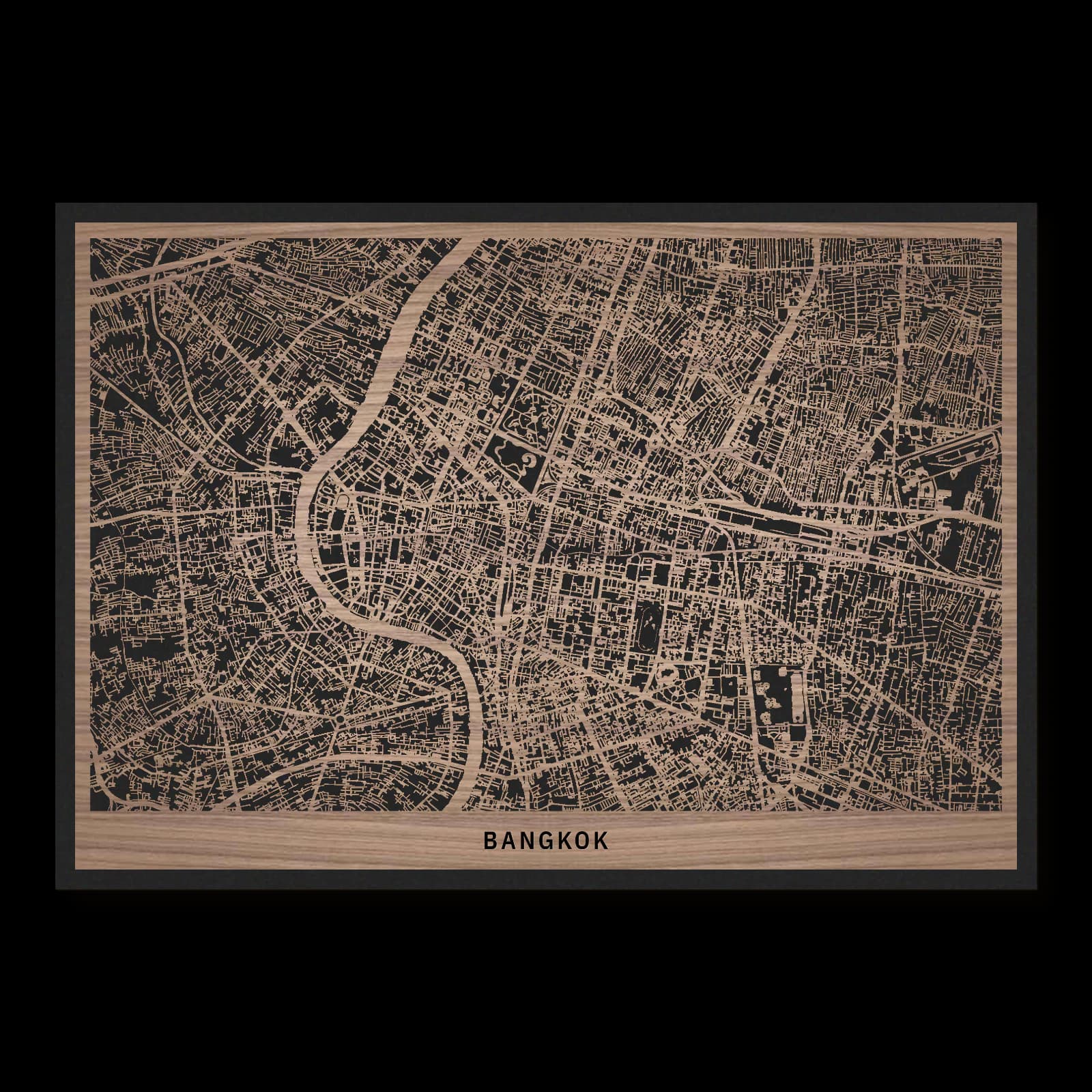
Bangkok.City Overview
Rectangular wooden city map made from oiled walnut – two layers with a black back plate.
About the product
Bangkok's expansive riverside palace grounds meet tightly connected commercial and residential streets. This wider view links the Grand Palace and Dusit with Lumphini Park and the eastern transport district around Makkasan. Their different scales come together in a wooden city map, while Chinatown and central routes complete a portrait that connects the capital's river origins with its later urban expansion.
What does the map show?
- Palace grounds and the opposite bank
- Chinatown trading district
- Northern and eastern routes to Dusit and Makkasan
- Precisely cut and engraved
- Fine laser details with clear depth
- Carefully inspected and securely packed
- Handmade in Germany
Configuration
Shape: Rectangular · Design: Layered · Material: Walnut · Sizes: 20 × 30 cm, 35 × 50 cm, 50 × 70 cm
The configuration shown in the cart and at the time of ordering is authoritative. The preview is not a dimensioned technical drawing.
Availability & production
- Availability
- Made to order
- Production time
- Ships in 3-5 business days
Production starts after successful payment and complete product configuration.
Materials & care
Depending on the variant, lacquered or oiled MDF or oiled real-wood veneer on MDF; optional stainless-steel mounting screws. Acrylic lacquer spray, hard-wax oil and white glue are used in production.
Wood is a natural material. Grain and color may vary slightly from the product images.
Clean with a dry, soft cloth and protect from prolonged moisture and direct heat.
Included & installation
The selected product in the ordered configuration, securely packed and prepared for installation.
- Maximum dimensions 50 × 70 cm and maximum product weight 2 kg.
- Wall-fixing screws and wall plugs are not included. Use fixings suitable for the wall type, substrate and product weight.
- Installation must be carried out by an adult. Keep optional mounting screws and other small parts away from children until installation.
Shipping & returns
Securely packed shipping. Return and cancellation information is available in the legal section.
Shipping costs and delivery options depend on the destination and format. The published cancellation right applies to non-personalised standard goods; it may be excluded for individually made products.
Manufacturer & product identifier
- Manufacturer
- Benjamin Nöst - Lightworks
Rorichmoorer Str. 76
26802 Moormerland, Deutschland
kontakt@lightworks.de - Product identifier
- LW-CAT-1E0701CD09EA-S, LW-CAT-1E0701CD09EA-M, LW-CAT-1E0701CD09EA-L
Together with the order or production batch, the relevant SKU enables traceability. Safety questions and incidents can be reported to the email address shown above.
Product safety
- Decorative product for dry indoor use only; not a toy and not intended for children.
- Protect from moisture, high heat and open flames.
- Do not continue to hang the product after a fall, breakage or visible damage. Keep damaged parts away from children.
Bangkok: River origins and metropolitan connections
Bangkok developed from a capital strongly organised around water into an extensive metropolis. Palace grounds, trading districts, parks and major transport routes occupy different parts of the inner city. Connecting them reveals several centres of activity and shows how the historic riverfront remains related to the much larger urban area around it.
A capital established beside the river
The Grand Palace recalls the establishment of the capital on the eastern bank in the late eighteenth century. Its extensive enclosed grounds differ from the smaller plots of neighbouring districts. Wat Arun provides another historic reference on the opposite side. Both banks therefore belong to Bangkok's story. The river served as a route and an urban connection before roads acquired their present reach. A broad view shows that the older capital consists of several political, religious and everyday settings linked by water, rather than one central square capable of representing the whole city.
The trading city's smaller spaces
Chinatown adds a major commercial district to the courtly and religious landscape. Its tighter connections and smaller urban units contrast with the large palace grounds. The difference reflects distinct requirements: trade, housing and representation do not need identical forms. Transitions between them are particularly characteristic of Bangkok. The city can change scale over short distances. Keeping these areas together in a wider portrait shows that their separate identities remain connected through shared routes and functions, making the relationships between districts as important as the character of each one.
Expansion north and east
Dusit points towards a later phase in the capital's development and extends the view northwards. Larger routes lead east through dense neighbourhoods towards Makkasan. This expansion demonstrates how Bangkok grew beyond its earlier river centre while continuing to depend on connections with it. The Jim Thompson House adds a cultural reference of a different scale within the central urban area. Places of this kind occupy settings between major corridors and smaller neighbourhoods. They resist a simple division between historical districts on one side and a completely separate modern city on the other.
Open ground within the metropolis
Lumphini Park provides a substantial green setting in the southeast, contrasting with surrounding roads and commercial areas. Farther west, Wat Saket introduces an elevated historical reference within denser development. Both help organise the city in different ways. Together with river, palace grounds, trading streets and northern institutions, they create a portrait with several centres. Bangkok becomes more understandable through their connections: waterways, inherited institutions and newer transport corridors continue to operate alongside one another, shaping a city whose spatial relationships remain in constant development.
Sources
- Tourism Authority of Thailand: Bangkok — https://www.tourismthailand.org/Destinations/Provinces/Bangkok/219
- Tourism Authority of Thailand: Grand Palace — https://www.tourismthailand.org/Attraction/the-grand-palace
- Thailand Tourismus: Bangkok Stadtführer — https://www.thailandtourismus.de/fileadmin/user_upload/E_Broschueren/Destinationen/Bangkok.pdf
- Wikivoyage: Bangkok — https://de.wikivoyage.org/wiki/Bangkok

Still deciding?
Configure your motif in the studio and see how your city map will look in your space.



