
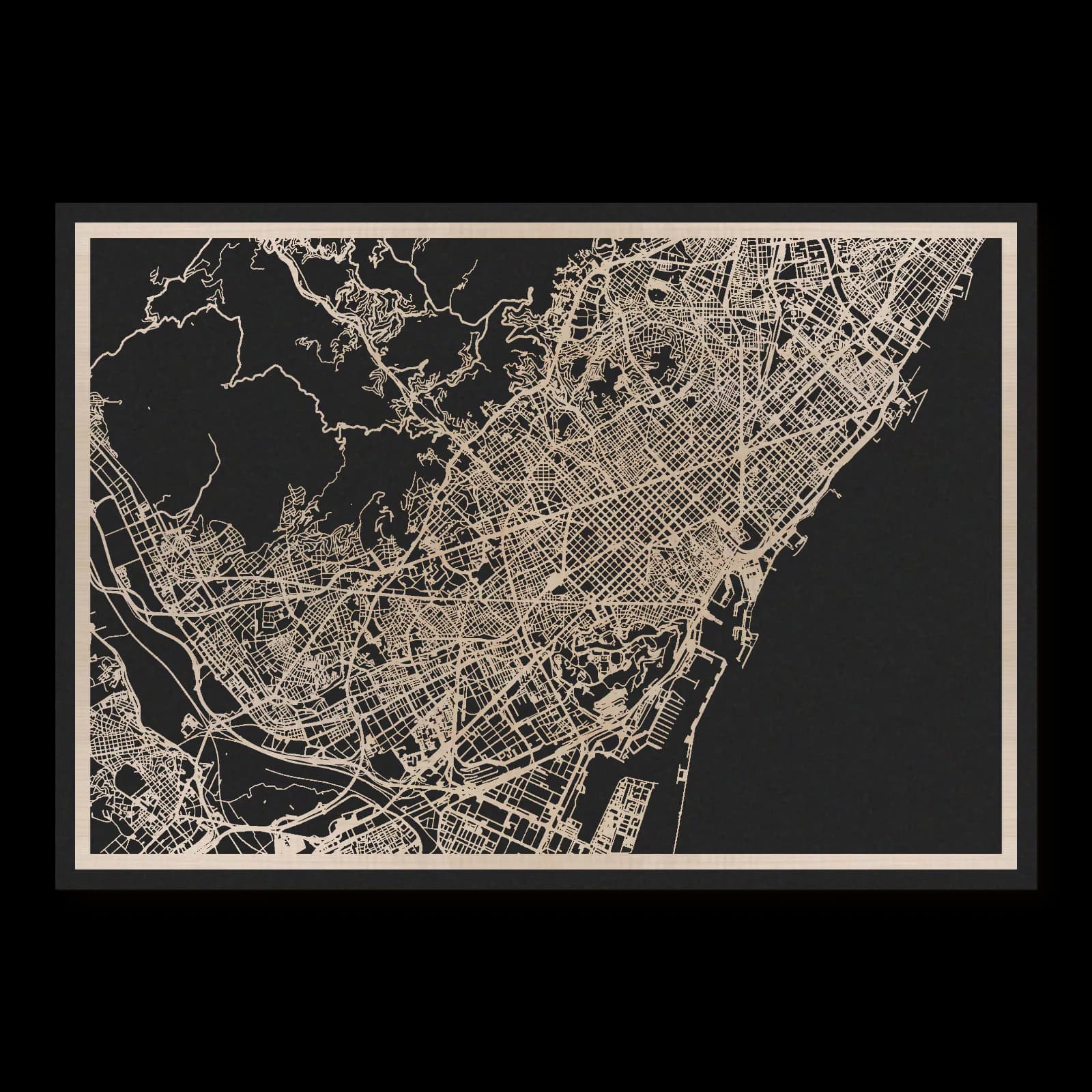
Barcelona.City grid between hillsides and coast
Rectangular wooden city map made from oiled maple – two layers with a black back plate.
About the product
Barcelona's street grid connects hillsides, monumental architecture and open coastal spaces. On wood, Park Güell, the Sagrada Família, Montjuïc Castle and the Fòrum belong to a broad urban composition. The streets between them carry the view. Alongside familiar landmarks, the map reveals the spatial order and contrasting edges of an inhabited city, giving its architecture a clear relationship with surrounding neighbourhoods.
What does the map show?
- Hillside Park Güell
- Sagrada Família within the grid
- Montjuïc Castle
- Coastal public spaces at the Fòrum
- Precisely cut and engraved
- Fine laser details with clear depth
- Carefully inspected and securely packed
- Handmade in Germany
Configuration
Shape: Rectangular · Design: Layered · Material: Maple · Sizes: 20 × 30 cm, 35 × 50 cm, 50 × 70 cm
The configuration shown in the cart and at the time of ordering is authoritative. The preview is not a dimensioned technical drawing.
Availability & production
- Availability
- Made to order
- Production time
- Ships in 3-5 business days
Production starts after successful payment and complete product configuration.
Materials & care
Depending on the variant, lacquered or oiled MDF or oiled real-wood veneer on MDF; optional stainless-steel mounting screws. Acrylic lacquer spray, hard-wax oil and white glue are used in production.
Wood is a natural material. Grain and color may vary slightly from the product images.
Clean with a dry, soft cloth and protect from prolonged moisture and direct heat.
Included & installation
The selected product in the ordered configuration, securely packed and prepared for installation.
- Maximum dimensions 50 × 70 cm and maximum product weight 2 kg.
- Wall-fixing screws and wall plugs are not included. Use fixings suitable for the wall type, substrate and product weight.
- Installation must be carried out by an adult. Keep optional mounting screws and other small parts away from children until installation.
Shipping & returns
Securely packed shipping. Return and cancellation information is available in the legal section.
Shipping costs and delivery options depend on the destination and format. The published cancellation right applies to non-personalised standard goods; it may be excluded for individually made products.
Manufacturer & product identifier
- Manufacturer
- Benjamin Nöst - Lightworks
Rorichmoorer Str. 76
26802 Moormerland, Deutschland
kontakt@lightworks.de - Product identifier
- LW-CAT-9E18E663E939-S, LW-CAT-9E18E663E939-M, LW-CAT-9E18E663E939-L
Together with the order or production batch, the relevant SKU enables traceability. Safety questions and incidents can be reported to the email address shown above.
Product safety
- Decorative product for dry indoor use only; not a toy and not intended for children.
- Protect from moisture, high heat and open flames.
- Do not continue to hang the product after a fall, breakage or visible damage. Keep damaged parts away from children.
Barcelona from its urban grid to hills and coast
Barcelona's streets connect markedly different urban situations. Park Güell occupies a designed hillside, while the Sagrada Família stands within the developed street grid. Montjuïc Castle provides another elevated reference and the Fòrum a public coastal setting. Together these places explain the relationships between prominent architecture and the inhabited city around it.
Gaudí in contrasting urban settings
Park Güell and the Sagrada Família are closely associated with Antoni Gaudí, but occupy different kinds of urban space. The park stands on a hillside and brings routes together with deliberately designed surroundings. Official visitor information emphasises the relationship between architecture and nature. The Sagrada Família, by contrast, occupies the developed city grid. The building's official history records Gaudí taking over the already begun project in the nineteenth century. For a geographical portrait, these differences matter more than a simple list of famous architecture. The same name connects a garden landscape and a monumental building among city streets. Barcelona remains inhabited between them, with everyday routes serving more than visits to landmarks. Each place consequently develops a different relationship with urban life through the character of its surroundings and the movement of people nearby.
Montjuïc as a landscape of development
Montjuïc Castle lies southwest of the central neighbourhoods and identifies another prominent height. Official information recalls how exhibitions and major sporting events influenced the mountain's development. Montjuïc is therefore more than a viewing edge behind the city. Its landscape and uses reflect deliberate urban change over time. The castle location helps distinguish this setting from the more closely developed street grid. Routes change direction and scale when moving from the regular network onto higher ground. Barcelona acquires another dimension through this relationship: an urban pattern stands alongside larger terrain that combines historical significance and public use in its own way. Both belong to the experience of the same city, with neither reducing the other to a simple backdrop for well-known sights.
Public life beside the coast
The Fòrum introduces a different reference in the east. The city describes it as a large setting for cultural, social and sporting events in a well-connected coastal location. Parc dels Auditoris forms part of this broader open setting. Openness beside the water becomes more prominent here than among the central blocks. Broad routes and larger open spaces create another environment for public life. Barcelona's varied streets occupy the area between this coast, Montjuïc and the two Gaudí places. The references consequently identify relationships rather than isolated islands. They show how architecture, terrain and daily routes interact in different settings. Looking across them reveals a city whose famous places gain character from the inhabited neighbourhoods between them and from their proximity to open coastal spaces.
Sources
- Park Güell — https://barcelonaturisme.com/wv3/en/page/853/park-guell.html
- Parc de Montjuïc - Turisme de Barcelona — https://bid.barcelonaturisme.com/wv3/es/page/534/parc-de-montjuic.html
- Parc del Fòrum | Barcelona Guide | Barcelona City Council — https://guia.barcelona.cat/en/agenda/detall/el-parc-del-forum_99400118971.html
- History of the Temple - Sagrada Família - Sagrada Familia — https://sagradafamilia.org/en/history-of-the-temple

Still deciding?
Configure your motif in the studio and see how your city map will look in your space.