
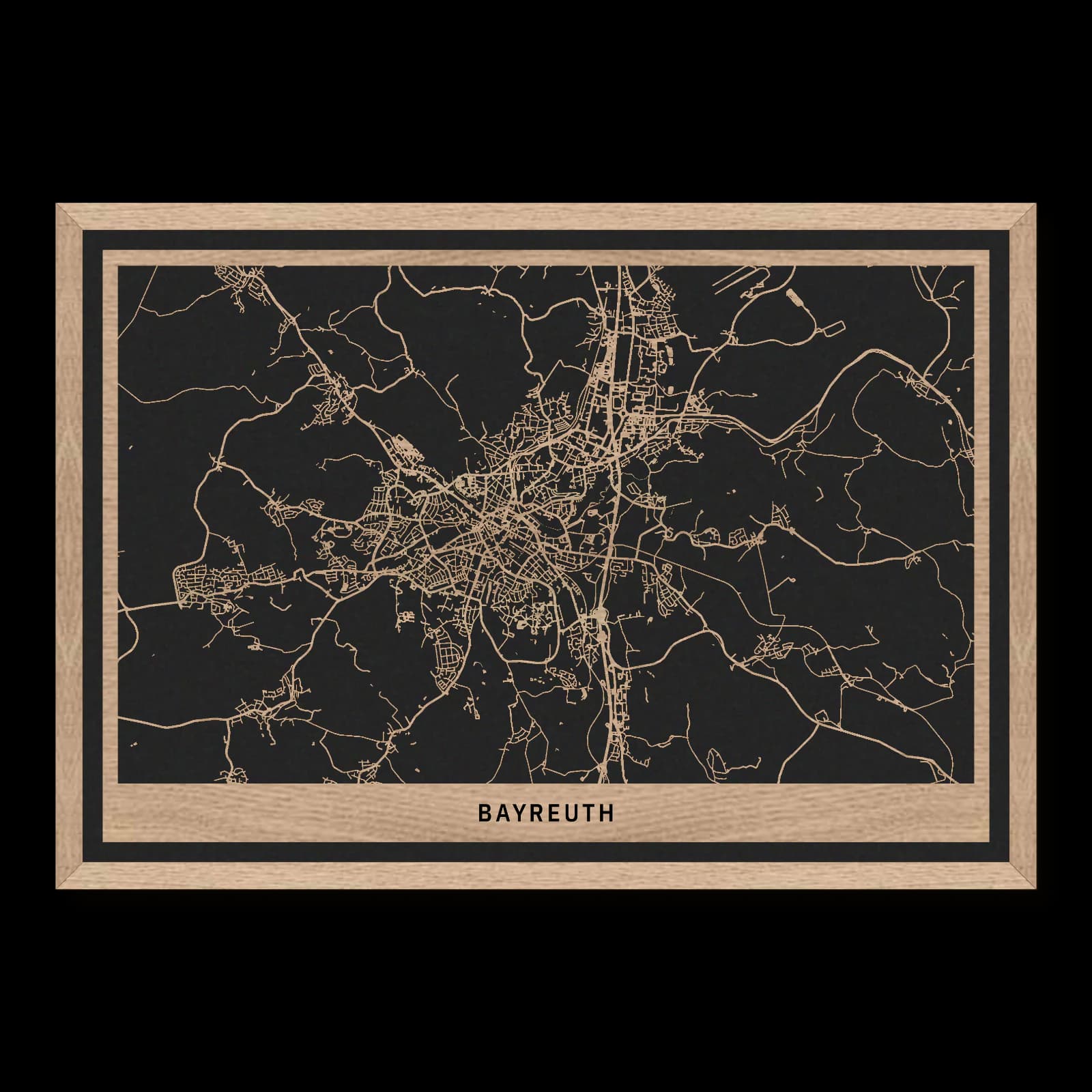
Bayreuth.
Framed wooden city map in oiled oak, landscape format.
About the product
Bayreuth unfolds between the Festival Theatre, historic centre, university and Hermitage. The Margravial Opera House and Wahnfried contribute different musical reference points, while streets and green spaces connect the wider city. This view recalls Bayreuth as more than one famous performance venue, bringing central routes together with grounds extending north, south and east. The landscape format gives Bayreuth’s cultural sites room within the wider city. An oiled oak frame surrounds the layered map, whose cut routes connect the centre, university and Hermitage rather than treating them as separate destinations.
What does the map show?
- Festspielhaus Bayreuth
- Markgräfliches Opernhaus
- Wahnfried
- Universität Bayreuth
- Precisely cut and engraved
- Fine laser details with clear depth
- Carefully inspected and securely packed
- Handmade in Germany
Configuration
Shape: Rectangular · Design: Framed · Material: Oak · Sizes: 20 × 30 cm, 35 × 50 cm, 50 × 70 cm
The configuration shown in the cart and at the time of ordering is authoritative. The preview is not a dimensioned technical drawing.
Availability & production
- Availability
- Made to order
- Production time
- Ships in 3-5 business days
Production starts after successful payment and complete product configuration.
Materials & care
Depending on the variant, lacquered or oiled MDF or oiled real-wood veneer on MDF; optional stainless-steel mounting screws. Acrylic lacquer spray, hard-wax oil and white glue are used in production.
Wood is a natural material. Grain and color may vary slightly from the product images.
Clean with a dry, soft cloth and protect from prolonged moisture and direct heat.
Included & installation
The selected product in the ordered configuration, securely packed and prepared for installation.
- Maximum dimensions 50 × 70 cm and maximum product weight 2 kg.
- Wall-fixing screws and wall plugs are not included. Use fixings suitable for the wall type, substrate and product weight.
- Installation must be carried out by an adult. Keep optional mounting screws and other small parts away from children until installation.
Shipping & returns
Securely packed shipping. Return and cancellation information is available in the legal section.
Shipping costs and delivery options depend on the destination and format. The published cancellation right applies to non-personalised standard goods; it may be excluded for individually made products.
Manufacturer & product identifier
- Manufacturer
- Benjamin Nöst - Lightworks
Rorichmoorer Str. 76
26802 Moormerland, Deutschland
kontakt@lightworks.de - Product identifier
- LW-CAT-F3398600018B-S, LW-CAT-F3398600018B-M, LW-CAT-F3398600018B-L
Together with the order or production batch, the relevant SKU enables traceability. Safety questions and incidents can be reported to the email address shown above.
Product safety
- Decorative product for dry indoor use only; not a toy and not intended for children.
- Protect from moisture, high heat and open flames.
- Do not continue to hang the product after a fall, breakage or visible damage. Keep damaged parts away from children.
Bayreuth: court theatre, festival city and university
Bayreuth's musical geography belongs to more than one period. The Margravial Opera House, Wahnfried and Festival Theatre represent different cultural ambitions and settings. The university and Hermitage extend the picture further, revealing a city where courtly landscapes, later institutions and contemporary education occupy distinct but connected parts of the urban area.
Two theatres from different worlds
The Margravial Opera House belongs to eighteenth-century court culture. Built between 1745 and 1750, its elaborate auditorium gave architectural form to courtly ceremony and social hierarchy. UNESCO particularly recognises the surviving theatre architecture and original materials. The building stands within the city and participates directly in the surrounding street space.
The Festival Theatre to the north represents Richard Wagner's nineteenth-century project. Conceived for performances of his stage works, it opened in 1876. Its position beyond the older centre creates a different kind of approach from that of the Margravial Opera House. Their contrasting approaches separate the urban court theatre from Wagner’s purpose-built festival setting before a visitor enters either auditorium.
A house and a courtly landscape
Wahnfried connects Wagner with a domestic address. The villa introduces a more intimate scale than the major performance building. House, garden and neighbouring streets locate cultural memory within a residential setting. Its relationship with the inner city contrasts with the more open surroundings of the Festival Theatre.
The Hermitage in the east forms a separate courtly landscape. Palace buildings, gardens and deliberately arranged open spaces extended representative culture beyond the central streets. This setting broadens an understanding of Bayreuth by showing how the residence city also shaped its surroundings. Architecture and landscaped ground were conceived in relation to one another.
A contemporary city between cultural sites
The university campus south of the centre establishes a much later concentration of activity. Teaching and research buildings, open areas and access routes respond to requirements unlike those of an opera house or historic villa. The campus represents Bayreuth as a present-day place of learning and work. It belongs to the city as fully as its better-known musical landmarks.
Routes between these areas pass through ordinary neighbourhoods. Theatres, gardens and institutions are not detached islands: homes, services and repeated daily journeys connect them. Those intervening districts are essential to understanding the cultural sites within a living urban setting.
The Margravial Opera House and the Festspielhaus do not form a continuous architectural history of one theatrical idea. Their settings and original purposes need to be considered separately. Wahnfried, too, begins as a residence and place of remembrance rather than another performance building. Present-day Bayreuth, with its university and residential districts, extends between these cultural addresses. The campus turns attention from celebrated performances towards daily learning, giving the musical past an urban context rather than asking it to explain the entire city.
Sources
- UNESCO World Heritage Centre: Margravial Opera House Bayreuth — https://whc.unesco.org/en/list/1379/
- Wikipedia: Festspielhaus Bayreuth — https://en.wikipedia.org/wiki/Bayreuth_Festspielhaus
- Wikipedia: Wahnfried — https://en.wikipedia.org/wiki/Wahnfried
- Wikipedia: Eremitage Bayreuth — https://de.wikipedia.org/wiki/Eremitage_(Bayreuth)
- Wikipedia: Universität Bayreuth — https://en.wikipedia.org/wiki/University_of_Bayreuth

Still deciding?
Configure your motif in the studio and see how your city map will look in your space.



