
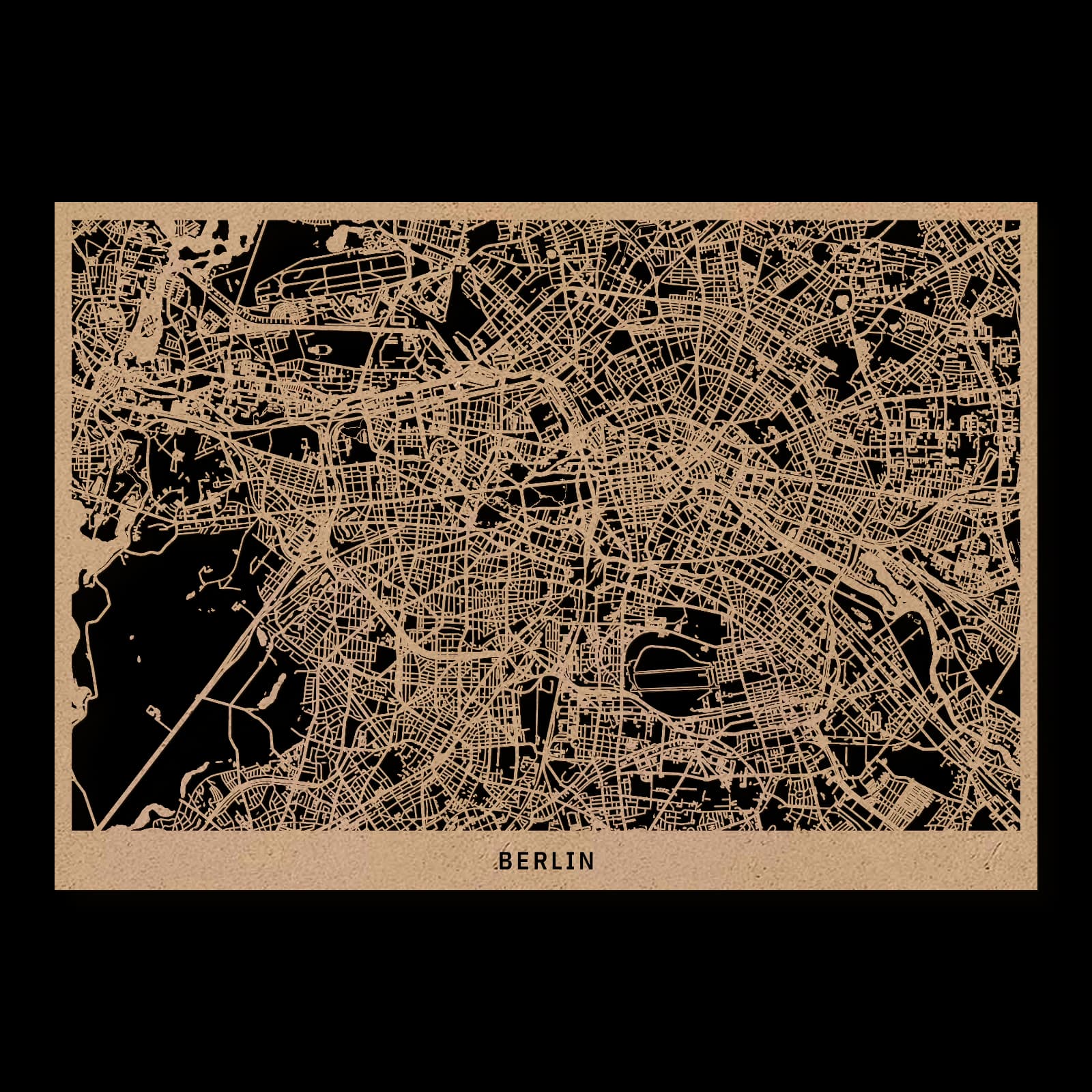
Berlin.City overview
A landscape wooden city map in natural oiled MDF, tracing Berlin’s streets and the bends of the Spree.
About the product
The broad spaces of Tiergarten and the former Tempelhof airfield punctuate Berlin’s dense neighbourhoods. Across this landscape view, Charlottenburg Palace and Alexanderplatz mark different parts of the inner city, with bends in the Spree linking the districts between them. Natural oiled MDF gives this Classic wooden map a restrained finish. The cut street pattern stands on its own, without a backing panel, keeping the emphasis on the city’s larger connections. It brings several sides of Berlin together as a piece of wall art, from palace grounds in the west to the open airfield in the south.
What does the map show?
- Charlottenburg Palace in the western part of the map
- Alexanderplatz towards the east
- Bends of the Spree through central districts
- The open spaces of Tiergarten and Tempelhofer Feld
- Precisely cut and engraved
- Fine laser details with clear depth
- Carefully inspected and securely packed
- Handmade in Germany
Configuration
Shape: Rectangular · Design: Classic · Material: Natural · Sizes: 20 × 30 cm, 35 × 50 cm, 50 × 70 cm
The configuration shown in the cart and at the time of ordering is authoritative. The preview is not a dimensioned technical drawing.
Availability & production
- Availability
- Made to order
- Production time
- Ships in 3-5 business days
Production starts after successful payment and complete product configuration.
Materials & care
Depending on the variant, lacquered or oiled MDF or oiled real-wood veneer on MDF; optional stainless-steel mounting screws. Acrylic lacquer spray, hard-wax oil and white glue are used in production.
Wood is a natural material. Grain and color may vary slightly from the product images.
Clean with a dry, soft cloth and protect from prolonged moisture and direct heat.
Included & installation
The selected product in the ordered configuration, securely packed and prepared for installation.
- Maximum dimensions 50 × 70 cm and maximum product weight 2 kg.
- Wall-fixing screws and wall plugs are not included. Use fixings suitable for the wall type, substrate and product weight.
- Installation must be carried out by an adult. Keep optional mounting screws and other small parts away from children until installation.
Shipping & returns
Securely packed shipping. Return and cancellation information is available in the legal section.
Shipping costs and delivery options depend on the destination and format. The published cancellation right applies to non-personalised standard goods; it may be excluded for individually made products.
Manufacturer & product identifier
- Manufacturer
- Benjamin Nöst - Lightworks
Rorichmoorer Str. 76
26802 Moormerland, Deutschland
kontakt@lightworks.de - Product identifier
- LW-CAT-813FDFE958A5-S, LW-CAT-813FDFE958A5-M, LW-CAT-813FDFE958A5-L
Together with the order or production batch, the relevant SKU enables traceability. Safety questions and incidents can be reported to the email address shown above.
Product safety
- Decorative product for dry indoor use only; not a toy and not intended for children.
- Protect from moisture, high heat and open flames.
- Do not continue to hang the product after a fall, breakage or visible damage. Keep damaged parts away from children.
Berlin across palace grounds, railways and open space
Central Berlin has several centres of gravity. Charlottenburg, Mitte and Tempelhof each tell a different story about how a city uses space. Reading them together brings the quieter elements into focus: a river bend, the edge of a park, or the sudden opening left by an airport.
A western point of departure
Charlottenburg Palace introduces a form of urban order that differs from the surrounding residential streets. A palace and its grounds occupy space deliberately, organising views and approaches around a major building. Nearby blocks work at a smaller scale. The contrast is useful when looking across Berlin: large institutions do not merely sit within the ordinary street pattern, but repeatedly interrupt and reshape it.
Further east, the Tiergarten creates a broad green interval. Its history reaches back to a hunting ground that became a public park, with significant landscape work by Peter Joseph Lenné in the nineteenth century. Individual paths offer one way of experiencing it. From a wider perspective, however, its role as a continuous open area is equally striking. Neighbourhoods on either side belong to the same central city while remaining visibly separated by trees and lawns.
Following movement through Mitte
Berlin Hauptbahnhof stands north of the park, close to the Spree. Railway infrastructure and the river bring different kinds of movement into the same part of town. Rail lines connect distant destinations; the river bends establish relationships between nearby banks. Bridges make those relationships tangible, gathering crossings into specific points rather than allowing movement everywhere.
Alexanderplatz presents another scale again. Broad traffic spaces and an expansive square contrast with the tighter streets elsewhere in Mitte. Potsdamer Platz supplies a further concentration to the southwest. Looking between these places is more revealing than treating one of them as the definitive centre. Their separation is part of Berlin’s identity, and the intervening streets give each a different urban setting.
The airfield that remained open
Tempelhofer Feld adds a particularly distinctive southern counterweight. The airport closed in 2008, and its former airfield became a large public space. Here the long runways preserve the geometry of aviation. The experience differs from the wooded Tiergarten: distance, exposure and the unusually long straight lines are central to the character of the place.
Together, these areas offer several ways to understand Berlin without reducing it to a sequence of monuments. Palace planning, landscape design, transport infrastructure and everyday blocks all remain legible. Pay particular attention to their boundaries. A street that meets a park or an airfield does more than change scenery; it marks a shift in how this part of the capital developed and how people move through it today.
Sources
- Wikipedia: Charlottenburg Palace — https://en.wikipedia.org/wiki/Charlottenburg_Palace
- visitBerlin: Tiergarten — https://www.visitberlin.de/en/tiergarten
- visitBerlin: Tempelhofer Feld — https://www.visitberlin.de/en/tempelhofer-feld-berlin
- visitBerlin: City centre in one tour — https://www.visitberlin.de/en/city-centre-one-tour

Still deciding?
Configure your motif in the studio and see how your city map will look in your space.



