
Bremen.Schnoor and Böttcherstraße
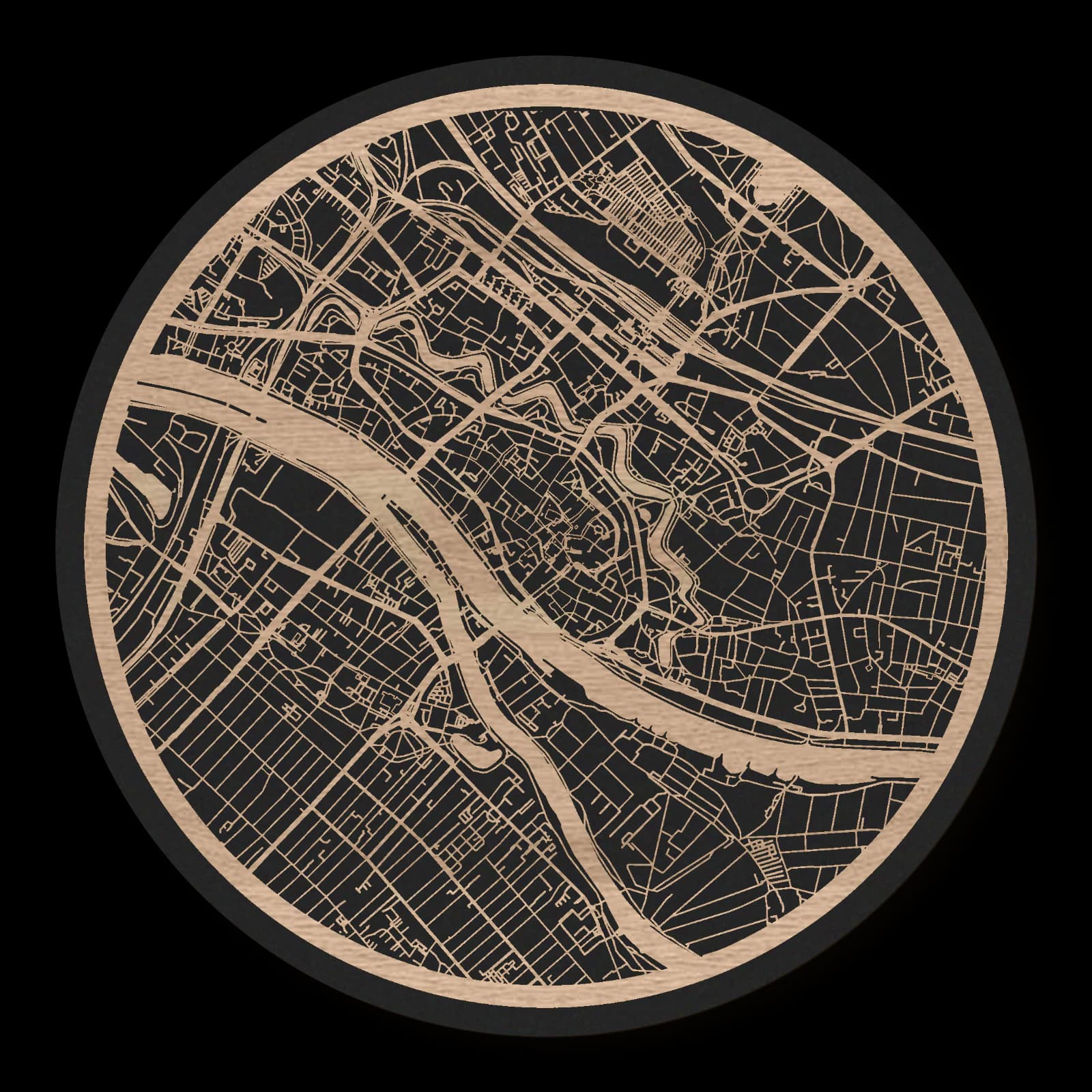
Round wooden city map of Schnoor and Böttcherstraße made from oiled oak – two layers with a black back plate.
About the product
Bremen changes scale within a few streets: the market square opens out beside the town hall and cathedral, then narrow lanes lead towards the Schnoor. Böttcherstraße and St John’s Church also fall within this map’s area. Their connecting streets give the historic centre its fine-grained pattern. Cut from oiled oak, the circular map sets that network against a black backing, combining the wood’s grain with the depth of a two-layer construction.
What does the map show?
- Market square around the town hall and cathedral
- The Schnoor’s network of lanes
- Böttcherstraße and St John’s Church
- Precisely cut and engraved
- Fine laser details with clear depth
- Carefully inspected and securely packed
- Handmade in Germany
Configuration
Shape: Round · Design: Layered · Material: Oak · Diameter: Ø 23 cm, Ø 35 cm, Ø 50 cm
The configuration shown in the cart and at the time of ordering is authoritative. The preview is not a dimensioned technical drawing.
Availability & production
- Availability
- Made to order
- Production time
- Ships in 3-5 business days
Production starts after successful payment and complete product configuration.
Materials & care
Depending on the variant, lacquered or oiled MDF or oiled real-wood veneer on MDF; optional stainless-steel mounting screws. Acrylic lacquer spray, hard-wax oil and white glue are used in production.
Wood is a natural material. Grain and color may vary slightly from the product images.
Clean with a dry, soft cloth and protect from prolonged moisture and direct heat.
Included & installation
The selected product in the ordered configuration, securely packed and prepared for installation.
- Maximum dimensions 50 × 70 cm and maximum product weight 2 kg.
- Wall-fixing screws and wall plugs are not included. Use fixings suitable for the wall type, substrate and product weight.
- Installation must be carried out by an adult. Keep optional mounting screws and other small parts away from children until installation.
Shipping & returns
Securely packed shipping. Return and cancellation information is available in the legal section.
Shipping costs and delivery options depend on the destination and format. The published cancellation right applies to non-personalised standard goods; it may be excluded for individually made products.
Manufacturer & product identifier
- Manufacturer
- Benjamin Nöst - Lightworks
Rorichmoorer Str. 76
26802 Moormerland, Deutschland
kontakt@lightworks.de - Product identifier
- LW-CAT-841C9A9B39C5-S, LW-CAT-841C9A9B39C5-M, LW-CAT-841C9A9B39C5-L
Together with the order or production batch, the relevant SKU enables traceability. Safety questions and incidents can be reported to the email address shown above.
Product safety
- Decorative product for dry indoor use only; not a toy and not intended for children.
- Protect from moisture, high heat and open flames.
- Do not continue to hang the product after a fall, breakage or visible damage. Keep damaged parts away from children.
Bremen’s market, Böttcherstraße and the Schnoor
Bremen’s historic centre changes character within a very short walk. The open market square, the designed architecture of Böttcherstraße and the narrow Schnoor lanes belong together without sharing the same origins. Their proximity makes it possible to compare several kinds of urban space at an unusually intimate scale.
Civic architecture around the market
Bremen’s town hall represents a long history of political and economic independence. Together with the Roland statue, it forms a UNESCO World Heritage ensemble. The market square provides an open setting in which these civic symbols can be understood as a group. The neighbouring cathedral introduces another substantial building with a different public role.
A few steps away, the city becomes more enclosed. This contrast is fundamental to the centre’s character. The major buildings gain presence partly because they stand beside smaller streets and plots, rather than within an uninterrupted landscape of monumental spaces. Walking between the two scales makes the difference immediately apparent.
A street conceived as an artistic ensemble
Böttcherstraße leads from the market area towards the river. Its present character was shaped largely during the 1920s and early 1930s by coffee merchant Ludwig Roselius. Bernhard Hoetger contributed an expressionist architectural language to important parts of the ensemble. The result is a consciously designed sequence rather than an ordinary row of commercial buildings.
Brickwork, passages and changing façades create a closely woven experience. No single viewpoint explains the whole street. Its character unfolds through movement, as one space opens and another closes. The Paula Modersohn-Becker Museum adds a specific artistic institution to this architectural setting, connecting the street’s design with its cultural purpose.
The finer grain of the Schnoor
The Schnoor has different roots. Mentioned in medieval records, it housed river fishermen, craftspeople and other trades. Small buildings and narrow lanes preserve a scale that contrasts sharply with the major public structures around the market. Their proximity is what makes the transition so striking.
St John’s Church recalls the former Franciscan monastery at the edge of the quarter. It introduces a larger communal building among the finer-grained streets without removing their intimate character. The relationship between church, houses and short routes gives this part of the Schnoor a particularly clear structure.
The three areas are best understood without blending them into a single generic image of an old town. The market expresses civic representation; Böttcherstraße presents a deliberately shaped cultural environment; the Schnoor reveals the compact fabric of a residential and working quarter. Their appeal lies in the ability to experience those differences within a few streets, using changes in enclosure and scale to understand how each part of Bremen developed.
Sources
- UNESCO World Heritage Centre: Town Hall and Roland on the Marketplace of Bremen — https://whc.unesco.org/en/list/1087/
- Bremen Tourismus: Böttcherstraße — https://www.bremen.eu/tourism/sights/boettcherstrasse
- Bremen Tourismus: Schnoor — https://www.bremen.de/tourismus/sehenswuerdigkeiten/schnoor

Still deciding?
Configure your motif in the studio and see how your city map will look in your space.