
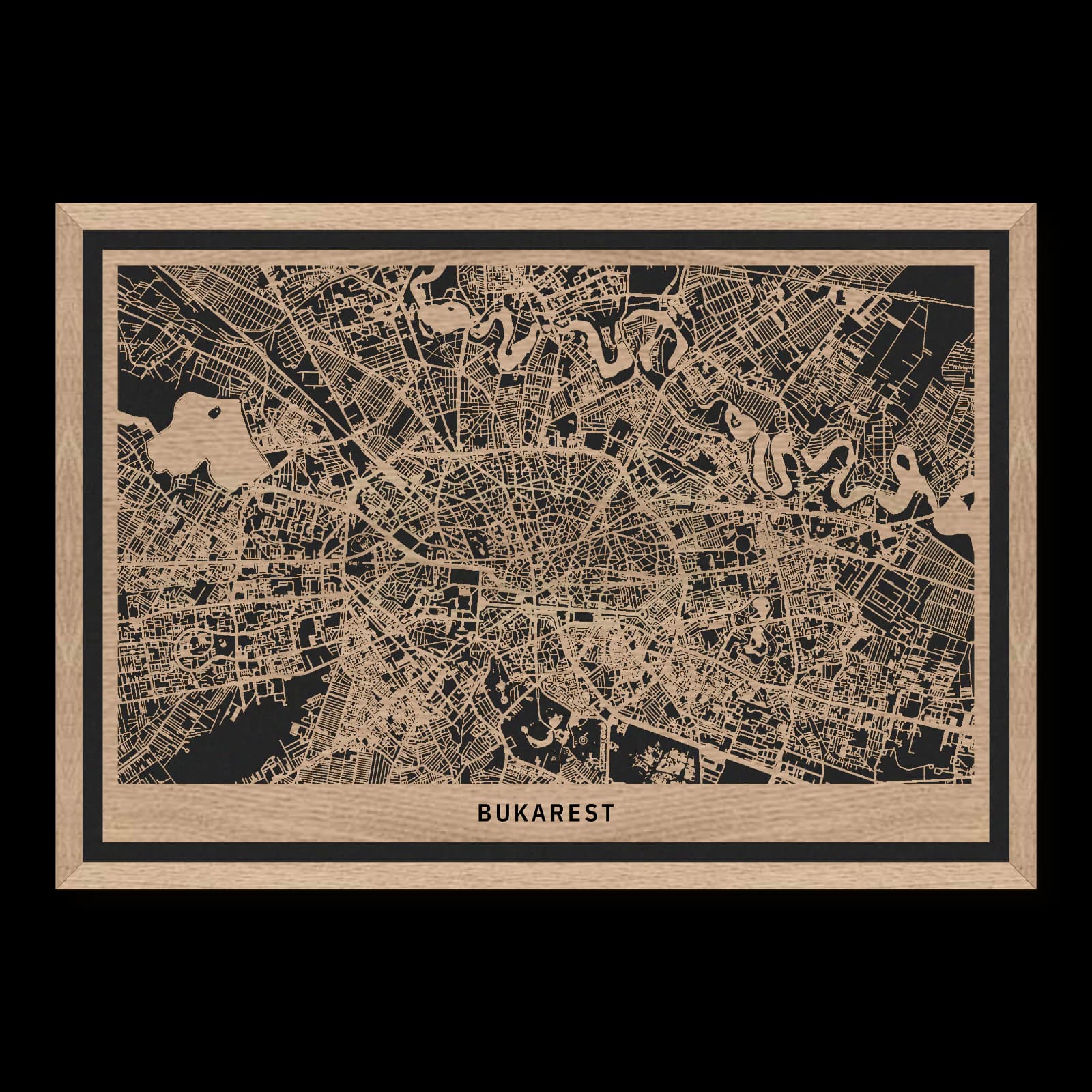
Bucharest.Boulevards, old town and green spaces
Rectangular wooden city map made from oiled oak – two layers with a black back plate and frame.
About the product
Bucharest connects smaller historic streets with broad boulevards and substantial public buildings. The Palace of Parliament, Romanian Athenaeum, Carol Park and Obor railway station give the map distinct directions. Wood brings their contrasting scales into one material setting. The central city landscape reveals relationships between public culture, state representation, green grounds and the residential neighbourhoods that connect these places.
What does the map show?
- Palace of Parliament
- Romanian Athenaeum
- Carol Park
- Obor railway station
- Historic centre
- Precisely cut and engraved
- Fine laser details with clear depth
- Carefully inspected and securely packed
- Handmade in Germany
Configuration
Shape: Rectangular · Design: Framed · Material: Oak · Sizes: 20 × 30 cm, 35 × 50 cm, 50 × 70 cm
The configuration shown in the cart and at the time of ordering is authoritative. The preview is not a dimensioned technical drawing.
Availability & production
- Availability
- Made to order
- Production time
- Ships in 3-5 business days
Production starts after successful payment and complete product configuration.
Materials & care
Depending on the variant, lacquered or oiled MDF or oiled real-wood veneer on MDF; optional stainless-steel mounting screws. Acrylic lacquer spray, hard-wax oil and white glue are used in production.
Wood is a natural material. Grain and color may vary slightly from the product images.
Clean with a dry, soft cloth and protect from prolonged moisture and direct heat.
Included & installation
The selected product in the ordered configuration, securely packed and prepared for installation.
- Maximum dimensions 50 × 70 cm and maximum product weight 2 kg.
- Wall-fixing screws and wall plugs are not included. Use fixings suitable for the wall type, substrate and product weight.
- Installation must be carried out by an adult. Keep optional mounting screws and other small parts away from children until installation.
Shipping & returns
Securely packed shipping. Return and cancellation information is available in the legal section.
Shipping costs and delivery options depend on the destination and format. The published cancellation right applies to non-personalised standard goods; it may be excluded for individually made products.
Manufacturer & product identifier
- Manufacturer
- Benjamin Nöst - Lightworks
Rorichmoorer Str. 76
26802 Moormerland, Deutschland
kontakt@lightworks.de - Product identifier
- LW-CAT-5B9AFE61B431-S, LW-CAT-5B9AFE61B431-M, LW-CAT-5B9AFE61B431-L
Together with the order or production batch, the relevant SKU enables traceability. Safety questions and incidents can be reported to the email address shown above.
Product safety
- Decorative product for dry indoor use only; not a toy and not intended for children.
- Protect from moisture, high heat and open flames.
- Do not continue to hang the product after a fall, breakage or visible damage. Keep damaged parts away from children.
Bucharest’s contrasting urban scales and civic purposes
Central Bucharest brings together older streets, monumental buildings and substantial green spaces. The Romanian Athenaeum represents public concert culture, while the Palace of Parliament reflects politically driven urban change. Carol Park extends the view southwards; Obor railway station introduces a northeastern reference. Neighbourhoods between these places connect their different roles within the present city fabric.
Older streets within a wider city
Bucharest’s historic centre developed as a trading and craft district with a smaller-scale street pattern. Buildings and routes stand closer together there than along many later principal axes. This difference helps explain the city’s structure. Broad boulevards connect central and more distant districts, while smaller streets serve individual neighbourhoods. Both scales belong to the same urban fabric. The city’s history can therefore be considered through changing spatial organisation: established areas coexist with planned avenues, larger building plots and later residential districts. Each supports a different physical arrangement of everyday life, without being separate from the connecting city around it.
The Athenaeum and public cultural ambition
The Romanian Athenaeum opened in 1888. Its creation combined the initiative of a cultural society with a nationwide fundraising campaign. The circular building and prominent dome belong to an architectural setting for concerts and public cultural activity. As the home of the George Enescu Philharmonic, it remains closely associated with music. Its position north of the older trading streets provides a distinct cultural reference within the centre. The scale differs from that of the Parliament building: a concentrated public institution stands within an area already shaped by neighbouring streets, buildings and the established urban life surrounding them.
Representation shaped by political conditions
The Palace of Parliament was constructed under Nicolae Ceaușescu’s regime during a period of severe economic difficulty. The project sought to concentrate important state functions. Its significance consequently involves political history as well as architectural size. The extensive building and broad surrounding spaces introduce a particularly large scale into the city. That difference becomes clear beside the tighter arrangement of older streets. The site demonstrates how state planning can reshape urban fabric, and why a monumental building remains connected to the conditions under which it was created. Its physical prominence is one aspect of that wider historical relationship.
Southern greenery and a northeastern station
Carol Park lies south of the older centre, offering a substantial green area with paths, tree cover and designed open grounds. Its creation belongs to development around the beginning of the twentieth century. Obor railway station provides a contrasting transport reference to the northeast. Further streets and residential areas connect the park, station, Athenaeum and Parliament building. They form the living city rather than merely the distances between familiar places. This combination explains the central landscape through several related purposes: trading history, cultural institutions, state representation, transport and greenery. Their different spatial forms continue within the shared urban structure of Bucharest.
Sources
- City of Bucharest, capital of Romania Visitor information — https://romaniatourism.com/bucharest.html
- The Palace of Parliament Building — https://cic.cdep.ro/en/prezentare/cladire
- George Enescu Philharmonic: Geschichte des Rumänischen Athenäums — https://filarmonicaenescu.ro/en/istoric-ateneul-roman
- Meetings and Incentive Travel in Romania — https://romaniatourism.com/meetings-incentive.html
- Stadt Bukarest: Kommunaler Bericht mit Geschichte des Carol-Parks — https://doc.pmb.ro/consiliu/sedinte/435/oz/9876.pdf

Still deciding?
Configure your motif in the studio and see how your city map will look in your space.