
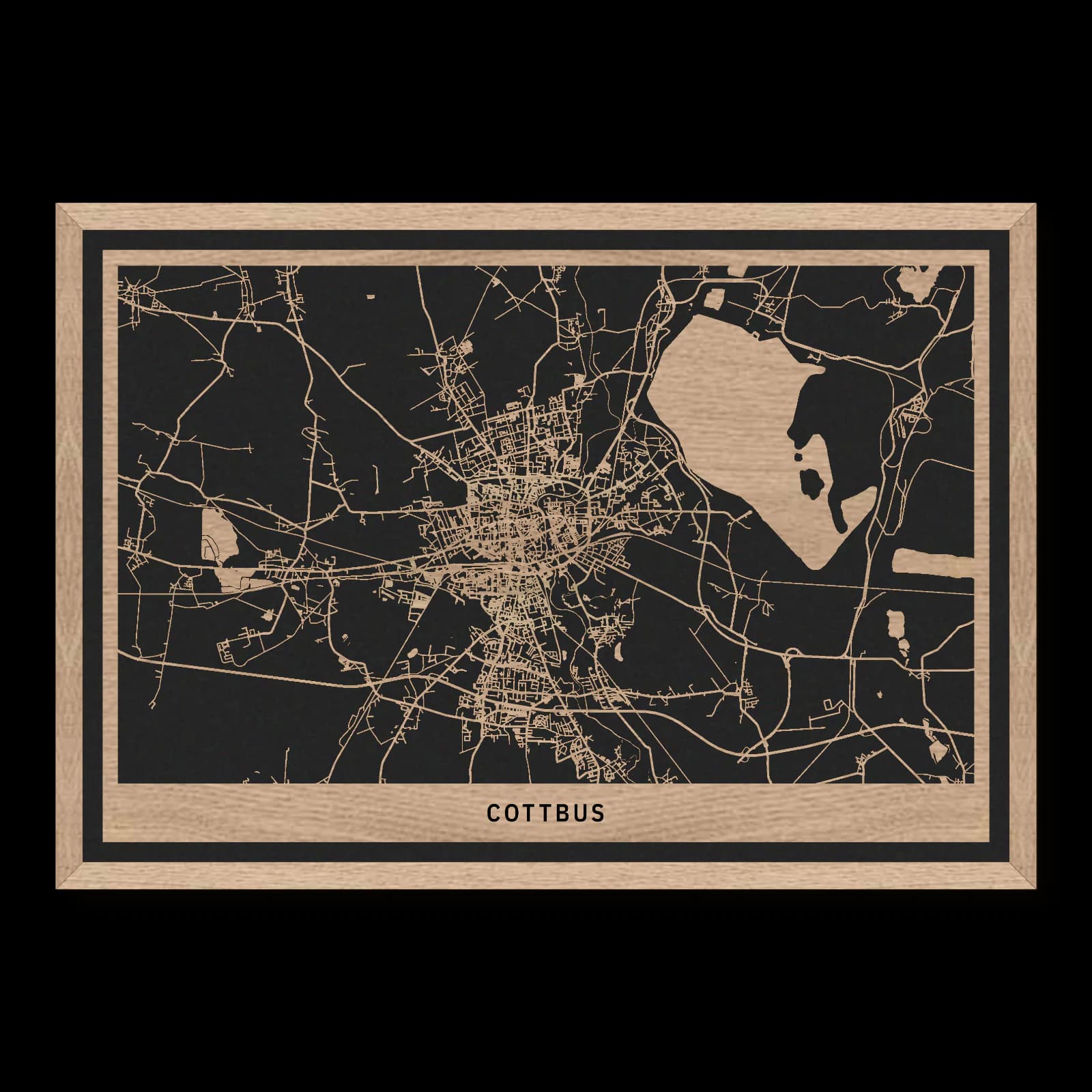
Cottbus/Chóśebuz.City Overview
Rectangular wooden city map made from oiled oak – two layers with a black back plate and frame.
About the product
Broad parks and a busy network of streets and railway lines shape Cottbus. From the State Theatre to Branitz Park, this wooden map follows the changing relationship between built neighbourhoods and designed landscape. The castle area and northern districts extend the view beyond the historic centre, bringing cultural landmarks, transport corridors and green edges into a single portrait of the city.
What does the map show?
- State Theatre west of the old centre
- Branitz Park to the southeast
- Railway districts reaching Merzdorf
- Precisely cut and engraved
- Fine laser details with clear depth
- Carefully inspected and securely packed
- Handmade in Germany
Configuration
Shape: Rectangular · Design: Framed · Material: Oak · Sizes: 20 × 30 cm, 35 × 50 cm, 50 × 70 cm
The configuration shown in the cart and at the time of ordering is authoritative. The preview is not a dimensioned technical drawing.
Availability & production
- Availability
- Made to order
- Production time
- Ships in 3-5 business days
Production starts after successful payment and complete product configuration.
Materials & care
Depending on the variant, lacquered or oiled MDF or oiled real-wood veneer on MDF; optional stainless-steel mounting screws. Acrylic lacquer spray, hard-wax oil and white glue are used in production.
Wood is a natural material. Grain and color may vary slightly from the product images.
Clean with a dry, soft cloth and protect from prolonged moisture and direct heat.
Included & installation
The selected product in the ordered configuration, securely packed and prepared for installation.
- Maximum dimensions 50 × 70 cm and maximum product weight 2 kg.
- Wall-fixing screws and wall plugs are not included. Use fixings suitable for the wall type, substrate and product weight.
- Installation must be carried out by an adult. Keep optional mounting screws and other small parts away from children until installation.
Shipping & returns
Securely packed shipping. Return and cancellation information is available in the legal section.
Shipping costs and delivery options depend on the destination and format. The published cancellation right applies to non-personalised standard goods; it may be excluded for individually made products.
Manufacturer & product identifier
- Manufacturer
- Benjamin Nöst - Lightworks
Rorichmoorer Str. 76
26802 Moormerland, Deutschland
kontakt@lightworks.de - Product identifier
- LW-CAT-62DAAC4BD8B9-S, LW-CAT-62DAAC4BD8B9-M, LW-CAT-62DAAC4BD8B9-L
Together with the order or production batch, the relevant SKU enables traceability. Safety questions and incidents can be reported to the email address shown above.
Product safety
- Decorative product for dry indoor use only; not a toy and not intended for children.
- Protect from moisture, high heat and open flames.
- Do not continue to hang the product after a fall, breakage or visible damage. Keep damaged parts away from children.
Cottbus/Chóśebuz: Theatre streets and landscaped horizons
Cottbus combines a Lusatian trading history with Sorbian cultural heritage, industrial expansion and distinctive landscape gardens. Its theatre district, older centre and southeastern parks occupy very different urban settings. Considering them together explains how the city grew and why its open spaces deserve as much attention as its best-known buildings.
A Lusatian crossroads
Trade routes and regional connections helped shape the development of Cottbus. Its history belongs to the wider story of Lusatia, where Sorbian culture remains an important presence, reflected in the name Cottbus/Chóśebuz. The older centre offers a useful starting point, but the modern city extends well beyond it. Residential streets, railway infrastructure and substantial green areas introduce different patterns around the historic core. Comparing their scale gives a clearer impression of urban growth than considering the central buildings in isolation. Routes leading out of the centre are part of that story too.
Culture beyond the old centre
The State Theatre establishes a major cultural focus to the west. Its early twentieth-century architecture belongs to an era when expanding cities expressed civic ambition through prominent public buildings. The separation between the theatre and the castle area is revealing: Cottbus does not concentrate all its significant places around one square. Streets and neighbourhoods connect several different centres of activity. Farther south, the main railway station introduces larger spaces and longer lines. The contrast between individual urban blocks, open settings around cultural buildings and railway land helps explain the city's varied physical character.
A deliberately composed landscape
Branitz Park carries the influence of Hermann von Pückler-Muskau and the tradition of landscape gardening. Curving paths and open scenes establish a different order from the streets of the town. The park should therefore be understood as designed landscape, rather than as an incidental patch of greenery on the outskirts. Its southeastern position draws attention beyond the most densely built districts. Bringing the city and park into the same view makes their relationship easier to appreciate: one is structured primarily by streets and buildings, the other by carefully arranged spaces and changes of direction.
Several generations of green space
The Spreeauenpark, created for the 1995 Federal Garden Show, forms part of the wider connection between the urban centre and Branitz. It also demonstrates that Cottbus's parks do not all belong to the same period. Historic landscape design and more recent recreational planning meet within a continuous setting. Northern and eastern railway corridors, including the area around Merzdorf, add another dimension to this portrait. A useful way to read the city is to compare its western cultural district, older core and southeastern parkland, then follow the streets linking them. This reveals an urban structure built from contrasting places, with green spaces providing meaningful connections rather than simply filling the gaps between buildings.
Sources
- Stadt Cottbus: Geschichte — https://cottbus.de/geschichte-und-traditionen/geschichte-der-stadt/
- Stadt Cottbus: Park Branitz — https://cottbus.de/kultur-und-tourismus/parke/parklandschaften-branitz-und-zatonie/park-branitz/
- Stadt Cottbus: Spreeauenpark — https://cottbus.de/kultur-und-tourismus/parke/spreeauenpark/
- Stadtmuseum Cottbus: Staatstheater — https://www.stadtmuseum-cottbus.de/cottbus-lexikon-detail/staatstheater.html
- Wikivoyage: Cottbus/Chóśebuz — https://de.wikivoyage.org/wiki/Cottbus

Still deciding?
Configure your motif in the studio and see how your city map will look in your space.



