
Dresden.Inner Neustadt
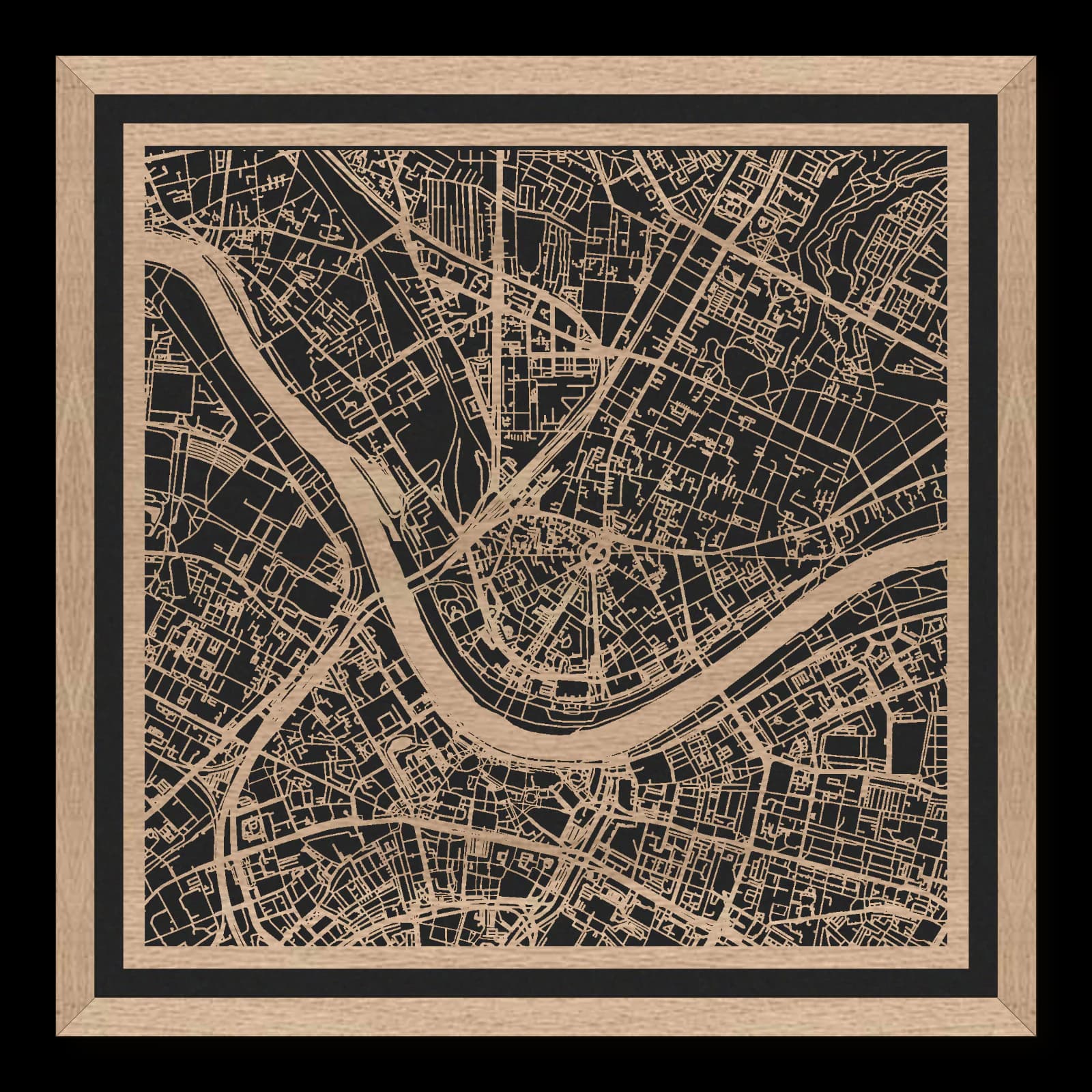
Square wooden city map in oiled oak, framed with two layers and a black backing plate.
About the product
Dresden’s Inner Neustadt combines long street axes with smaller connections between them. The Japanese Palace, Dreikönigskirche and Albertplatz all lie within this crop, providing reference points for the district’s varied pattern. The design pairs a square oak frame with an oiled oak map front and black backing plate. No engraving interrupts the street composition. Its two-layer construction gives the cut lines a contrasting background, while the square format holds the neighbourhood view within equal sides. The map is offered in three sizes.
What does the map show?
- Crop includes the Japanese Palace and Dreikönigskirche
- Albertplatz provides a northern reference
- Square frame in oiled oak
- Two-layer map without engraving
- Precisely cut and engraved
- Fine laser details with clear depth
- Carefully inspected and securely packed
- Handmade in Germany
Configuration
Shape: Square · Design: Framed · Material: Oak · Sizes: 23 × 23 cm, 35 × 35 cm, 50 × 50 cm
The configuration shown in the cart and at the time of ordering is authoritative. The preview is not a dimensioned technical drawing.
Availability & production
- Availability
- Made to order
- Production time
- Ships in 3-5 business days
Production starts after successful payment and complete product configuration.
Materials & care
Depending on the variant, lacquered or oiled MDF or oiled real-wood veneer on MDF; optional stainless-steel mounting screws. Acrylic lacquer spray, hard-wax oil and white glue are used in production.
Wood is a natural material. Grain and color may vary slightly from the product images.
Clean with a dry, soft cloth and protect from prolonged moisture and direct heat.
Included & installation
The selected product in the ordered configuration, securely packed and prepared for installation.
- Maximum dimensions 50 × 70 cm and maximum product weight 2 kg.
- Wall-fixing screws and wall plugs are not included. Use fixings suitable for the wall type, substrate and product weight.
- Installation must be carried out by an adult. Keep optional mounting screws and other small parts away from children until installation.
Shipping & returns
Securely packed shipping. Return and cancellation information is available in the legal section.
Shipping costs and delivery options depend on the destination and format. The published cancellation right applies to non-personalised standard goods; it may be excluded for individually made products.
Manufacturer & product identifier
- Manufacturer
- Benjamin Nöst - Lightworks
Rorichmoorer Str. 76
26802 Moormerland, Deutschland
kontakt@lightworks.de - Product identifier
- LW-CAT-A9BDA5CC6413-S, LW-CAT-A9BDA5CC6413-M, LW-CAT-A9BDA5CC6413-L
Together with the order or production batch, the relevant SKU enables traceability. Safety questions and incidents can be reported to the email address shown above.
Product safety
- Decorative product for dry indoor use only; not a toy and not intended for children.
- Protect from moisture, high heat and open flames.
- Do not continue to hang the product after a fall, breakage or visible damage. Keep damaged parts away from children.
Inner Neustadt: Baroque streets and smaller connections
Dresden’s Inner Neustadt combines planned axes with older, finer-grained routes. The Japanese Palace, Dreikönigskirche and Albertplatz provide orientation, but the spaces between them are equally revealing. Looking towards passages and courtyards, as well as along façades, brings the district’s layered urban history into clearer view.
Rebuilding as a planning opportunity
A major fire in 1685 transformed the urban area north of the Elbe. Reconstruction created an opportunity to reorganise streets and building plots. The later Baroque pattern therefore differs from a district whose routes developed only through small, gradual changes. Deliberate planning became a visible part of the neighbourhood’s identity.
Königstraße offers a particularly clear way to understand this approach. Related façade heights and orientation towards larger landmarks establish a composed street scene. Individual houses remain distinguishable, but they also contribute to a shared effect. Attention follows a sequence of fronts rather than resting entirely on one exceptional building.
A palace at the end of a view
The Japanese Palace forms an important point within this arrangement. Expanded during the eighteenth century, it was associated with Augustus the Strong’s collecting ambitions. Its name recalls enthusiasm for East Asian porcelain, although the intended use was not realised in the form originally envisaged.
Its urban position matters as much as that historical association. A substantial building at the end of a view performs a different role from one encountered beside a street. The palace gives the approach a destination, making the intervening spaces feel like parts of a connected sequence. The open area before it and the façade reinforce one another.
A finer network within the larger scheme
Dreikönigskirche establishes another focus. Around it, broader streets meet smaller connections. These changes prevent the neighbourhood from feeling like a completely uniform Baroque plan. Older routes and courtyard structures add a finer layer to the ordered building fronts, revealing ways of moving that are less apparent from the main axes.
Albertplatz opens the district towards the north. Several streets meet there, giving it the role of a transition between different parts of Neustadt. Rather than closing a view in the manner of the palace, the square sends movement onwards in several directions.
A walk can make these contrasts explicit: follow a long street line, turn towards a more intimate space, then emerge onto a square. This approach treats Inner Neustadt as more than a setting of historic façades. Its history becomes visible through relationships between planned order, surviving earlier routes and the everyday connections that keep the neighbourhood active. Each change of scale contributes to a more complete understanding of the area.
Sources
- Wikipedia: Barockviertel Königstraße — https://de.wikipedia.org/wiki/Barockviertel_Königstraße
- Staatliche Kunstsammlungen Dresden: Japanisches Palais – damals und heute — https://japanisches-palais.skd.museum/ueber-uns/
- Wikipedia: Dreikönigskirche (Dresden) — https://de.wikipedia.org/wiki/Dreikönigskirche_(Dresden)
- Wikipedia: Albertplatz (Dresden) — https://de.wikipedia.org/wiki/Albertplatz_(Dresden)

Still deciding?
Configure your motif in the studio and see how your city map will look in your space.



