Düsseldorf.Media Harbour
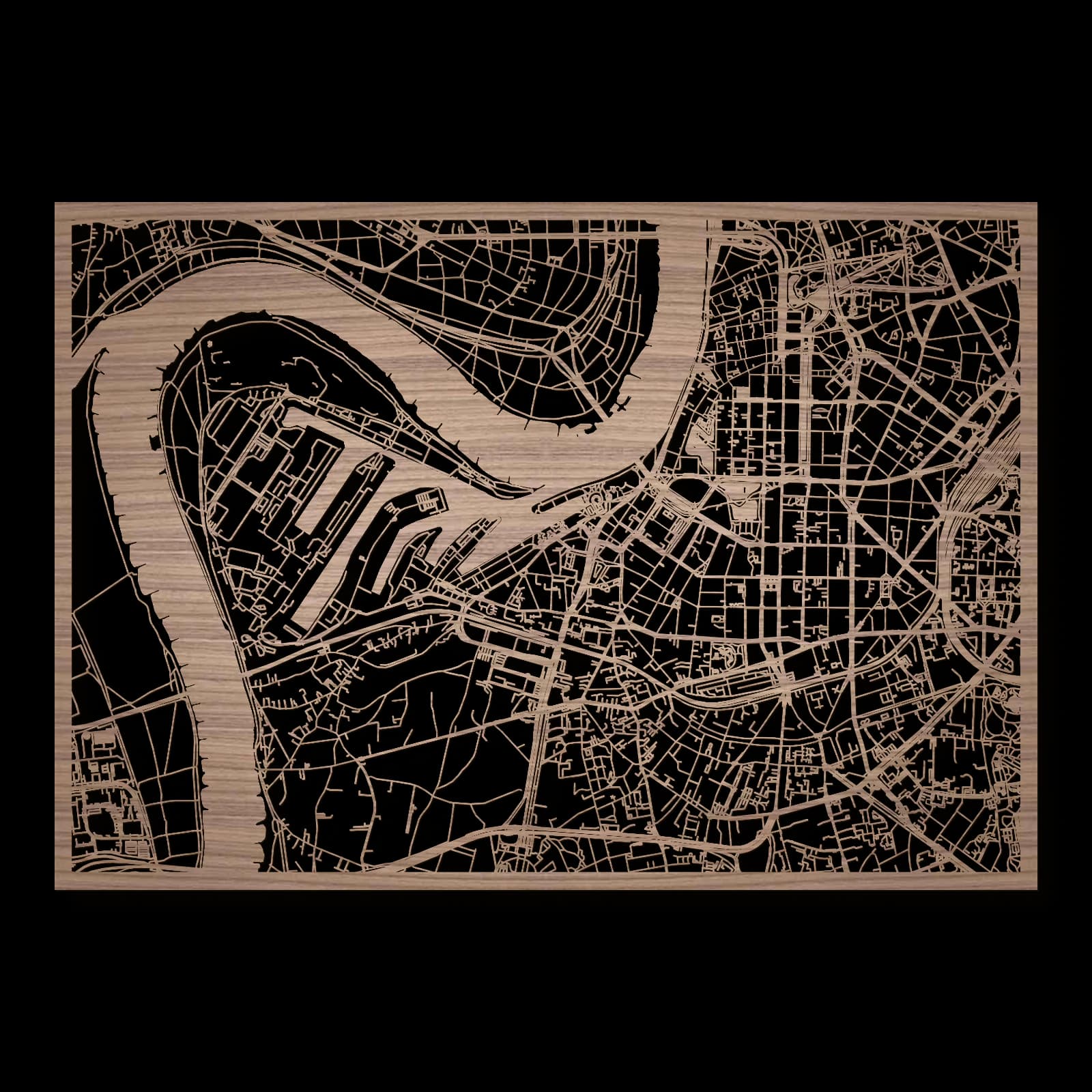
Rectangular wooden city map of Media Harbour made from oiled walnut.
About the product
Quays and basins still organise Düsseldorf’s Media Harbour beneath its newer architecture. The map covers Neuer Zollhof, the Colorium, Rhine Tower and the state parliament area, following the streets that connect the harbour to the inner city. Made from oiled walnut, its rectangular outline holds these neighbouring places in one composition. The classic construction uses a single cut layer without an added backing, letting the district’s network of routes carry the design.
What does the map show?
- Media Harbour basins
- Area around Neuer Zollhof and Colorium
- Rhine Tower and state parliament within the map
- Precisely cut and engraved
- Fine laser details with clear depth
- Carefully inspected and securely packed
- Handmade in Germany
Configuration
Shape: Rectangular · Design: Classic · Material: Walnut · Sizes: 20 × 30 cm, 35 × 50 cm, 50 × 70 cm
The configuration shown in the cart and at the time of ordering is authoritative. The preview is not a dimensioned technical drawing.
Availability & production
- Availability
- Made to order
- Production time
- Ships in 3-5 business days
Production starts after successful payment and complete product configuration.
Materials & care
Depending on the variant, lacquered or oiled MDF or oiled real-wood veneer on MDF; optional stainless-steel mounting screws. Acrylic lacquer spray, hard-wax oil and white glue are used in production.
Wood is a natural material. Grain and color may vary slightly from the product images.
Clean with a dry, soft cloth and protect from prolonged moisture and direct heat.
Included & installation
The selected product in the ordered configuration, securely packed and prepared for installation.
- Maximum dimensions 50 × 70 cm and maximum product weight 2 kg.
- Wall-fixing screws and wall plugs are not included. Use fixings suitable for the wall type, substrate and product weight.
- Installation must be carried out by an adult. Keep optional mounting screws and other small parts away from children until installation.
Shipping & returns
Securely packed shipping. Return and cancellation information is available in the legal section.
Shipping costs and delivery options depend on the destination and format. The published cancellation right applies to non-personalised standard goods; it may be excluded for individually made products.
Manufacturer & product identifier
- Manufacturer
- Benjamin Nöst - Lightworks
Rorichmoorer Str. 76
26802 Moormerland, Deutschland
kontakt@lightworks.de - Product identifier
- LW-CAT-7FBB17559473-S, LW-CAT-7FBB17559473-M, LW-CAT-7FBB17559473-L
Together with the order or production batch, the relevant SKU enables traceability. Safety questions and incidents can be reported to the email address shown above.
Product safety
- Decorative product for dry indoor use only; not a toy and not intended for children.
- Protect from moisture, high heat and open flames.
- Do not continue to hang the product after a fall, breakage or visible damage. Keep damaged parts away from children.
The Media Harbour and its changing architecture
The Media Harbour invites comparison between buildings that are intentionally unlike one another. Their common ground is the older harbour layout. Looking beyond the celebrated façades to basins, paths and sightlines explains how these independent structures relate so strongly to their surroundings and to each other.
A harbour beneath the new district
The Media Harbour’s present buildings occupy a setting already organised by basins and quay edges. That earlier structure remains active. It determines where land ends, how people can move around the water and the distance from which buildings are seen. Water creates separation while also bringing several stretches of waterfront into one view.
This distinguishes the district from a conventional commercial street. Some buildings face one another across a basin rather than across a road. Their architectural presence therefore depends on viewpoints beyond their immediate neighbours. Even a short walk beside the water can change the apparent relationship between the individual structures.
Comparing the Neuer Zollhof buildings
Frank Gehry’s three buildings at Neuer Zollhof are among the area’s most recognisable elements. Different façade treatments and irregular forms make them a related group without making them identical. Their sense of movement comes from the buildings themselves: surfaces lean, outlines shift and each structure responds differently to the space around it.
The comparison with the harbour basin is especially useful. A clear water edge provides a stable reference against which these changing forms can be understood. The district demonstrates how an existing urban arrangement can accommodate distinctive new architecture while retaining its own legibility. Looking at the quay and the buildings together is more revealing than isolating a famous façade.
Other ways to establish a presence
William Alsop’s Colorium introduces a different approach on Speditionstraße. Its coloured glass façade and red upper element contrast with the forms at Neuer Zollhof. The emphasis is on the treatment of a rising surface rather than on the apparent movement of exterior walls. Comparing the buildings shows that architectural individuality can emerge through very different decisions.
The Rhine Tower supplies a much taller reference near the edge of the district. Towards the state parliament, the balance between buildings and open space changes once more. This neighbouring public and political setting adds another dimension to the harbour’s offices and service uses.
A walk through the area is therefore most rewarding when the spaces between landmarks receive equal attention. A view across a basin, a continuing quay edge or the opening towards a forecourt can explain how the district holds together. These connections turn a series of notable buildings into a recognisable part of Düsseldorf rather than an outdoor collection of unrelated architectural statements.
Sources
- Düsseldorf Health: MedienHafen — https://www.duesseldorf-health.de/duesseldorf-entdecken/medienhafen
- Wikipedia: Colorium — https://de.wikipedia.org/wiki/Colorium
- Wikipedia: Landtag of North Rhine-Westphalia — https://en.wikipedia.org/wiki/Landtag_of_North_Rhine-Westphalia
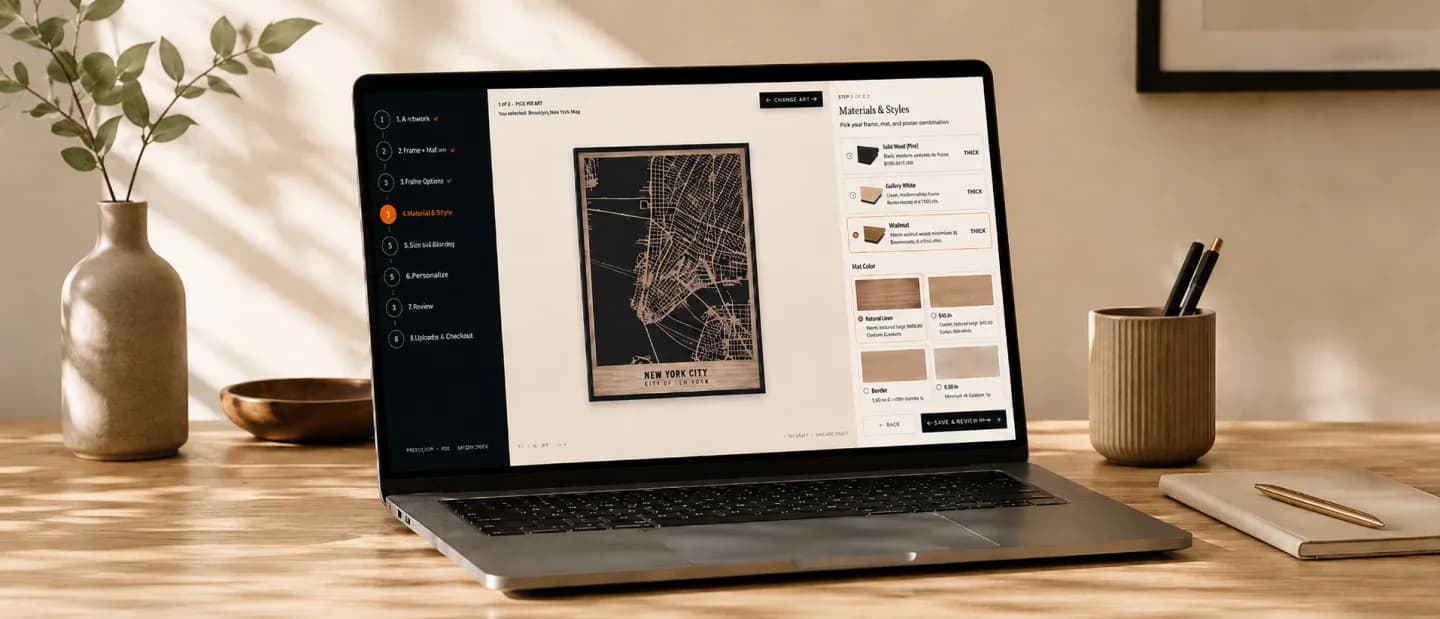
Still deciding?
Configure your motif in the studio and see how your city map will look in your space.