
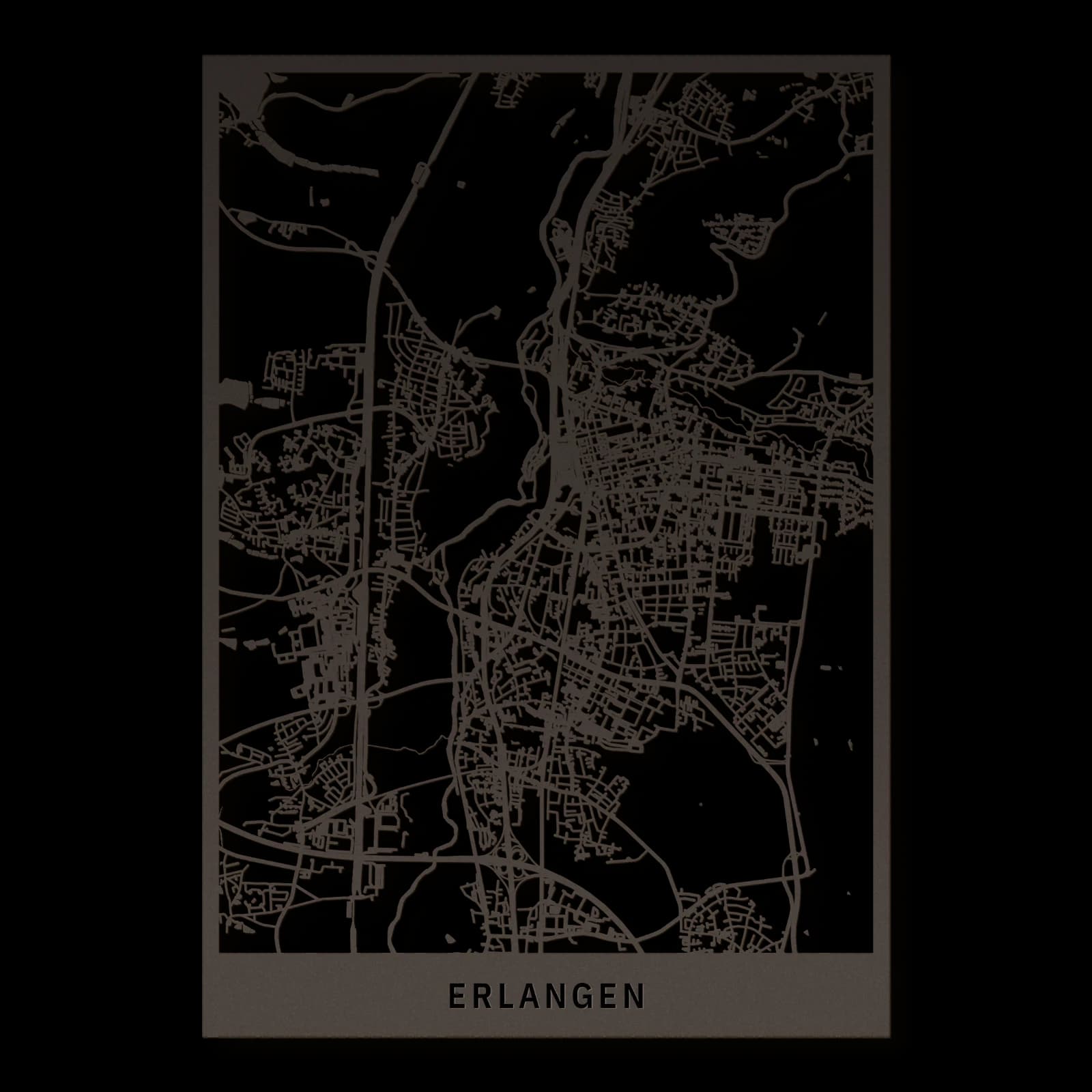
Erlangen.Baroque centre, Castle Hill and southern campus districts
Rectangular wooden city map made from black lacquered MDF.
About the product
Erlangen's orderly streets meet the Castle Hill gardens and southern campus neighbourhoods. On wood, the view connects the palace with the urban routes reaching Bruck, giving space to both built areas and green heights. The result is a calm composition with distinct layers of city life. Baroque planning, contemporary workplaces and established residential districts remain part of one connected geography.
What does the map show?
- Palace in the historic centre
- Northern Castle Hill gardens
- Southern Siemens Campus
- Established Bruck district
- Precisely cut and engraved
- Fine laser details with clear depth
- Carefully inspected and securely packed
- Handmade in Germany
Configuration
Shape: Rectangular · Design: Classic · Material: Black · Sizes: 20 × 30 cm, 35 × 50 cm, 50 × 70 cm
The configuration shown in the cart and at the time of ordering is authoritative. The preview is not a dimensioned technical drawing.
Availability & production
- Availability
- Made to order
- Production time
- Ships in 3-5 business days
Production starts after successful payment and complete product configuration.
Materials & care
Depending on the variant, lacquered or oiled MDF or oiled real-wood veneer on MDF; optional stainless-steel mounting screws. Acrylic lacquer spray, hard-wax oil and white glue are used in production.
Wood is a natural material. Grain and color may vary slightly from the product images.
Clean with a dry, soft cloth and protect from prolonged moisture and direct heat.
Included & installation
The selected product in the ordered configuration, securely packed and prepared for installation.
- Maximum dimensions 50 × 70 cm and maximum product weight 2 kg.
- Wall-fixing screws and wall plugs are not included. Use fixings suitable for the wall type, substrate and product weight.
- Installation must be carried out by an adult. Keep optional mounting screws and other small parts away from children until installation.
Shipping & returns
Securely packed shipping. Return and cancellation information is available in the legal section.
Shipping costs and delivery options depend on the destination and format. The published cancellation right applies to non-personalised standard goods; it may be excluded for individually made products.
Manufacturer & product identifier
- Manufacturer
- Benjamin Nöst - Lightworks
Rorichmoorer Str. 76
26802 Moormerland, Deutschland
kontakt@lightworks.de - Product identifier
- LW-CAT-D5B2082E6185-S, LW-CAT-D5B2082E6185-M, LW-CAT-D5B2082E6185-L
Together with the order or production batch, the relevant SKU enables traceability. Safety questions and incidents can be reported to the email address shown above.
Product safety
- Decorative product for dry indoor use only; not a toy and not intended for children.
- Protect from moisture, high heat and open flames.
- Do not continue to hang the product after a fall, breakage or visible damage. Keep damaged parts away from children.
Erlangen from baroque planning to Bruck
Erlangen is often associated with university life and technology. Its urban geography also reflects baroque planning, a green Castle Hill and expansion toward the south. The palace, hillside sculpture garden, Siemens Campus and Bruck identify different parts of this development, connecting historical order with the neighbourhoods of the present city.
Historical planning in daily use
Erlangen Palace belongs to the baroque setting of the central city. The official visitor walk describes this area as a courtly ensemble within a deliberately planned new town. That origin remains understandable through the relationship between streets, public spaces and buildings. The ordered structure distinguishes it from a network of lanes that developed without an overall plan. Yet this is not a closed historical stage. The centre remains part of present-day routes and institutions. Moving through it means encountering an old spatial idea within contemporary life. The palace provides a clear reference without making one historical period the only explanation for the city around it.
Art on the northern slopes
Castle Hill gardens lie north of the centre. Their sculpture garden is dedicated to Heinrich Kirchner's work and brings art into a different topographic setting. Paths and views change across the slope, in contrast with the more ordered level ground of the central city. The sculptures therefore inhabit more than an interchangeable green space. Their setting invites attention to the relationship between people, nature and designed surroundings. Castle Hill gives Erlangen an important counterpart to its central streets: a height within the urban geography and a calmer, more landscape-oriented part of the experience. The change in terrain accompanies a change in pace and perspective.
Contemporary work has a location
The Siemens Campus south of the palace anchors another part of Erlangen's identity. Technology and research here have a physical place rather than appearing only as labels in a city description. The campus relates to streets and neighbourhoods extending southward, making urban development visible as a continuing process. The historic centre and contemporary working environment are not independent exhibits placed beside one another. An inhabited city lies between them, with routes that support everyday movement. This connection allows Erlangen to be understood both as a place shaped by historical planning and as a location for modern activity, without either side becoming the sole account of its character.
Bruck and the wider inhabited city
Bruck occupies the southern urban setting and broadens attention beyond Erlangen's best-known central places. As an established district, it introduces a different scale from the courtly ensemble of the centre. Its position near the southern campus areas brings distinct layers of the present city into contact. Residential routes, wider connections and workplaces share the same urban network. Considered alongside Castle Hill and the palace, Bruck reveals a city with markedly different surroundings along its north-south extent. Moving through these spaces can lead from planned order to greenery and onward to contemporary neighbourhoods. This variety makes Erlangen more tangible than any single cultural or economic description could achieve.
Sources
- Stadtspaziergang durch Erlangen — https://www.visit-erlangen.de/wanderwege/stadtspaziergang_durch_erlange-3755/
- Heinrich Kirchner Sculpture Garden - Visit Erlangen — https://en.visit-erlangen.de/poi/skulpturengarten_heinrich_kirc-27280/
- Siemens in Erlangen | Siemens — https://www.siemens.com/de-de/company/global-locations/germany/erlangen/

Still deciding?
Configure your motif in the studio and see how your city map will look in your space.



