
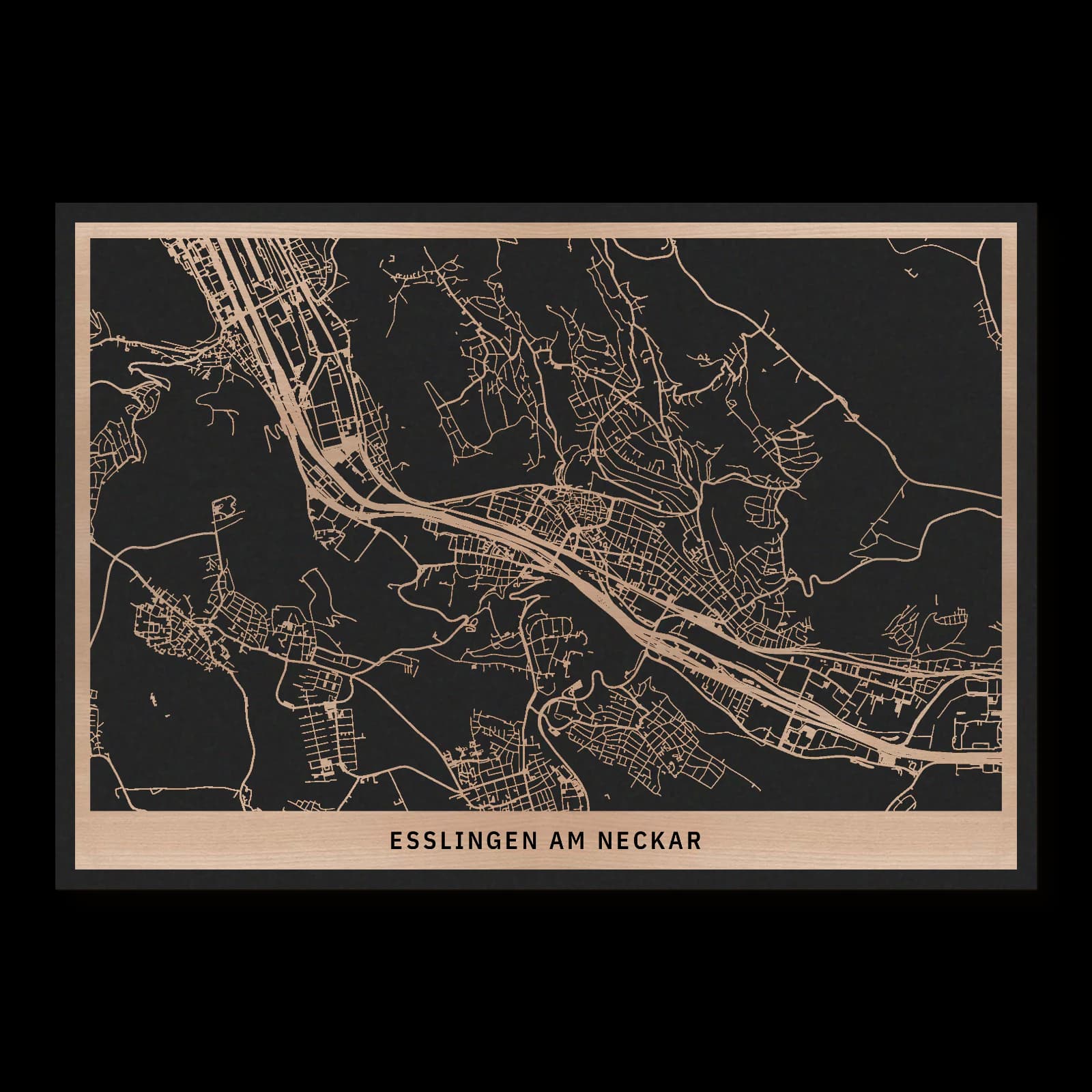
Esslingen am Neckar.Neckar city from Mettingen to Oberesslingen
Rectangular wooden city map made from oiled beech – two layers with a black back plate.
About the product
Esslingen's historic centre belongs to an urban corridor stretching from Mettingen to Oberesslingen. This wooden map connects the castle and St. Dionys with neighbourhoods along the Neckar setting. Dense streets and more open transitions give the composition its rhythm. The familiar old-town silhouette remains present, while the broader geography of an inhabited and continually developing city receives equal attention.
What does the map show?
- Castle above the centre
- St. Dionys city church
- Western Mettingen
- Eastern Oberesslingen
- Precisely cut and engraved
- Fine laser details with clear depth
- Carefully inspected and securely packed
- Handmade in Germany
Configuration
Shape: Rectangular · Design: Layered · Material: Beech · Sizes: 20 × 30 cm, 35 × 50 cm, 50 × 70 cm
The configuration shown in the cart and at the time of ordering is authoritative. The preview is not a dimensioned technical drawing.
Availability & production
- Availability
- Made to order
- Production time
- Ships in 3-5 business days
Production starts after successful payment and complete product configuration.
Materials & care
Depending on the variant, lacquered or oiled MDF or oiled real-wood veneer on MDF; optional stainless-steel mounting screws. Acrylic lacquer spray, hard-wax oil and white glue are used in production.
Wood is a natural material. Grain and color may vary slightly from the product images.
Clean with a dry, soft cloth and protect from prolonged moisture and direct heat.
Included & installation
The selected product in the ordered configuration, securely packed and prepared for installation.
- Maximum dimensions 50 × 70 cm and maximum product weight 2 kg.
- Wall-fixing screws and wall plugs are not included. Use fixings suitable for the wall type, substrate and product weight.
- Installation must be carried out by an adult. Keep optional mounting screws and other small parts away from children until installation.
Shipping & returns
Securely packed shipping. Return and cancellation information is available in the legal section.
Shipping costs and delivery options depend on the destination and format. The published cancellation right applies to non-personalised standard goods; it may be excluded for individually made products.
Manufacturer & product identifier
- Manufacturer
- Benjamin Nöst - Lightworks
Rorichmoorer Str. 76
26802 Moormerland, Deutschland
kontakt@lightworks.de - Product identifier
- LW-CAT-C76C535087DE-S, LW-CAT-C76C535087DE-M, LW-CAT-C76C535087DE-L
Together with the order or production batch, the relevant SKU enables traceability. Safety questions and incidents can be reported to the email address shown above.
Product safety
- Decorative product for dry indoor use only; not a toy and not intended for children.
- Protect from moisture, high heat and open flames.
- Do not continue to hang the product after a fall, breakage or visible damage. Keep damaged parts away from children.
Esslingen from imperial-city history to daily life
Esslingen is known for its historic centre, but its inhabited geography continues in both directions along the Neckar setting. The castle and St. Dionys provide strong central references. Mettingen and Oberesslingen broaden attention toward other neighbourhoods, connecting older urban history with the development of a contemporary city for living and working.
Different histories in the same city
The municipal account connects Esslingen with its medieval imperial-city past and its later development as an industrial and educational location. These histories do not cancel one another out. They coexist in the present city and relate through routes and neighbourhoods. The historical centre has a particularly close sequence of streets and buildings. Its character explains Esslingen's familiarity, yet it remains embedded within wider urban surroundings. Considering the city as a whole reveals more than a preserved historical scene. A clearly recognisable old centre meets neighbourhoods whose contemporary daily life has other spatial forms and practical purposes, making historical identity part of a city that continues to change and be used.
Castle height and central church
Esslingen Castle stands above the centre, while St. Dionys occupies the central streets. Part of the historical fortification, the castle has a widely noticeable position. Together these places reveal the relationship between higher ground and dense development. Proximity does not make their urban situations identical. Moving between them changes terrain and direction of view: the church belongs to the immediate street setting, while the castle opens a wider perspective. This layering contributes significantly to Esslingen's identity. Historical architecture becomes understandable through more than individual forms, acquiring meaning from the positions of its buildings and from the routes connecting different elevations within the inhabited city.
Mettingen and the western direction
Mettingen lies west of the historical centre and introduces another section of the connected urban area. Its distance brings residential and working routes into view that are easily overlooked when attention concentrates on a few old-town lanes. Between Mettingen and the centre, the city remains inhabited and actively used. Streets link local neighbourhoods with central facilities. The Neckar setting consequently supports an elongated urban relationship rather than one directed only toward a historic midpoint. Mettingen provides an important counterpart in this broader understanding. It makes the westward extent tangible and gives current daily routes more weight than a simple sequence of visitor attractions would allow.
The city continues through Oberesslingen
Oberesslingen lies farther east on the other side of the centre. With this reference, the city's extension becomes understandable in both directions. Castle and church remain central anchors, but they do not mark the limits of the inhabited surroundings. Routes eastward lead into districts with their own routines and transitions between development and open space. Together the four places reveal an Esslingen in which historical closeness and wider urban distances coexist. The Neckar setting provides their geographical relationship. Attention to the outer neighbourhoods complements the familiar historical views with the spatial development of a present-day city, where everyday life continues beyond the streets that visitors know best.
Sources
- Stadtporträt | Esslingen — https://www.esslingen.de/%2CLde_DE/stadt-und-politik/stadtportraet
- Stadtgeschichte | Esslingen — https://www.esslingen.de/stadt-und-politik/stadtportraet/stadtgeschichte

Still deciding?
Configure your motif in the studio and see how your city map will look in your space.