
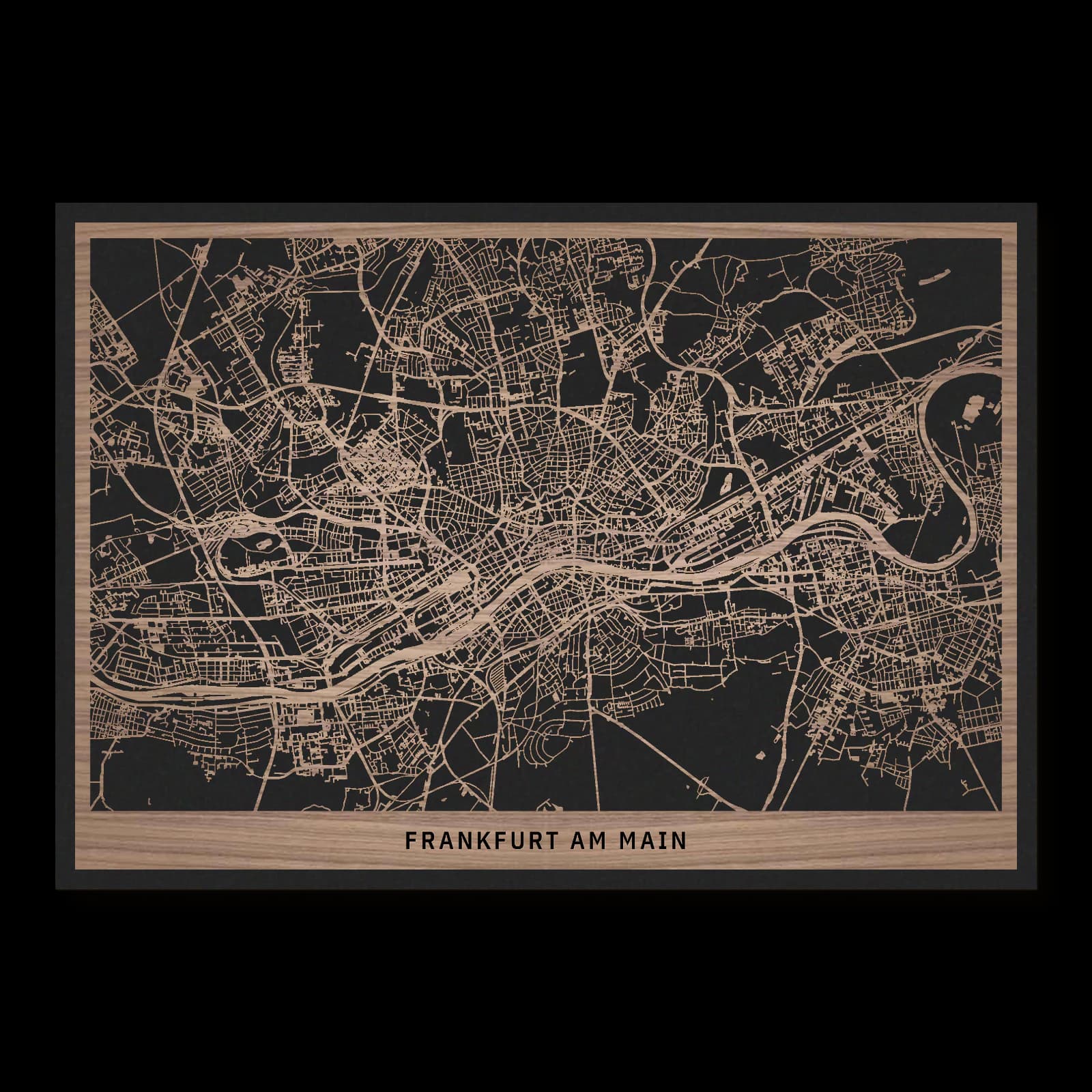
Frankfurt am Main.
Layered wooden city map in oiled walnut, landscape format.
About the product
Follow Frankfurt beyond its skyline, from the exhibition grounds and Palmengarten to the eastern zoo district and the museums south of the Main. This city view brings together places usually encountered on separate journeys. Bridges connect the riverbanks, broad urban routes give way to smaller neighbourhood streets, and gardens interrupt the surrounding density. Oiled walnut brings its grain to this broad street plan. A backing panel separates the cut map from the wall, giving the routes between the fairgrounds, parks, river and eastern districts a measured sense of depth.
What does the map show?
- Palmengarten
- Frankfurter Zoo
- Städel
- Messe Torhaus
- Precisely cut and engraved
- Fine laser details with clear depth
- Carefully inspected and securely packed
- Handmade in Germany
Configuration
Shape: Rectangular · Design: Layered · Material: Walnut · Sizes: 20 × 30 cm, 35 × 50 cm, 50 × 70 cm
The configuration shown in the cart and at the time of ordering is authoritative. The preview is not a dimensioned technical drawing.
Availability & production
- Availability
- Made to order
- Production time
- Ships in 3-5 business days
Production starts after successful payment and complete product configuration.
Materials & care
Depending on the variant, lacquered or oiled MDF or oiled real-wood veneer on MDF; optional stainless-steel mounting screws. Acrylic lacquer spray, hard-wax oil and white glue are used in production.
Wood is a natural material. Grain and color may vary slightly from the product images.
Clean with a dry, soft cloth and protect from prolonged moisture and direct heat.
Included & installation
The selected product in the ordered configuration, securely packed and prepared for installation.
- Maximum dimensions 50 × 70 cm and maximum product weight 2 kg.
- Wall-fixing screws and wall plugs are not included. Use fixings suitable for the wall type, substrate and product weight.
- Installation must be carried out by an adult. Keep optional mounting screws and other small parts away from children until installation.
Shipping & returns
Securely packed shipping. Return and cancellation information is available in the legal section.
Shipping costs and delivery options depend on the destination and format. The published cancellation right applies to non-personalised standard goods; it may be excluded for individually made products.
Manufacturer & product identifier
- Manufacturer
- Benjamin Nöst - Lightworks
Rorichmoorer Str. 76
26802 Moormerland, Deutschland
kontakt@lightworks.de - Product identifier
- LW-CAT-4425F231D4BF-S, LW-CAT-4425F231D4BF-M, LW-CAT-4425F231D4BF-L
Together with the order or production batch, the relevant SKU enables traceability. Safety questions and incidents can be reported to the email address shown above.
Product safety
- Decorative product for dry indoor use only; not a toy and not intended for children.
- Protect from moisture, high heat and open flames.
- Do not continue to hang the product after a fall, breakage or visible damage. Keep damaged parts away from children.
Frankfurt: trade, riverbanks and civic gardens
The familiar skyline explains only part of Frankfurt. Exhibition grounds, civic gardens, the eastern zoo district and the cultural institutions beside the Main form several centres of activity. Looking across them reveals how a trading city also made room for collections, public landscapes and neighbourhoods with very different scales.
Several centres, one river city
The Main offers a useful starting point for understanding Frankfurt, but the city is not arranged around a single landmark. Exhibition grounds extend west of the historic centre, the Palmengarten occupies part of the Westend to the north, and the zoo marks another destination in the east. Across the river, museums establish a different kind of attraction. Their distribution helps explain the changing character of journeys through the inner city.
At the exhibition grounds, the Messe Torhaus translates the idea of a gateway into a conspicuous high-rise building. Designed by Oswald Mathias Ungers, it belongs to a setting of large halls and substantial transport infrastructure. From above, the important contrast is one of scale: these broad footprints differ from the tighter street blocks surrounding them. Trade has shaped an extensive piece of Frankfurt rather than simply occupying a few central addresses.
Institutions created by citizens
The Palmengarten opened in 1871 after an initiative financed privately. Its collections and glasshouses introduced plants from different climates into a public setting. Within the Westend, the garden provides a network of paths and open spaces that interrupts the neighbouring streets. The zoo, founded in 1858, offers another example of citizens helping to establish a lasting urban institution.
South of the Main, the Städel represents a related tradition of civic collecting. It developed from the bequest of banker and collector Johann Friedrich Städel. Frankfurt lacked the royal collections that underpinned museums in many residence cities, making private endowments especially significant. Later plans for the Museumsufer connected established institutions with new museum buildings. This history accounts for the unusual relationship between former villas, gardens and more recent architecture along the southern bank.
Reading the crossings
Compare the bridges with the routes continuing inland on either side. They do not connect identical halves of the city. Streets on the northern bank lead towards commercial districts, while those to the south enter neighbourhoods with a different grain and the museum landscape. The river provides continuity even as the adjoining urban settings change.
Palmengarten, zoo and Städel raise a question easily overlooked behind the skyline: what did Frankfurt's citizens want to leave their city? Plants, animals and art became subjects of public interest through institutions that still occupy substantial urban sites. The exhibition grounds represent another form of exchange, connecting Frankfurt with places far beyond the Main. Between these destinations lie ordinary homes and working journeys. Civic ambition has a geography here, extending across both banks rather than belonging exclusively to the commercial centre.
Sources
- Museumsufer Frankfurt: Geschichte — https://www.museumsufer.de/en/about-museumsufer-frankfurt/about-museumsufer-frankfurt-history/
- Wikipedia: Palmengarten — https://en.wikipedia.org/wiki/Palmengarten
- Wikipedia: Frankfurter Zoo — https://en.wikipedia.org/wiki/Frankfurt_Zoo
- Wikipedia: Messe Torhaus — https://en.wikipedia.org/wiki/Messe_Torhaus
- Wikipedia: Frankfurt — https://en.wikipedia.org/wiki/Frankfurt

Still deciding?
Configure your motif in the studio and see how your city map will look in your space.