
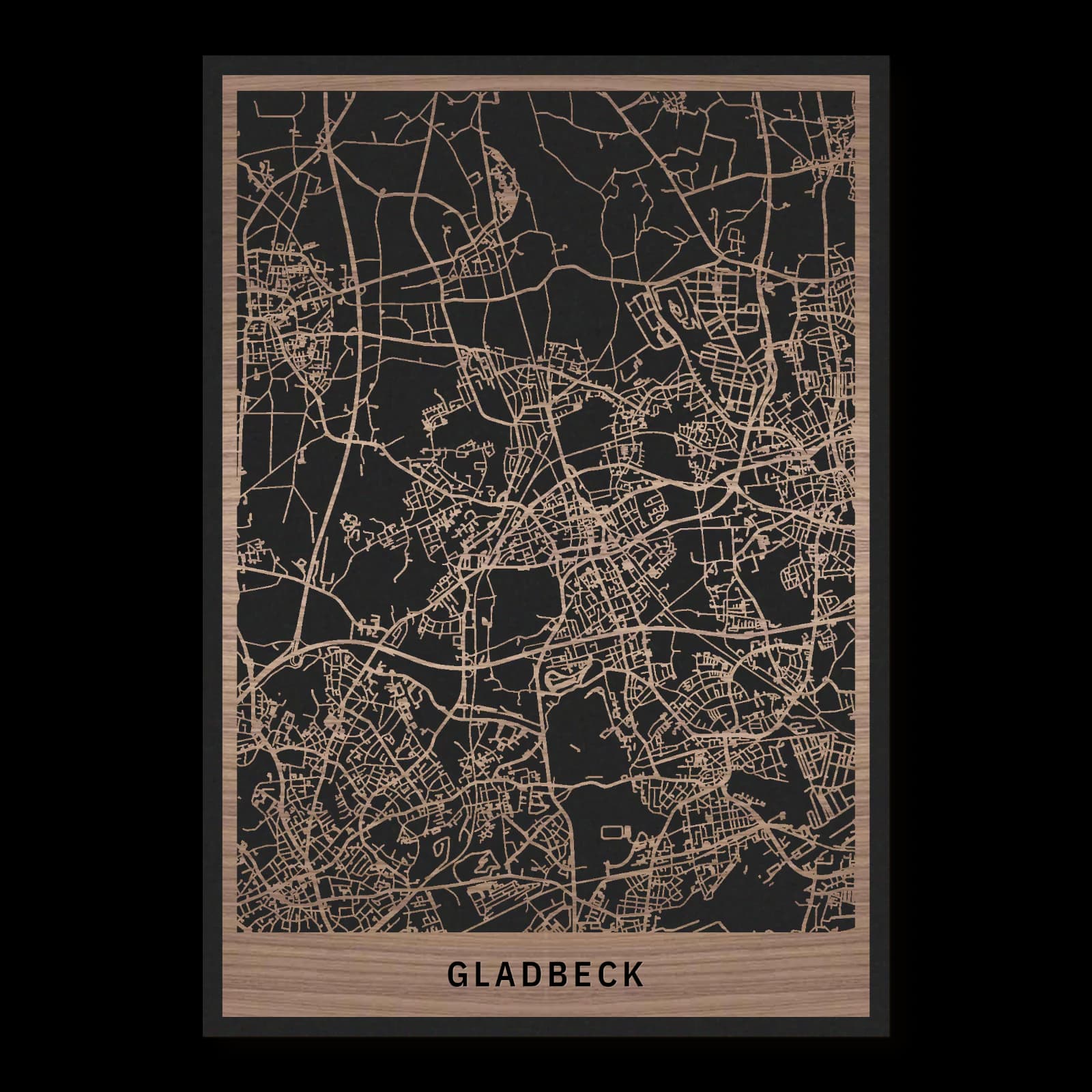
Gladbeck.Mining heritage and green spaces
Rectangular wooden city map made from oiled walnut – two layers with a black back plate.
About the product
Gladbeck's mining history runs through the city from Zweckel to the Mottbruchhalde. The town hall and Haus Wittringen add civic architecture and a substantial park landscape to that story. Rendered as a wooden city map, residential districts, industrial remains and green spaces form a connected composition. It reflects a town shaped by work and by the creation of shared open space.
What does the map show?
- Zweckel machine hall
- Haus Wittringen
- Mottbruchhalde
- Gladbeck Town Hall
- Precisely cut and engraved
- Fine laser details with clear depth
- Carefully inspected and securely packed
- Handmade in Germany
Configuration
Shape: Rectangular · Design: Layered · Material: Walnut · Sizes: 20 × 30 cm, 35 × 50 cm, 50 × 70 cm
The configuration shown in the cart and at the time of ordering is authoritative. The preview is not a dimensioned technical drawing.
Availability & production
- Availability
- Made to order
- Production time
- Ships in 3-5 business days
Production starts after successful payment and complete product configuration.
Materials & care
Depending on the variant, lacquered or oiled MDF or oiled real-wood veneer on MDF; optional stainless-steel mounting screws. Acrylic lacquer spray, hard-wax oil and white glue are used in production.
Wood is a natural material. Grain and color may vary slightly from the product images.
Clean with a dry, soft cloth and protect from prolonged moisture and direct heat.
Included & installation
The selected product in the ordered configuration, securely packed and prepared for installation.
- Maximum dimensions 50 × 70 cm and maximum product weight 2 kg.
- Wall-fixing screws and wall plugs are not included. Use fixings suitable for the wall type, substrate and product weight.
- Installation must be carried out by an adult. Keep optional mounting screws and other small parts away from children until installation.
Shipping & returns
Securely packed shipping. Return and cancellation information is available in the legal section.
Shipping costs and delivery options depend on the destination and format. The published cancellation right applies to non-personalised standard goods; it may be excluded for individually made products.
Manufacturer & product identifier
- Manufacturer
- Benjamin Nöst - Lightworks
Rorichmoorer Str. 76
26802 Moormerland, Deutschland
kontakt@lightworks.de - Product identifier
- LW-CAT-3600E1C52674-S, LW-CAT-3600E1C52674-M, LW-CAT-3600E1C52674-L
Together with the order or production batch, the relevant SKU enables traceability. Safety questions and incidents can be reported to the email address shown above.
Product safety
- Decorative product for dry indoor use only; not a toy and not intended for children.
- Protect from moisture, high heat and open flames.
- Do not continue to hang the product after a fall, breakage or visible damage. Keep damaged parts away from children.
Gladbeck: Mining heritage and green spaces
Mining transformed Gladbeck from a rural community into a rapidly growing town. Civic institutions and public landscapes followed that expansion. Zweckel, the town hall, Wittringen and the Mottbruchhalde record different consequences of the change, connecting industrial work with the spaces created for administration, housing and recreation across the urban area.
A mining settlement becomes a town
Gladbeck expanded rapidly during the final quarter of the nineteenth century. Mining attracted workers and increased the need for housing, services and public institutions. The former rural community received town rights in 1919. By then, industrial growth had already changed both its population and its requirements for local government.
The machine hall at Zweckel provides a northern reference point for this transformation. Its scale differs from that of nearby residential streets. Mining introduced extensive sites and specialised connections into the settlement. When extraction ended, these physical arrangements did not simply disappear. Surviving industrial buildings continue to explain the activities that helped the town grow.
Civic architecture before town status
Gladbeck's town hall was built between 1908 and 1910 to designs by Otto Müller-Jena. Originally an administrative office building, it predates the formal award of town rights. That sequence is revealing: the practical needs of a growing community demanded a stronger civic centre before its legal status changed.
The building stands between the northern industrial area and the larger green spaces farther south. Across this geography, production, administration, housing and recreation occupied different kinds of land. Routes connected them without making their forms identical. The city developed through the close proximity of places operating at markedly different scales.
Making Wittringen public
In 1922, the municipality acquired Haus Wittringen and its woodland. The subsequent development created an extensive recreational landscape. An older historic property was brought into the service of an industrial population. Paths, water and open green areas became components of a public facility rather than the setting of a private estate alone.
Wittringen therefore connects two histories: the earlier estate and the municipal effort to provide space for leisure and health. Its significance lies in that change of purpose as well as in its buildings.
Farther south, the Mottbruchhalde records another consequence of industrial work. Unlike a town hall or manor house, a spoil heap arose from the movement of material and became a landform in its own right. Together with Zweckel, it frames different aspects of Gladbeck's mining inheritance. Between those industrial reference points stand the civic and green spaces that supported urban life. This relationship makes the connection between work, government and landscape particularly clear.
Sources
- Historie — https://www.verkehrsverein-gladbeck.de/historie/
- Öffentliche Parks in Gladbeck - Heimatverein Gladbeck — https://www.heimatverein-gladbeck.de/natur-und-umwelt/oeffentliche-parks/
- LWL | Gladbeck – Deckenmalerei Haus Wittringen (Juni 2026) - LWL-Denkmalpflege, Landschafts- und Baukultur in Westfalen — https://www.lwl-dlbw.de/de/denkmaeler-entdecken/denkmal-des-monats/gladbeck-haus-wittringen/
- LVR / KuLaDig: Rathaus Gladbeck — https://www.kuladig.de/Objektansicht/O-90202-20140406-550

Still deciding?
Configure your motif in the studio and see how your city map will look in your space.



