
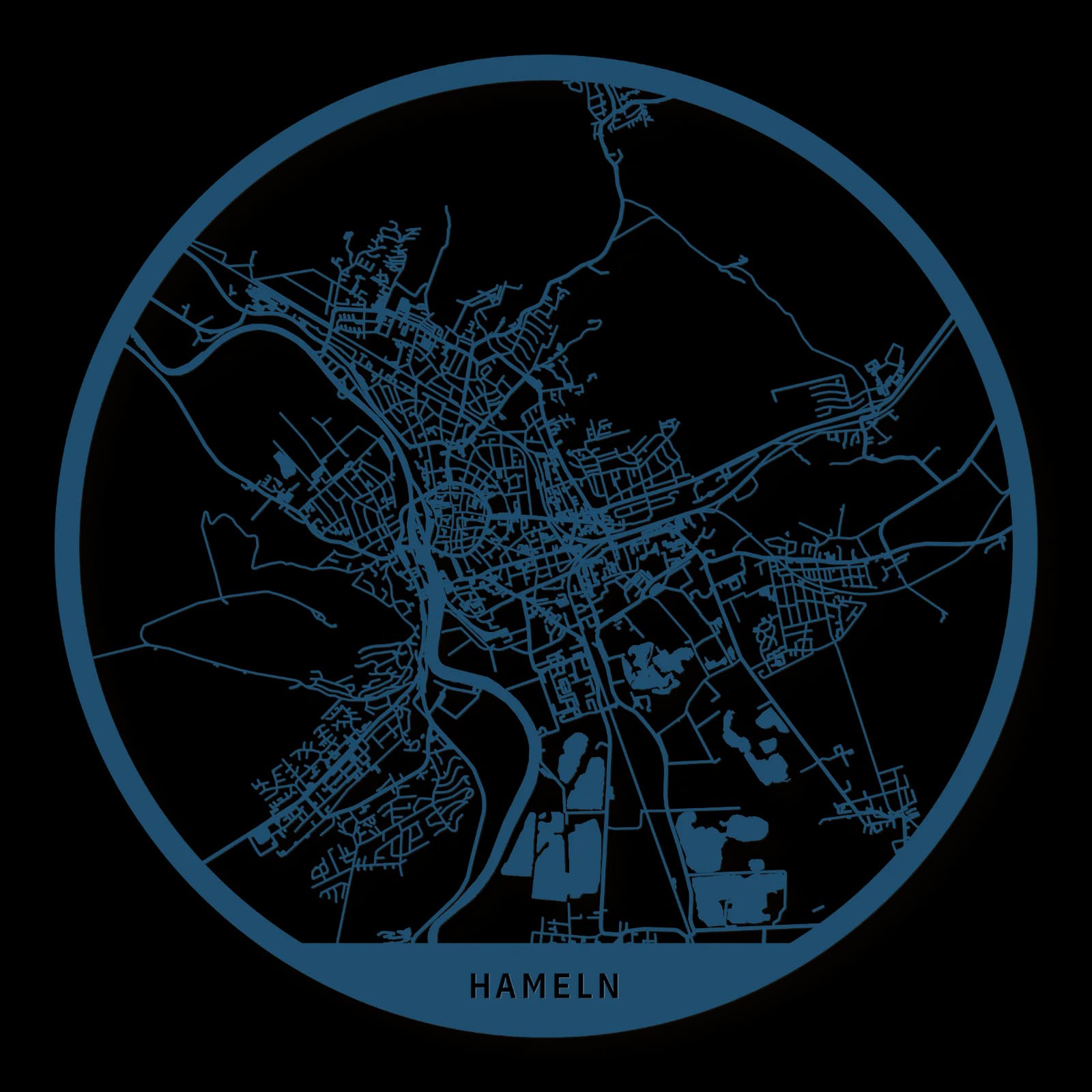
Hamelin.City overview
Round wooden city map made from blue lacquered MDF.
About the product
The Weser gives Hamelin a strong dividing line, with the wooded Klüt rising on its western side and the old town close to the eastern bank. Beyond the historic streets, the urban area extends towards the railway station and Afferde. This sequence adds depth to a place often associated primarily with the Pied Piper. The Klütturm recalls the conversion of a fortified height into a viewpoint, while the station represents growth during the railway age. Bridges and riverside routes connect the different parts. Hamelin’s distinctive shape comes from the contrast between the hill above one bank and the broader built landscape spreading out from the other.
What does the map show?
- The Weser divides the urban area
- Old town close to the eastern bank
- The Klüt rises west of the river
- Precisely cut and engraved
- Fine laser details with clear depth
- Carefully inspected and securely packed
- Handmade in Germany
Configuration
Shape: Round · Design: Classic · Material: Blue · Diameter: Ø 23 cm, Ø 35 cm, Ø 50 cm
The configuration shown in the cart and at the time of ordering is authoritative. The preview is not a dimensioned technical drawing.
Availability & production
- Availability
- Made to order
- Production time
- Ships in 3-5 business days
Production starts after successful payment and complete product configuration.
Materials & care
Depending on the variant, lacquered or oiled MDF or oiled real-wood veneer on MDF; optional stainless-steel mounting screws. Acrylic lacquer spray, hard-wax oil and white glue are used in production.
Wood is a natural material. Grain and color may vary slightly from the product images.
Clean with a dry, soft cloth and protect from prolonged moisture and direct heat.
Included & installation
The selected product in the ordered configuration, securely packed and prepared for installation.
- Maximum dimensions 50 × 70 cm and maximum product weight 2 kg.
- Wall-fixing screws and wall plugs are not included. Use fixings suitable for the wall type, substrate and product weight.
- Installation must be carried out by an adult. Keep optional mounting screws and other small parts away from children until installation.
Shipping & returns
Securely packed shipping. Return and cancellation information is available in the legal section.
Shipping costs and delivery options depend on the destination and format. The published cancellation right applies to non-personalised standard goods; it may be excluded for individually made products.
Manufacturer & product identifier
- Manufacturer
- Benjamin Nöst - Lightworks
Rorichmoorer Str. 76
26802 Moormerland, Deutschland
kontakt@lightworks.de - Product identifier
- LW-CAT-6C848DC8B514-S, LW-CAT-6C848DC8B514-M, LW-CAT-6C848DC8B514-L
Together with the order or production batch, the relevant SKU enables traceability. Safety questions and incidents can be reported to the email address shown above.
Product safety
- Decorative product for dry indoor use only; not a toy and not intended for children.
- Protect from moisture, high heat and open flames.
- Do not continue to hang the product after a fall, breakage or visible damage. Keep damaged parts away from children.
Hamelin between the Weser and the Klüt
Hamelin’s legend is famous, but its geography tells another compelling story. The Weser, the wooded Klüt and the eastern railway district reveal a town shaped by trade, defence and expansion. Understanding their relationship places the celebrated old streets within a larger urban landscape, extending well beyond the historic centre.
A town facing its river
The Weser provides Hamelin with a clear geographical structure. The historic centre occupies the eastern side, while the Klüt rises above the western bank. Bridges bring the two sides together and make crossing the water part of everyday urban movement. The contrast between the wooded hill and the more extensive built area is fundamental to the town’s identity. Hamelin has a strong landscape edge on one side and a broader direction of urban growth on the other.
Within the old town, timber-framed and sandstone buildings reflect the prosperity of merchants and townspeople. Weser Renaissance architecture is an important part of that story. The municipality identifies sixteenth-century wealth as a key influence on the impressive houses. Their character comes from the streets they form together, rather than from isolated façades alone. The Pied Piper story, traditionally associated with 1284, belongs to a different kind of history: it is a cultural legend, not a substitute for understanding how the town was built.
From defence to a viewpoint
The Klütturm records a striking change in the use of the western hill. Built in 1843, the lookout tower incorporated stone from Fort George, whose fortifications had been demolished following the events of 1808. Material from a defensive structure was therefore reused for a place intended for looking out over the landscape. The same elevated ground that had served military purposes acquired a new relationship with the town below.
The removal of fortifications also mattered for Hamelin’s wider development. It helped create opportunities for expansion beyond the earlier centre. New urban areas could grow while the compact old streets retained their recognisable identity. The relationship between enclosed historic core and later additions is still useful for reading the town as a whole.
Growth towards the railway
East of the old centre, the railway station marks another stage in that expansion. Opened in 1872, it introduced a transport focus distinct from the river. Tracks and adjoining neighbourhoods show how the town developed beyond its older limits. Afferde lies farther east, contributing another settlement area to the modern urban landscape.
Between the Klüt, old town, station and Afferde, the scale changes repeatedly. Wooded slopes give way to narrow streets, larger transport spaces and residential areas. Those differences explain Hamelin more fully than its famous legend alone. The Weser remains the strongest geographical feature, while the railway and eastern neighbourhoods reveal how the town’s built life spread beyond the historic riverfront.
Sources
- Stadt Hameln – Stadtgeschichte — https://www.hameln.de/de/tourismus/altstadt-und-weserbergland/altstadt-und-stadtgeschichte/stadtgeschichte
- Deutsche Zentrale für Tourismus – Hameln — https://www.germany.travel/en/cities-culture/hamelin.html
- Wikipedia – Klütturm — https://de.wikipedia.org/wiki/Kl%C3%BCtturm
- Wikipedia – Bahnhof Hameln — https://de.wikipedia.org/wiki/Bahnhof_Hameln
- Wikipedia – Afferde — https://de.wikipedia.org/wiki/Afferde

Still deciding?
Configure your motif in the studio and see how your city map will look in your space.



