
Herne.Wanne, Strünkede and cultural landmarks
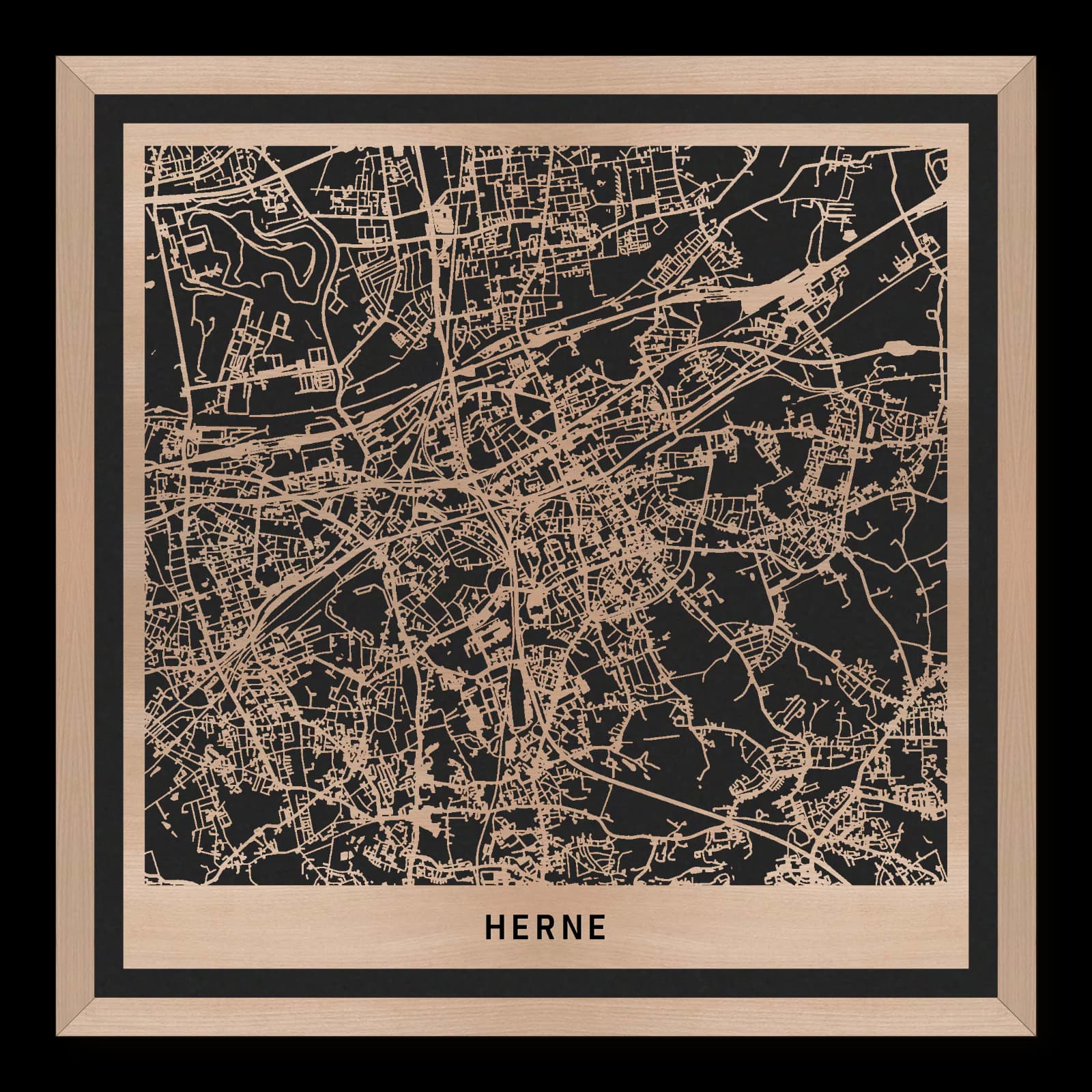
Square wooden city map made from oiled beech – two layers with a black back plate and frame.
About the product
Herne’s city pattern joins the established areas of Wanne and Herne with parks and cultural places. Strünkede Castle, the Flottmann-Hallen and Gysenberg occupy different sides of the urban fabric, with Wanne-Eickel station farther west. Wood lends the map a grounded material presence. Connecting streets and residential districts bring pre-industrial heritage, former working grounds and green landscapes into one wider portrait.
What does the map show?
- Strünkede Castle
- Flottmann-Hallen
- Gysenberg
- Wanne
- Residential connections
- Precisely cut and engraved
- Fine laser details with clear depth
- Carefully inspected and securely packed
- Handmade in Germany
Configuration
Shape: Square · Design: Framed · Material: Beech · Sizes: 23 × 23 cm, 35 × 35 cm, 50 × 50 cm
The configuration shown in the cart and at the time of ordering is authoritative. The preview is not a dimensioned technical drawing.
Availability & production
- Availability
- Made to order
- Production time
- Ships in 3-5 business days
Production starts after successful payment and complete product configuration.
Materials & care
Depending on the variant, lacquered or oiled MDF or oiled real-wood veneer on MDF; optional stainless-steel mounting screws. Acrylic lacquer spray, hard-wax oil and white glue are used in production.
Wood is a natural material. Grain and color may vary slightly from the product images.
Clean with a dry, soft cloth and protect from prolonged moisture and direct heat.
Included & installation
The selected product in the ordered configuration, securely packed and prepared for installation.
- Maximum dimensions 50 × 70 cm and maximum product weight 2 kg.
- Wall-fixing screws and wall plugs are not included. Use fixings suitable for the wall type, substrate and product weight.
- Installation must be carried out by an adult. Keep optional mounting screws and other small parts away from children until installation.
Shipping & returns
Securely packed shipping. Return and cancellation information is available in the legal section.
Shipping costs and delivery options depend on the destination and format. The published cancellation right applies to non-personalised standard goods; it may be excluded for individually made products.
Manufacturer & product identifier
- Manufacturer
- Benjamin Nöst - Lightworks
Rorichmoorer Str. 76
26802 Moormerland, Deutschland
kontakt@lightworks.de - Product identifier
- LW-CAT-C27D01F63EE9-S, LW-CAT-C27D01F63EE9-M, LW-CAT-C27D01F63EE9-L
Together with the order or production batch, the relevant SKU enables traceability. Safety questions and incidents can be reported to the email address shown above.
Product safety
- Decorative product for dry indoor use only; not a toy and not intended for children.
- Protect from moisture, high heat and open flames.
- Do not continue to hang the product after a fall, breakage or visible damage. Keep damaged parts away from children.
Herne’s castle, industrial culture and connected urban centres
Herne brings several historical layers into a varied urban area. Strünkede Castle lies north of the centre, while the former Flottmann works provide a southern cultural place. Wanne to the west and Gysenberg to the east broaden the portrait. Residential streets and the railway connections around Wanne bring these established parts of Herne together.
An older history at Strünkede
Strünkede Castle preserves a history that began well before Herne’s industrial growth. The site is recorded in medieval sources and acquired its characteristic form through later changes. Its moat and park create a separate landscape setting in the northern city. This arrangement differs from the closely built streets of neighbouring districts. Strünkede therefore gives the urban portrait an important earlier reference. It demonstrates that the history of a Ruhr city includes forms of settlement and authority preceding the factories and workplaces with which the region is often associated.
From production to public culture
The Flottmann-Hallen stand south of the centre. The former works were connected with the manufacture of drilling hammers and other technical products. Surviving buildings retain parts of the industrial setting, while their uses have changed substantially. Since 1986, the halls have accommodated cultural activity including theatre, dance and art. The shift of function is central to understanding the place. A former production site remains physically present in the city, providing new purposes without removing the architectural record of the work once carried out there.
Buildings that record working conditions
The surviving Flottmann buildings belong to a period when architectural design and industrial requirements were consciously combined. The city identifies them as evidence of production conditions around 1910. The wrought-iron gate contributes another element to that history. Compared with Strünkede Castle, the works reveal a different reason for creating substantial architecture. Both sites preserve older structures, but their original functions were far apart. Together they show how authority, manufacturing and later public culture left distinct physical traces in different parts of the same city.
Wanne and the western connections
Wanne-Eickel’s main station extends the city view westward. Its position makes the presence of several established urban areas clear. Transport routes connect Wanne with central Herne and the districts farther east, while local street patterns retain differences between those places. The relationship is not confined to major roads and railways. Residential streets and everyday uses occupy the intervening areas and provide urban continuity. Wanne consequently contributes more than a peripheral station landmark: it forms an essential part of understanding how the city’s separate centres belong together.
Green space towards Gysenberg
Gysenberg adds park and woodland areas on the eastern side. It complements the northern castle landscape with a different kind of green setting, associated with recreation and wooded terrain. Its location reveals how open spaces are distributed through the city. Castle, former works, station and Gysenberg do not gather around one historic square. Instead, their separate positions explain Herne’s spatial variety. The city can be understood through the links between local centres, working heritage and green ground, with ordinary residential districts forming the connections between these recognisable places.
Sources
- Schloss Strünkede - Stadt Herne — https://www.herne.de/Kultur-und-Freizeit/Kulturorte/Schloss-Str%C3%BCnkede/
- Die Flottmann-Hallen - Herner Szenetreff für Kunst, Kultur, Tanz ... — https://www.herne.de/Kultur-und-Freizeit/Tourismus/Sehensw%C3%BCrdigkeiten/Flottmann-Hallen/
- Die Zeit von 1970 bis 1989 - Stadt Herne — https://www.herne.de/Stadt-und-Leben/Stadtgeschichte/Die-Zeit-von-1970-bis-1989/
- Wald - Stadt Herne — https://www.herne.de/Stadt-und-Leben/Umwelt/Stadtgruen/Wald/
- Soziale Stadt Wanne-Süd - Startseite — https://www.herne.de/soziale-stadt-wanne-sued/

Still deciding?
Configure your motif in the studio and see how your city map will look in your space.



