
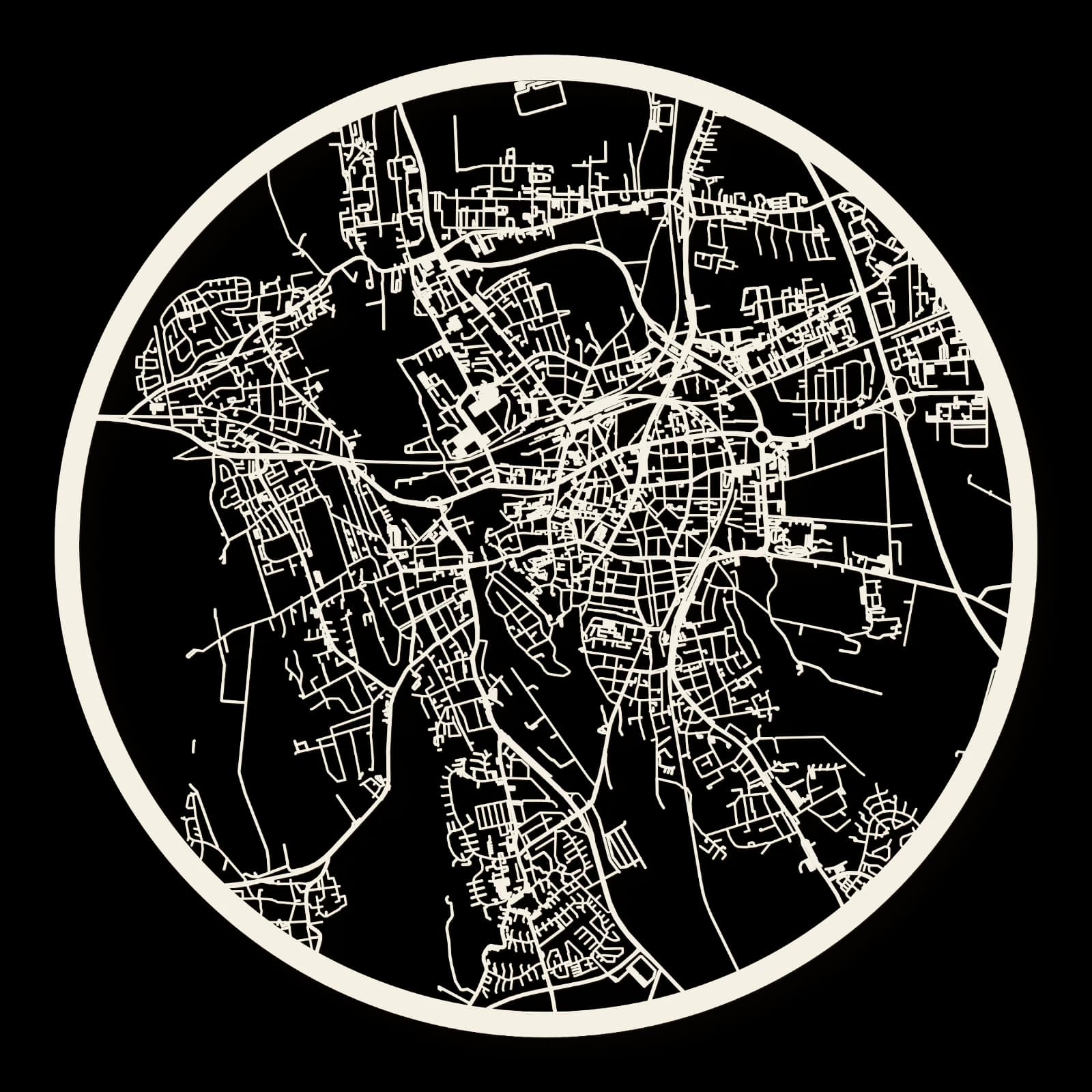
Hildesheim.Heritage city between the station and Hohnsensee
Round wooden city map made from white lacquered MDF.
About the product
Hildesheim's World Heritage churches belong to a city extending toward the station and Hohnsensee. This wooden map connects the cathedral and St. Michael's with the streets and open spaces between them. Their relationship with the historic centre stays clear while everyday surroundings remain visible. The balanced composition brings medieval architecture, current urban routes and the more open southern setting together.
What does the map show?
- Hildesheim Cathedral
- World Heritage St. Michael's
- Northern main railway station
- Southern Hohnsensee
- Precisely cut and engraved
- Fine laser details with clear depth
- Carefully inspected and securely packed
- Handmade in Germany
Configuration
Shape: Round · Design: Classic · Material: White · Diameter: Ø 23 cm, Ø 35 cm, Ø 50 cm
The configuration shown in the cart and at the time of ordering is authoritative. The preview is not a dimensioned technical drawing.
Availability & production
- Availability
- Made to order
- Production time
- Ships in 3-5 business days
Production starts after successful payment and complete product configuration.
Materials & care
Depending on the variant, lacquered or oiled MDF or oiled real-wood veneer on MDF; optional stainless-steel mounting screws. Acrylic lacquer spray, hard-wax oil and white glue are used in production.
Wood is a natural material. Grain and color may vary slightly from the product images.
Clean with a dry, soft cloth and protect from prolonged moisture and direct heat.
Included & installation
The selected product in the ordered configuration, securely packed and prepared for installation.
- Maximum dimensions 50 × 70 cm and maximum product weight 2 kg.
- Wall-fixing screws and wall plugs are not included. Use fixings suitable for the wall type, substrate and product weight.
- Installation must be carried out by an adult. Keep optional mounting screws and other small parts away from children until installation.
Shipping & returns
Securely packed shipping. Return and cancellation information is available in the legal section.
Shipping costs and delivery options depend on the destination and format. The published cancellation right applies to non-personalised standard goods; it may be excluded for individually made products.
Manufacturer & product identifier
- Manufacturer
- Benjamin Nöst - Lightworks
Rorichmoorer Str. 76
26802 Moormerland, Deutschland
kontakt@lightworks.de - Product identifier
- LW-CAT-99DAF1528316-S, LW-CAT-99DAF1528316-M, LW-CAT-99DAF1528316-L
Together with the order or production batch, the relevant SKU enables traceability. Safety questions and incidents can be reported to the email address shown above.
Product safety
- Decorative product for dry indoor use only; not a toy and not intended for children.
- Protect from moisture, high heat and open flames.
- Do not continue to hang the product after a fall, breakage or visible damage. Keep damaged parts away from children.
Hildesheim from World Heritage to everyday streets
Hildesheim Cathedral and St. Michael's together form a UNESCO World Heritage site. Their exceptional importance explains only part of the city. The railway station opens a northern direction and Hohnsensee a southern one. Between them lies an inhabited urban setting where historical architecture and everyday routes retain their different roles.
Two churches with shared significance
Hildesheim Cathedral and St. Michael's entered the World Heritage List together in 1985. Their significance relates to exceptional examples of medieval art and architecture. Within the city, their proximity is equally interesting, as are the differences between their surroundings. They are not distant excursion destinations. Both belong to a central urban setting in which walking between them forms part of the experience. International cultural importance therefore stands alongside a specific local relationship. The buildings are widely recognised while remaining places within an inhabited city. Their shared status becomes more tangible when attention turns from their fame to their actual positions and to the streets that connect them.
St. Michael's and its elevated setting
St. Michael's lies northwest of the cathedral on slightly higher ground. Official visitor information describes its powerful exterior and harmonious interior, with particular attention to its medieval painted ceiling. Understanding the place spatially means considering this artistic importance together with the site itself. The church stands out through architecture and through its relationship with the terrain and neighbouring streets. Its surroundings offer a different introduction to the heritage setting from that around the cathedral. Walking between them consequently connects more than two significant buildings. It also joins two distinct situations within central Hildesheim, allowing changes of setting to accompany the differences in their historical architecture.
A northern geography of arrival
The main railway station lies north of the churches and broadens attention beyond their closest historical surroundings. It represents arrival and onward movement, the routes through which a contemporary city is used. Streets and neighbourhoods between station and heritage places have daily lives not determined solely by the history of famous buildings. This matters when considering Hildesheim as a present-day city. A visit may begin with the churches, but their inhabited surroundings reach farther. The northern connection shows how cultural importance remains embedded in a practical urban network, relating to current central functions and to the movements of residents and visitors through ordinary streets.
Open space toward Hohnsensee
Hohnsensee stands south of the cathedral and adds water and open surroundings to the city portrait. Its scale differs markedly from that of closely defined historical streets. Shores, distance and views across an open surface become more important here. Everyday routes within Hildesheim connect this setting with the churches. Together the places allow different activities to coexist in one urban picture: internationally significant art history in the centre, arrivals to the north and recreation to the south. The famous buildings remain strong references, but station, residential routes and lake give them a wider context. Hildesheim becomes understandable as a living place with historical depth and contemporary daily uses.
Sources
- Stadt Hildesheim: UNESCO-Welterbe — https://www.stadt-hildesheim.de/portal/seiten/unesco-welterbe-900000454-33610.html
- UNESCO-Welterbe St. Michaelis - Hildesheim Tourismus — https://www.hildesheim-tourismus.de/sehenswuerdigkeiten/unesco-welterbe-st-michaelis
- Michaeliskirche (Hildesheim) – Wikipedia — https://de.wikipedia.org/wiki/Michaeliskirche_%28Hildesheim%29

Still deciding?
Configure your motif in the studio and see how your city map will look in your space.



