
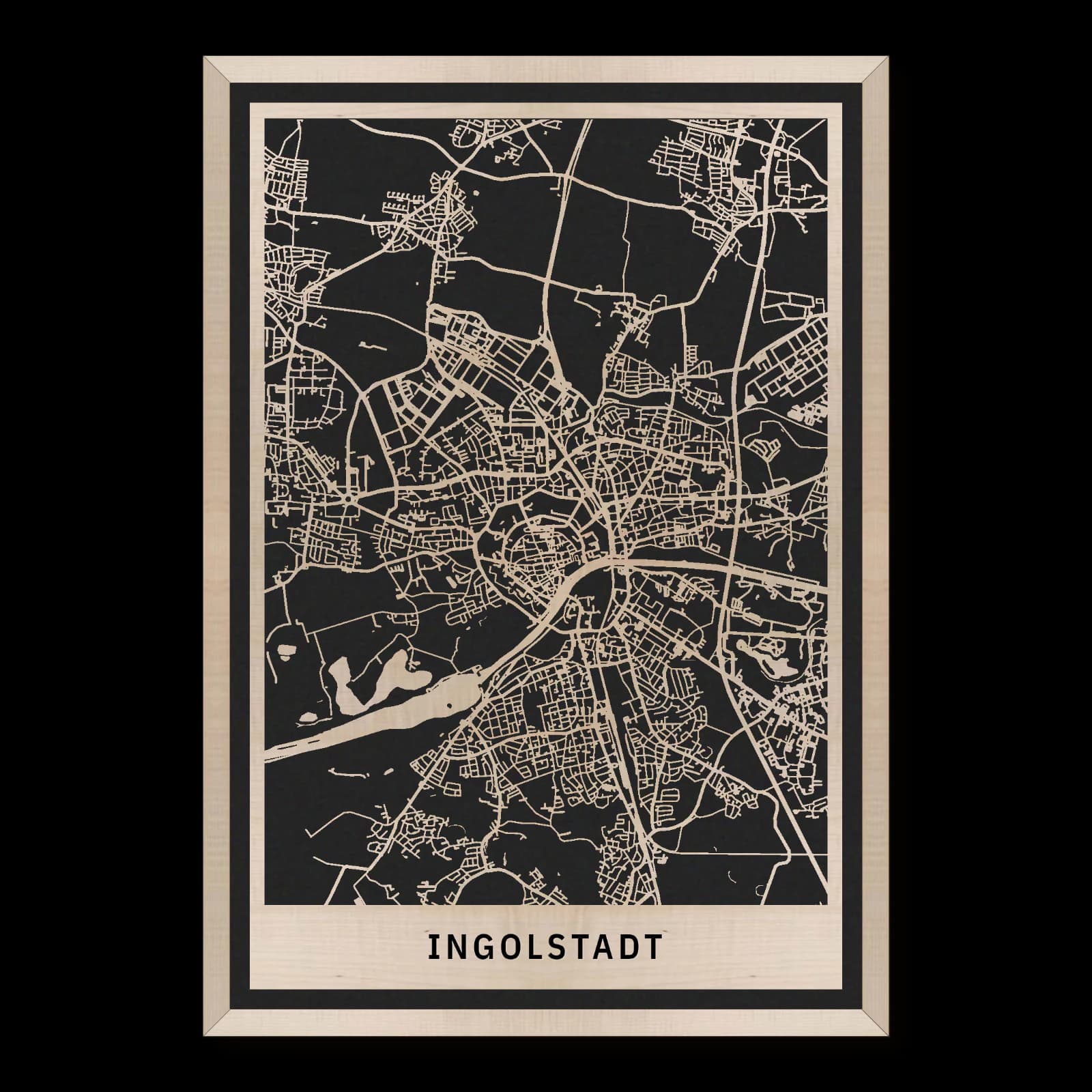
Ingolstadt.Danube, fortress city and industrial history
Rectangular wooden city map made from oiled maple – two layers with a black back plate and frame.
About the product
Ingolstadt’s Danube setting joins a historic residence with fortress heritage and industrial history. The New Castle, Kreuztor and Klenzepark establish different older references, while the Audi museum mobile extends the view northward. The southern station adds another connection across the river. The city map’s wood gives this broad arrangement a restrained physical quality, bringing historic structures and everyday neighbourhoods into the same urban pattern.
What does the map show?
- New Castle
- Kreuztor
- Klenzepark
- Audi museum mobile
- Danube
- Precisely cut and engraved
- Fine laser details with clear depth
- Carefully inspected and securely packed
- Handmade in Germany
Configuration
Shape: Rectangular · Design: Framed · Material: Maple · Sizes: 20 × 30 cm, 35 × 50 cm, 50 × 70 cm
The configuration shown in the cart and at the time of ordering is authoritative. The preview is not a dimensioned technical drawing.
Availability & production
- Availability
- Made to order
- Production time
- Ships in 3-5 business days
Production starts after successful payment and complete product configuration.
Materials & care
Depending on the variant, lacquered or oiled MDF or oiled real-wood veneer on MDF; optional stainless-steel mounting screws. Acrylic lacquer spray, hard-wax oil and white glue are used in production.
Wood is a natural material. Grain and color may vary slightly from the product images.
Clean with a dry, soft cloth and protect from prolonged moisture and direct heat.
Included & installation
The selected product in the ordered configuration, securely packed and prepared for installation.
- Maximum dimensions 50 × 70 cm and maximum product weight 2 kg.
- Wall-fixing screws and wall plugs are not included. Use fixings suitable for the wall type, substrate and product weight.
- Installation must be carried out by an adult. Keep optional mounting screws and other small parts away from children until installation.
Shipping & returns
Securely packed shipping. Return and cancellation information is available in the legal section.
Shipping costs and delivery options depend on the destination and format. The published cancellation right applies to non-personalised standard goods; it may be excluded for individually made products.
Manufacturer & product identifier
- Manufacturer
- Benjamin Nöst - Lightworks
Rorichmoorer Str. 76
26802 Moormerland, Deutschland
kontakt@lightworks.de - Product identifier
- LW-CAT-31009707AF34-S, LW-CAT-31009707AF34-M, LW-CAT-31009707AF34-L
Together with the order or production batch, the relevant SKU enables traceability. Safety questions and incidents can be reported to the email address shown above.
Product safety
- Decorative product for dry indoor use only; not a toy and not intended for children.
- Protect from moisture, high heat and open flames.
- Do not continue to hang the product after a fall, breakage or visible damage. Keep damaged parts away from children.
Ingolstadt’s residence, fortress landscapes and industrial history
The Danube links Ingolstadt’s historic centre with its southern districts. The New Castle and Kreuztor represent different functions of the older city, while Klenzepark preserves a later fortress setting on the southern bank. The northern Audi museum mobile and southern main station broaden the portrait with industrial heritage and transport connections.
A residence on the eastern side
The New Castle stands in the eastern part of Ingolstadt’s old town. Its construction began under Duke Ludwig in the early fifteenth century and continued over an extended period. The complex records the city’s role as a residence, making the relationship between government and urban settlement physically apparent. Its present public context differs from the purpose for which it was built. The location near the Danube nevertheless remains important. Castle, old streets and river landscape meet at a historical point that helps explain the eastern part of the older city.
The western gate at Kreuztor
The Kreuztor supplies a counterpart farther west. Built around 1385, it formed part of the defences and served as an entrance to the old town. Unlike the castle, the gate was concerned with passage between the city and the outside. Today that earlier boundary lies within a much larger built area. Looking between gate and residence therefore helps reveal the extent and organisation of historic Ingolstadt. Their different functions belonged to the same urban structure, establishing distinct western and eastern reference points that still clarify the older settlement.
A park with a military background
Klenzepark lies on the southern Danube bank opposite the old town. Created for the 1992 Bavarian state horticultural exhibition, it incorporates older Neoclassical fortress buildings. Public greenery and former military space therefore occupy the same setting. The name recalls Leo von Klenze’s connection with those defensive structures. Its position across the river expands the historical picture beyond the compact central streets. The park makes another phase of development visible, showing how inherited infrastructure can remain part of the city even when the use of its surrounding ground changes.
Automotive history farther north
The Audi museum mobile adds an industrial chapter to Ingolstadt’s story. Its fully glazed exterior and distinctive form differ markedly from older gates and palace architecture. Historical vehicles and other exhibits address the development of Audi and its predecessor brands. The museum’s northern location also brings a separate area of the city into view. These places do not represent one continuous architectural programme. They record different needs: residence, defence and automotive production. Their coexistence reveals several periods whose buildings and grounds have distinct roles within the present urban landscape.
Connected districts on both banks
The main station stands well south of the Danube, extending the portrait towards the neighbourhoods on that side. Streets and inhabited areas connect it with Klenzepark, the old town and the northern museum. These intervening districts are part of contemporary Ingolstadt just as much as the better-known historical structures. The river offers a shared landscape line, while roads and railway corridors introduce other directions. Through their relationships, the dispersed landmarks reveal a city whose identity reaches beyond its old centre into several connected stages of settlement, infrastructure and industrial growth.
Sources
- Ingolstadt, Neues Schloss - Historisches Lexikon Bayerns — https://www.historisches-lexikon-bayerns.de/Lexikon/Ingolstadt%2C_Neues_Schloss
- Altstadtrundgang - Ingolstadt.live — https://www.ingolstadt.live/kolumne-mit-karte/altstadtrundgang/
- Audi museum mobile | Audi Forum Ingolstadt — https://www.audi.de/audi-forum-ingolstadt/de/audi-museum-mobile/
- Ingolstadt_live - Klenzepark - Ingolstadt.live — https://www.ingolstadt.live/sight/klenzepark/
- Ingolstadt_live - Kreuztor — https://www.ingolstadt.live/sight/kreuztor/

Still deciding?
Configure your motif in the studio and see how your city map will look in your space.



