
Iserlohn.City Overview
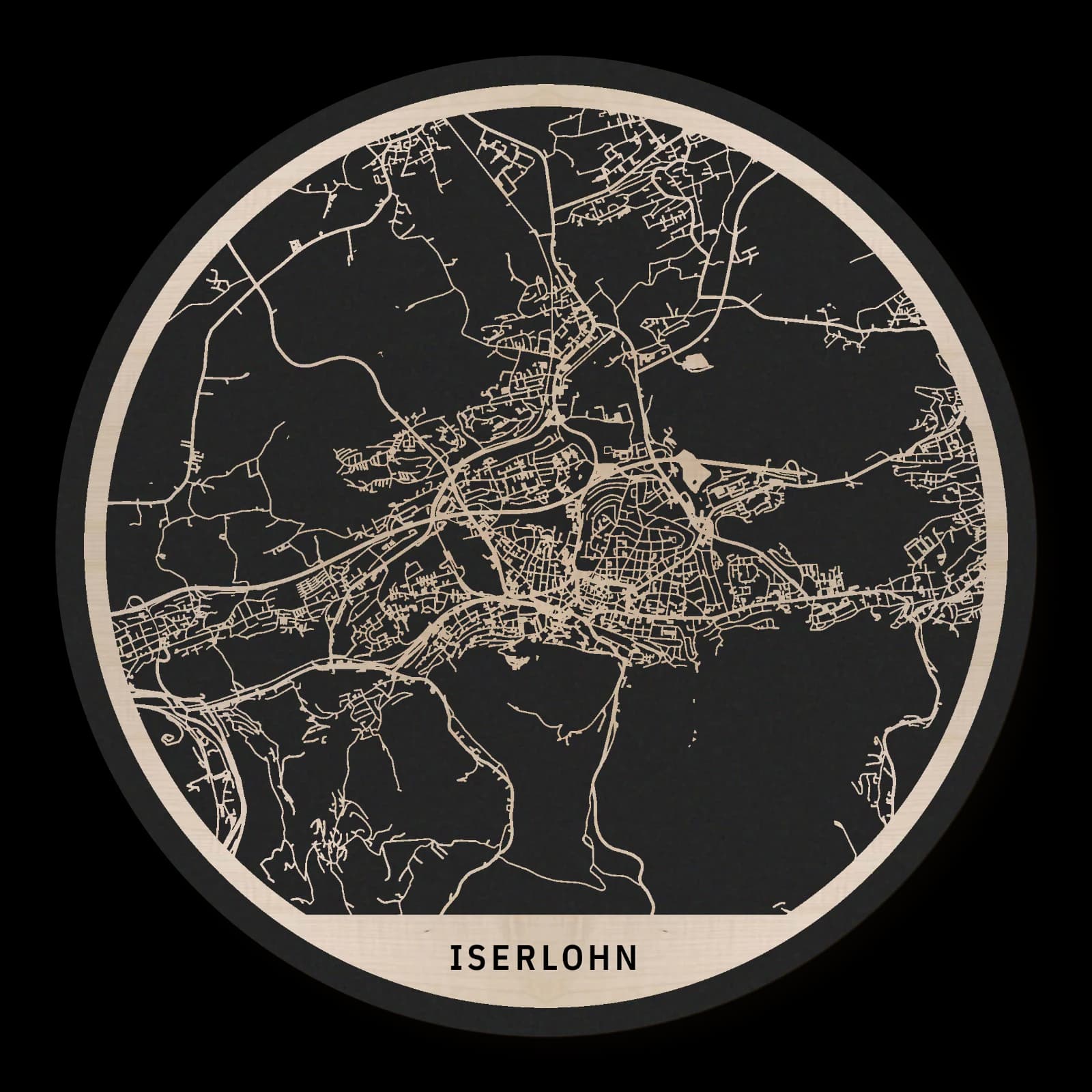
Round wooden city map made from oiled maple – two layers with a black back plate.
About the product
Wooded heights and the Seilersee frame Iserlohn's closely woven streets. The circular view links the Danzturm, town museum and Barendorf, connecting industrial heritage with the surrounding landscape. On this wooden map, compact central blocks give way to more open edges. Northern working and residential districts complete a wider portrait of Iserlohn's connected urban core and its changing relationship with the hills.
What does the map show?
- Seilersee as an open urban setting
- Barendorf north of the centre
- Wooded heights around the Danzturm
- Precisely cut and engraved
- Fine laser details with clear depth
- Carefully inspected and securely packed
- Handmade in Germany
Configuration
Shape: Round · Design: Layered · Material: Maple · Diameter: Ø 23 cm, Ø 35 cm, Ø 50 cm
The configuration shown in the cart and at the time of ordering is authoritative. The preview is not a dimensioned technical drawing.
Availability & production
- Availability
- Made to order
- Production time
- Ships in 3-5 business days
Production starts after successful payment and complete product configuration.
Materials & care
Depending on the variant, lacquered or oiled MDF or oiled real-wood veneer on MDF; optional stainless-steel mounting screws. Acrylic lacquer spray, hard-wax oil and white glue are used in production.
Wood is a natural material. Grain and color may vary slightly from the product images.
Clean with a dry, soft cloth and protect from prolonged moisture and direct heat.
Included & installation
The selected product in the ordered configuration, securely packed and prepared for installation.
- Maximum dimensions 50 × 70 cm and maximum product weight 2 kg.
- Wall-fixing screws and wall plugs are not included. Use fixings suitable for the wall type, substrate and product weight.
- Installation must be carried out by an adult. Keep optional mounting screws and other small parts away from children until installation.
Shipping & returns
Securely packed shipping. Return and cancellation information is available in the legal section.
Shipping costs and delivery options depend on the destination and format. The published cancellation right applies to non-personalised standard goods; it may be excluded for individually made products.
Manufacturer & product identifier
- Manufacturer
- Benjamin Nöst - Lightworks
Rorichmoorer Str. 76
26802 Moormerland, Deutschland
kontakt@lightworks.de - Product identifier
- LW-CAT-B45567F4159E-S, LW-CAT-B45567F4159E-M, LW-CAT-B45567F4159E-L
Together with the order or production batch, the relevant SKU enables traceability. Safety questions and incidents can be reported to the email address shown above.
Product safety
- Decorative product for dry indoor use only; not a toy and not intended for children.
- Protect from moisture, high heat and open flames.
- Do not continue to hang the product after a fall, breakage or visible damage. Keep damaged parts away from children.
Iserlohn: Wooded hills around an industrial town
Iserlohn sits where an urban landscape meets the wooded hills of the Sauerland. Metalworking, the older town centre and recreational spaces occupy different parts of that setting. Looking from the Danzturm towards Barendorf and the Seilersee reveals a broader identity than either the historic centre or the industrial story can provide alone.
Metalworking across the city
The town museum introduces Iserlohn's long association with metalworking. It places industrial history within the older urban centre, while Barendorf extends the subject northwards. Considering these sites together reveals a larger geography of work. Industrial development shaped connections between workplaces, housing and transport, leaving traces that go beyond surviving buildings. The distance between historical sites is part of the story. Following the intervening urban fabric helps explain how separate phases of development became a connected town, and why working and residential areas occupy noticeably different amounts of space.
An open setting at the Seilersee
Northeast of the centre, the Seilersee establishes a distinct recreational landscape. Its water and surrounding open ground interrupt the smaller pattern of built neighbourhoods. This does not make the lake separate from the city. Instead, it gives nearby districts a shared point of reference and a different kind of public space. The transition between residential streets and the lakeside is particularly revealing. It shows how an urban place can depend on open land for its structure, not merely for leisure. Iserlohn's identity repeatedly emerges from these close relationships between development and landscape.
Terrain before landmarks
Iserlohn's position beside the Sauerland helps explain the frequent transition between buildings and woodland. The southern hills differ markedly from the more extensively developed areas to the north. That distinction provides an essential framework for understanding the city. Streets respond to terrain and inherited uses rather than following a uniform grid. Across the urban core, smaller central blocks, larger working areas and landscape edges create different kinds of neighbourhood. Their changing scale makes the wider setting as useful for orientation as any individual landmark, especially when following routes away from the centre.
Reading the surrounding heights
The Danzturm and Bismarckturm occupy different positions beyond the tightest central streets. One directs attention towards the southern woodland, the other towards the northeastern heights. Together with Barendorf and the Seilersee, they offer a useful framework for reading the connected urban core. More distant western districts have their own settings and histories. Within this view, the strongest contrast is between northern working areas and the wooded southern slope. Comparing those edges gives a sense of how economic activity and terrain shaped the town together, while the routes between them explain the variety of spaces encountered across Iserlohn.
Sources
- Stadt Iserlohn: Erleben und entdecken — https://www.iserlohn.de/freizeit-tourismus/erleben-entdecken
- Stadt Iserlohn: Seilersee — https://www.iserlohn.de/freizeit-tourismus/erleben-entdecken/seilersee
- Wikivoyage: Iserlohn — https://de.wikivoyage.org/wiki/Iserlohn

Still deciding?
Configure your motif in the studio and see how your city map will look in your space.



