
Istanbul.Sultanahmet
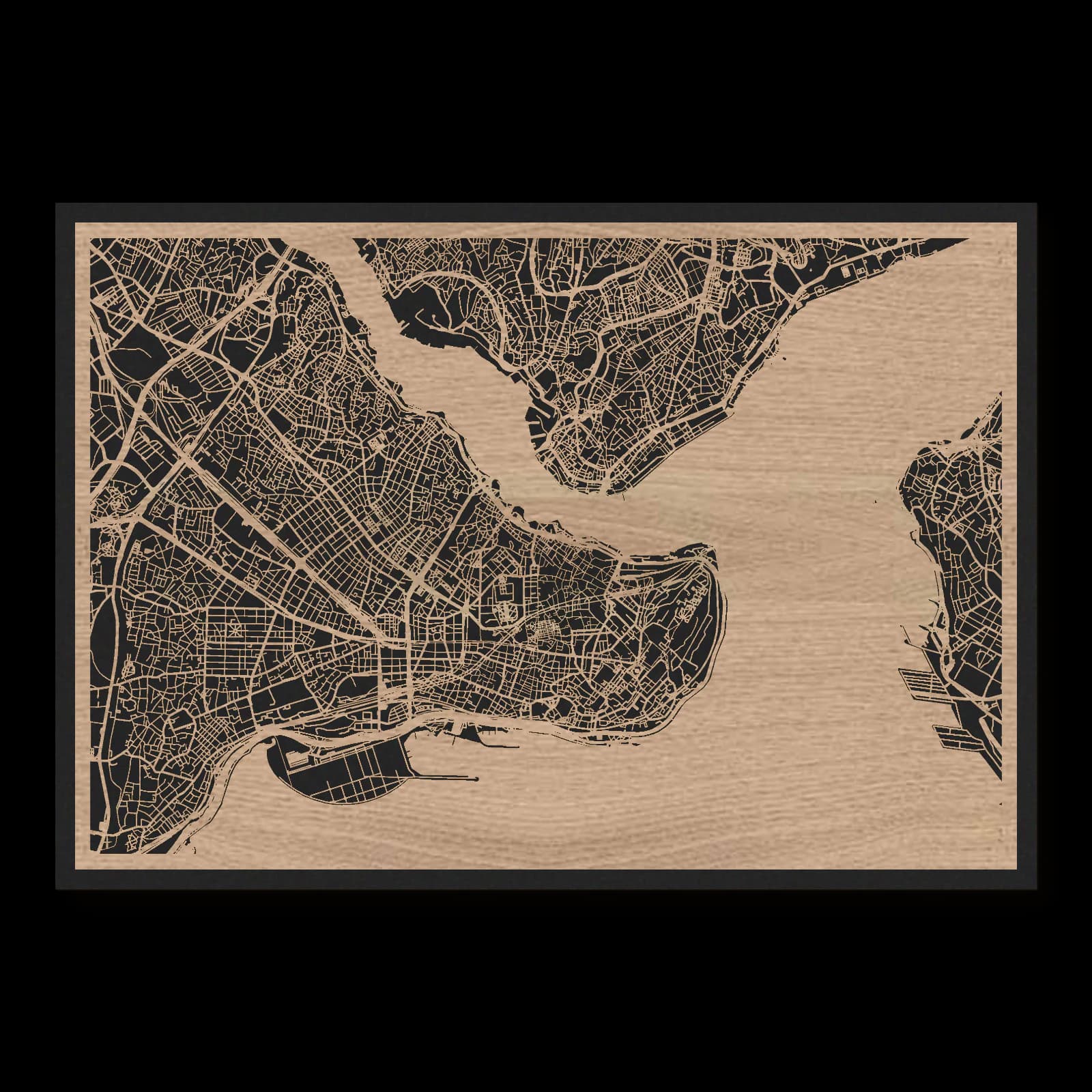
Rectangular city map in oiled oak, with two layers and a black back plate in landscape format.
About the product
A short walk through Sultanahmet can lead from the open space between Hagia Sophia and the Blue Mosque to the long grounds of the former Hippodrome. Topkapı Palace lies to the northeast, adding its courts and approaches to this closely connected part of Istanbul. The map takes these familiar surroundings as its starting point, with a wider crop that follows the streets into the city beyond the district. An oiled oak upper layer sits over a black back plate, giving the street pattern depth through two contrasting layers. The rectangular landscape format leaves the map free of added lettering. It is a piece for remembering the routes between places as much as the landmarks themselves: a turn towards a square, a nearby street, or the way back from a day exploring the old city.
What does the map show?
- The streets linking Hagia Sophia and the Blue Mosque
- The long open space of the former Hippodrome
- Topkapı Palace and its surroundings to the northeast
- A wider view of the streets around Istanbul’s historic core
- Precisely cut and engraved
- Fine laser details with clear depth
- Carefully inspected and securely packed
- Handmade in Germany
Configuration
Shape: Rectangular · Design: Layered · Material: Oak · Sizes: 20 × 30 cm, 35 × 50 cm, 50 × 70 cm
The configuration shown in the cart and at the time of ordering is authoritative. The preview is not a dimensioned technical drawing.
Availability & production
- Availability
- Made to order
- Production time
- Ships in 3-5 business days
Production starts after successful payment and complete product configuration.
Materials & care
Depending on the variant, lacquered or oiled MDF or oiled real-wood veneer on MDF; optional stainless-steel mounting screws. Acrylic lacquer spray, hard-wax oil and white glue are used in production.
Wood is a natural material. Grain and color may vary slightly from the product images.
Clean with a dry, soft cloth and protect from prolonged moisture and direct heat.
Included & installation
The selected product in the ordered configuration, securely packed and prepared for installation.
- Maximum dimensions 50 × 70 cm and maximum product weight 2 kg.
- Wall-fixing screws and wall plugs are not included. Use fixings suitable for the wall type, substrate and product weight.
- Installation must be carried out by an adult. Keep optional mounting screws and other small parts away from children until installation.
Shipping & returns
Securely packed shipping. Return and cancellation information is available in the legal section.
Shipping costs and delivery options depend on the destination and format. The published cancellation right applies to non-personalised standard goods; it may be excluded for individually made products.
Manufacturer & product identifier
- Manufacturer
- Benjamin Nöst - Lightworks
Rorichmoorer Str. 76
26802 Moormerland, Deutschland
kontakt@lightworks.de - Product identifier
- LW-CAT-3F42316464A1-S, LW-CAT-3F42316464A1-M, LW-CAT-3F42316464A1-L
Together with the order or production batch, the relevant SKU enables traceability. Safety questions and incidents can be reported to the email address shown above.
Product safety
- Decorative product for dry indoor use only; not a toy and not intended for children.
- Protect from moisture, high heat and open flames.
- Do not continue to hang the product after a fall, breakage or visible damage. Keep damaged parts away from children.
Sultanahmet above and below the streets
Some of Istanbul’s most significant buildings stand within a small area of Sultanahmet. Their proximity should not obscure their different dates and purposes. Hagia Sophia, the Blue Mosque, the Hippodrome, the Basilica Cistern and Topkapı Palace reveal how religious, political and practical needs shaped the same part of the city.
Two monumental buildings face one another
Hagia Sophia dates from the sixth century and is a major work of Byzantine architecture. Its place in Istanbul’s urban setting remains exceptional. Across the open area stands the Sultan Ahmed Mosque, widely known as the Blue Mosque. Built in the early seventeenth century, it belongs to a different architectural and historical tradition.
Their surroundings make comparison possible without making the two buildings equivalent. Domes, subsidiary structures and approaches can be considered together. The intervening space is essential to this relationship: it provides distance, allows several directions of approach and keeps both monuments present within one public setting.
The long space of the Hippodrome
West of the mosque lies the area of the former Hippodrome. Its elongated form recalls a different kind of public gathering from the religious buildings nearby. Competition, spectators and civic representation once shared this space. Although the ancient structure is not preserved in its complete form, its direction remains significant within the district.
Comparing it with surrounding courts and squares is revealing. Open areas do not all originate from the same purpose. An elongated place for events produces different routes and sightlines from the approach to a mosque. Sultanahmet can therefore be understood through its open spaces as well as through its celebrated buildings.
Water storage and palace courts
The Basilica Cistern introduces a less visible urban function. Built in the sixth century under Justinian, the underground reservoir uses columns to support a space originally intended for water storage. It is a reminder that a monumental city depended on practical infrastructure that did not dominate its public appearance.
Topkapı Palace presents another form of organisation through a sequence of courts and separate buildings. Developed over time as an Ottoman seat of power, it differs from the image of a palace as one compact block. Several areas contribute to a larger institutional complex.
Exploring Sultanahmet brings these purposes into conversation: religious gathering, public spectacle, water supply and political authority. The places are close, but each requires a different way of approaching and understanding it. That change of experience gives the district much of its historical density. Its significance rests not only on the rank of individual monuments, but also on the survival of different kinds of space that a major city needed over many centuries.
Sources
- UNESCO World Heritage Centre: Historic Areas of Istanbul — https://whc.unesco.org/en/list/356/
- Wikipedia: Blue Mosque, Istanbul — https://en.wikipedia.org/wiki/Blue_Mosque,_Istanbul
- Wikipedia: Basilica Cistern — https://en.wikipedia.org/wiki/Basilica_Cistern
- Wikipedia: Topkapı Palace — https://en.wikipedia.org/wiki/Topkapı_Palace
- Wikipedia: Hippodrome of Constantinople — https://en.wikipedia.org/wiki/Hippodrome_of_Constantinople

Still deciding?
Configure your motif in the studio and see how your city map will look in your space.