
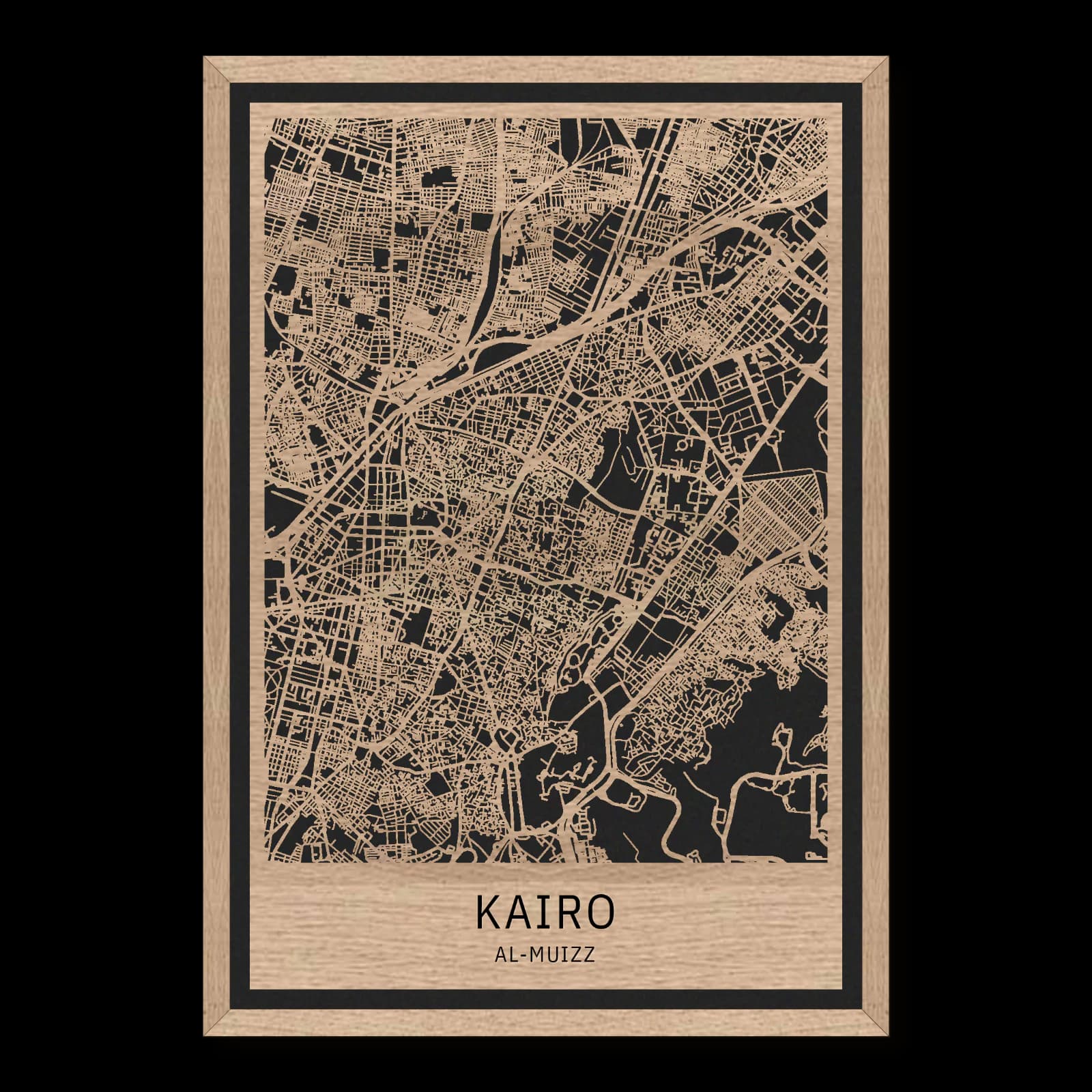
Cairo.Al-Muizz and the city gates
Rectangular wooden city map made from oiled oak – two layers with a black back plate and frame.
About the product
Al-Muizz runs through historic Cairo between Bab al-Futuh and Bab Zuweila. Khan al-Khalili and Al-Azhar Mosque add trading spaces and religious architecture beside the main route. Wood gives warmth to the map's fine network of lanes and larger building complexes. Within a compact area, the old city gates connect with the varied spaces of these long-established neighbourhoods.
What does the map show?
- Bab al-Futuh to the north
- Al-Muizz’s historic street axis
- Khan al-Khalili and Al-Azhar
- Bab Zuweila to the south
- Precisely cut and engraved
- Fine laser details with clear depth
- Carefully inspected and securely packed
- Handmade in Germany
Configuration
Shape: Rectangular · Design: Framed · Material: Oak · Sizes: 20 × 30 cm, 35 × 50 cm, 50 × 70 cm
The configuration shown in the cart and at the time of ordering is authoritative. The preview is not a dimensioned technical drawing.
Availability & production
- Availability
- Made to order
- Production time
- Ships in 3-5 business days
Production starts after successful payment and complete product configuration.
Materials & care
Depending on the variant, lacquered or oiled MDF or oiled real-wood veneer on MDF; optional stainless-steel mounting screws. Acrylic lacquer spray, hard-wax oil and white glue are used in production.
Wood is a natural material. Grain and color may vary slightly from the product images.
Clean with a dry, soft cloth and protect from prolonged moisture and direct heat.
Included & installation
The selected product in the ordered configuration, securely packed and prepared for installation.
- Maximum dimensions 50 × 70 cm and maximum product weight 2 kg.
- Wall-fixing screws and wall plugs are not included. Use fixings suitable for the wall type, substrate and product weight.
- Installation must be carried out by an adult. Keep optional mounting screws and other small parts away from children until installation.
Shipping & returns
Securely packed shipping. Return and cancellation information is available in the legal section.
Shipping costs and delivery options depend on the destination and format. The published cancellation right applies to non-personalised standard goods; it may be excluded for individually made products.
Manufacturer & product identifier
- Manufacturer
- Benjamin Nöst - Lightworks
Rorichmoorer Str. 76
26802 Moormerland, Deutschland
kontakt@lightworks.de - Product identifier
- LW-CAT-8AC539194EDB-S, LW-CAT-8AC539194EDB-M, LW-CAT-8AC539194EDB-L
Together with the order or production batch, the relevant SKU enables traceability. Safety questions and incidents can be reported to the email address shown above.
Product safety
- Decorative product for dry indoor use only; not a toy and not intended for children.
- Protect from moisture, high heat and open flames.
- Do not continue to hang the product after a fall, breakage or visible damage. Keep damaged parts away from children.
Al-Muizz between Cairo’s historic gateways
Al-Muizz connects important parts of historic Cairo along a clear north–south relationship. Gates define the wider sequence, while markets, religious complexes and smaller lanes give it density. The proximity of different periods and functions makes this street setting a particularly revealing introduction to the older city and its development across many centuries.
A lasting line through the older city
Al-Muizz is closely associated with the Fatimid foundation of Cairo in 969. The street passes through a central part of the historic city and is accompanied by buildings from several later periods. Its importance therefore comes from more than one uniform architectural moment. Successive rulers and uses added to and altered the urban setting. The result is a closely layered historical environment. An older street line remained significant while religious, commercial and representative buildings continued to change its surroundings, allowing several periods of the city’s development to occupy the same connected space.
Gateways defining the historical sequence
Bab al-Futuh in the north and Bab Zuweila in the south establish clear points of reference. They belong to the surviving medieval fortifications and recall an earlier city boundary. Within present-day Cairo, they are also monumental buildings surrounded by a metropolis that continued growing beyond them. This change gives their setting particular interest. Structures that once controlled entry through the urban edge now stand within a dense network of streets and neighbourhoods. The gates nevertheless preserve the memory of an earlier outline and help explain the extent of the historic north–south connection.
Trade beside religious institutions
Khan al-Khalili stands beside the main axis and is one of historic Cairo’s best-known commercial areas. Al-Azhar Mosque lies southeast of it, adding an important religious and scholarly place. Their proximity demonstrates the functional variety of the older city. Trade, worship and learning occupied different buildings within the same close neighbourhood rather than existing in separate urban worlds. The change between substantial complexes and narrow lanes gives this part of Cairo its distinctive grain. Monumental architecture remains directly related to the smaller-scale network through which everyday urban connections developed.
History within a continuous street setting
The area between the gates can be read as a sequence of different urban spaces. The principal line provides orientation, while side connections lead into more finely divided surroundings. Individual monuments stand out but remain parts of a larger historic fabric. This relationship is central to the significance of Historic Cairo as a World Heritage property. Buildings gain context through streets, neighbourhoods and recurring uses. Al-Muizz brings these layers together especially closely. Fortification, commerce and religious institutions retain their separate forms while contributing to one continuous historical urban landscape within the modern city.
Sources
- Egyptian Ministry of Tourism and Antiquities: Al-Muizz Street — https://egymonuments.gov.eg/archaeological-sites/al-muizz-street/
- Egyptian Ministry of Tourism and Antiquities: The Walls of Cairo — https://egymonuments.gov.eg/monuments/the-walls-of-cairo/
- Egyptian Ministry of Tourism and Antiquities: Historic Cairo — https://egymonuments.gov.eg/world-heritage/historic-cairo/
- UNESCO: Historic Cairo — https://whc.unesco.org/en/list/89

Still deciding?
Configure your motif in the studio and see how your city map will look in your space.