
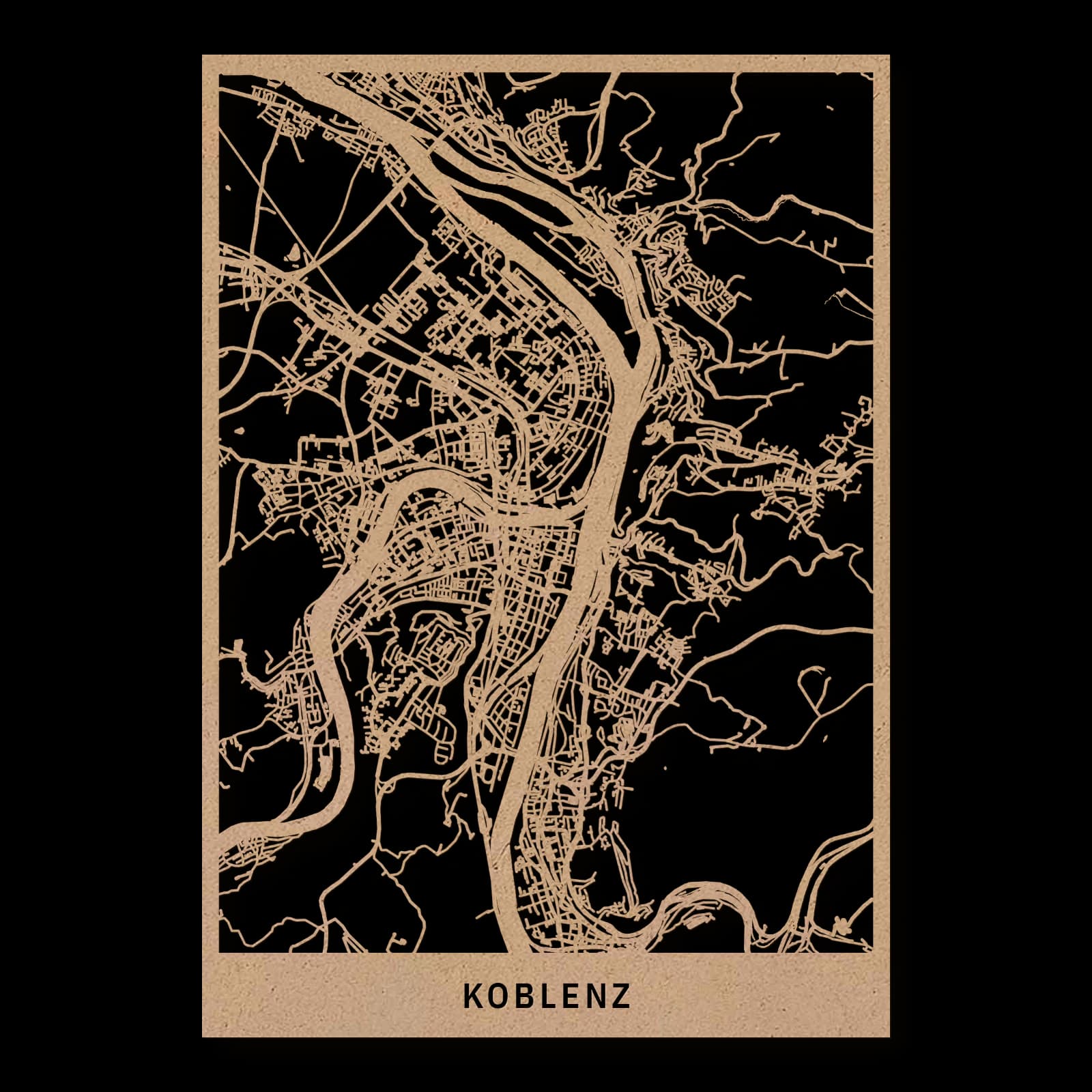
Koblenz.City overview
A single-layer Classic city map of Koblenz in natural oiled MDF, centred on the Rhine and Moselle.
About the product
The meeting of the Rhine and Moselle sets the direction for this Koblenz map. Its crop includes the Deutsches Eck, Electoral Palace and main station, together with Ehrenbreitstein across the Rhine. The connecting streets place the river confluence within a wider city. Cut from natural oiled MDF, the single-layer Classic construction leaves the openings free of a back plate.
What does the map show?
- Deutsches Eck
- Ehrenbreitstein Fortress
- Electoral Palace
- Koblenz main station
- Single wooden layer without a back plate
- Precisely cut and engraved
- Fine laser details with clear depth
- Carefully inspected and securely packed
- Handmade in Germany
Configuration
Shape: Rectangular · Design: Classic · Material: Natural · Sizes: 20 × 30 cm, 35 × 50 cm, 50 × 70 cm
The configuration shown in the cart and at the time of ordering is authoritative. The preview is not a dimensioned technical drawing.
Availability & production
- Availability
- Made to order
- Production time
- Ships in 3-5 business days
Production starts after successful payment and complete product configuration.
Materials & care
Depending on the variant, lacquered or oiled MDF or oiled real-wood veneer on MDF; optional stainless-steel mounting screws. Acrylic lacquer spray, hard-wax oil and white glue are used in production.
Wood is a natural material. Grain and color may vary slightly from the product images.
Clean with a dry, soft cloth and protect from prolonged moisture and direct heat.
Included & installation
The selected product in the ordered configuration, securely packed and prepared for installation.
- Maximum dimensions 50 × 70 cm and maximum product weight 2 kg.
- Wall-fixing screws and wall plugs are not included. Use fixings suitable for the wall type, substrate and product weight.
- Installation must be carried out by an adult. Keep optional mounting screws and other small parts away from children until installation.
Shipping & returns
Securely packed shipping. Return and cancellation information is available in the legal section.
Shipping costs and delivery options depend on the destination and format. The published cancellation right applies to non-personalised standard goods; it may be excluded for individually made products.
Manufacturer & product identifier
- Manufacturer
- Benjamin Nöst - Lightworks
Rorichmoorer Str. 76
26802 Moormerland, Deutschland
kontakt@lightworks.de - Product identifier
- LW-CAT-2248B69E1A87-S, LW-CAT-2248B69E1A87-M, LW-CAT-2248B69E1A87-L
Together with the order or production batch, the relevant SKU enables traceability. Safety questions and incidents can be reported to the email address shown above.
Product safety
- Decorative product for dry indoor use only; not a toy and not intended for children.
- Protect from moisture, high heat and open flames.
- Do not continue to hang the product after a fall, breakage or visible damage. Keep damaged parts away from children.
Koblenz where the Rhine and Moselle meet
The meeting of two rivers gives Koblenz a particularly clear geographical identity. The Deutsches Eck, the Electoral Palace, the main station and Ehrenbreitstein Fortress occupy different parts of that setting. Together they connect the old town with its southern extension and the higher ground across the Rhine.
Understanding the meeting of rivers
The Moselle joins the Rhine at the Deutsches Eck. This projecting point provides a geographical key to Koblenz, bringing two river corridors into one relationship. The adjoining old town occupies land shaped by both waterways. Its position differs from that of a settlement spreading evenly on either side of a single river, and this distinction remains fundamental to the city's form.
The confluence also establishes directions. The Moselle connects with the western part of the landscape, while the Rhine continues along the city. These banks are active boundaries within the urban structure. Streets and bridges respond to their positions, linking areas that water separates. Reading those connections helps explain why central Koblenz has its particular arrangement.
The palace and the southern city
South of the old town, the Electoral Palace occupies a substantial site beside the Rhine. Its broad arrangement introduces a scale different from the smaller streets farther north. The riverside becomes a setting for princely representation. Understanding the palace therefore involves its relationship with both the city behind it and the water beside it, rather than its architecture alone.
The main railway station lies farther southwest, within the southern extension of the city. It introduces another stage of urban development. Railway infrastructure follows its own linear requirements and occupies ground differently from either a palace or an old street network. The station's position broadens the portrait beyond the historic centre and shows how Koblenz developed southwards.
The intervening streets give these places their shared urban setting. A station, palace and river confluence might otherwise appear as isolated destinations. Their neighbourhoods and connecting routes explain how they function as parts of one city. This middle ground is essential to understanding the reach and continuity of central Koblenz.
A fortress across the water
Ehrenbreitstein Fortress stands on elevated ground east of the Rhine. Its position introduces a pronounced vertical element into the predominantly horizontal geography of the rivers. The military importance of the site becomes understandable through that relationship: the fortress overlooks a significant stretch of water and faces the area around the confluence and western city.
Including Ehrenbreitstein makes the relationship between the two banks explicit. The fortress is physically separated from the old town, yet strongly connected to it by position. This is a different kind of relationship from the close neighbours within the centre. Together, the two scales define Koblenz: compact urban connections on one hand, and a wider dialogue between city, river and fortified height on the other.
Sources
- Deutsche Zentrale für Tourismus – Koblenz — https://www.germany.travel/en/cities-culture/koblenz.html
- Wikipedia – Deutsches Eck — https://en.wikipedia.org/wiki/Deutsches_Eck
- Wikipedia – Festung Ehrenbreitstein — https://de.wikipedia.org/wiki/Festung_Ehrenbreitstein
- Wikipedia – Kurfürstliches Schloss (Koblenz) — https://de.wikipedia.org/wiki/Kurf%C3%BCrstliches_Schloss_%28Koblenz%29
- Wikipedia – Koblenz Hauptbahnhof — https://de.wikipedia.org/wiki/Koblenz_Hauptbahnhof

Still deciding?
Configure your motif in the studio and see how your city map will look in your space.