

Cologne.Rheinauhafen
Rectangular wooden city map of Rheinauhafen made from oiled walnut – two layers with a black back plate and frame.
About the product
Cologne’s Rheinauhafen follows the Rhine in a long waterfront strip. The Chocolate Museum, Kranhäuser and Bayenturm anchor the map area, connected by streets and a promenade running beside the river. The design follows those relationships through the surrounding neighbourhood. Oiled walnut forms the cut map layer, set above a black backing in a rectangular frame. The two-layer construction gives the harbour’s street pattern depth while the frame contains its strong riverside direction.
What does the map show?
- Rheinauhafen and its waterfront connections
- Chocolate Museum and Kranhäuser within the map
- Bayenturm as a southern reference point
- Precisely cut and engraved
- Fine laser details with clear depth
- Carefully inspected and securely packed
- Handmade in Germany
Configuration
Shape: Rectangular · Design: Framed · Material: Walnut · Sizes: 20 × 30 cm, 35 × 50 cm, 50 × 70 cm
The configuration shown in the cart and at the time of ordering is authoritative. The preview is not a dimensioned technical drawing.
Availability & production
- Availability
- Made to order
- Production time
- Ships in 3-5 business days
Production starts after successful payment and complete product configuration.
Materials & care
Depending on the variant, lacquered or oiled MDF or oiled real-wood veneer on MDF; optional stainless-steel mounting screws. Acrylic lacquer spray, hard-wax oil and white glue are used in production.
Wood is a natural material. Grain and color may vary slightly from the product images.
Clean with a dry, soft cloth and protect from prolonged moisture and direct heat.
Included & installation
The selected product in the ordered configuration, securely packed and prepared for installation.
- Maximum dimensions 50 × 70 cm and maximum product weight 2 kg.
- Wall-fixing screws and wall plugs are not included. Use fixings suitable for the wall type, substrate and product weight.
- Installation must be carried out by an adult. Keep optional mounting screws and other small parts away from children until installation.
Shipping & returns
Securely packed shipping. Return and cancellation information is available in the legal section.
Shipping costs and delivery options depend on the destination and format. The published cancellation right applies to non-personalised standard goods; it may be excluded for individually made products.
Manufacturer & product identifier
- Manufacturer
- Benjamin Nöst - Lightworks
Rorichmoorer Str. 76
26802 Moormerland, Deutschland
kontakt@lightworks.de - Product identifier
- LW-CAT-62D15100540D-S, LW-CAT-62D15100540D-M, LW-CAT-62D15100540D-L
Together with the order or production batch, the relevant SKU enables traceability. Safety questions and incidents can be reported to the email address shown above.
Product safety
- Decorative product for dry indoor use only; not a toy and not intended for children.
- Protect from moisture, high heat and open flames.
- Do not continue to hang the product after a fall, breakage or visible damage. Keep damaged parts away from children.
Rheinauhafen and the changing uses of Cologne’s waterfront
Rheinauhafen is easy to follow along its north-south axis, but the buildings beside it belong to different histories. The Chocolate Museum, Kranhäuser and Bayenturm reveal cultural reuse, port activity and medieval defence. Their shared river setting makes those differences particularly clear without requiring a long journey across Cologne.
A place organised by its length
Rheinauhafen lies south of Cologne’s historic centre. Its elongated form developed through harbour use, which required water access, storage and onward movement rather than the arrangement of an ordinary residential district. That direction along the Rhine remains apparent despite the transformation of the area.
For someone walking through it, the waterfront offers unusually clear orientation. Water accompanies the route while buildings and smaller connections lie beside it. The experience is not entirely uniform, however. Changing building volumes, entrances and openings create a sequence of distinct situations. Paying attention to these differences reveals more than treating the harbour simply as a backdrop for familiar architectural photographs.
Buildings that recall the cranes
The three Kranhäuser are among Cologne’s most recognisable contemporary structures. Their projecting upper sections evoke the cranes once associated with port work. This establishes a connection with the place’s earlier function without imitating a historic warehouse. The new buildings remain legible as a separate architectural layer.
Their relationship with ground level is particularly striking. A structure extending sideways creates a different impression from a conventional vertical tower. The buildings do more than rise above the waterfront: they reach into the view. As a visitor moves along the river, the apparent distance and relationship between their individual parts changes.
Culture beside an older boundary
The Chocolate Museum provides a cultural focus at the northern end. Its location ties it to the water and to the approach from the inner city. It represents an activity that brings visitors into the district, while the surrounding harbour arrangement remains visible. New use has entered an older geographical framework.
Bayenturm belongs to a much earlier period. The medieval defensive tower formed part of Cologne’s fortifications and marked a southern corner beside the Rhine. Its surviving form recalls a time when the waterfront also served as a controlled boundary.
These perspectives complement one another. The tower speaks of protecting the city, the harbour layout of handling goods, and the newer buildings of later urban ambitions. Along a relatively short riverside route, they can be compared through their different scales and relationships with the ground. This depth of history makes Rheinauhafen more than a district of contemporary architecture: it is a place where several uses of the same river edge remain visible together.
Sources
- Wikipedia: Rheinauhafen — https://en.wikipedia.org/wiki/Rheinauhafen
- Cologne Tourist Board: Crane Houses — https://www.cologne-tourism.com/arts-culture/sights/detail/crane-houses
- Wikipedia: Bayenturm — https://de.wikipedia.org/wiki/Bayenturm
- Wikipedia: Imhoff-Schokoladenmuseum — https://en.wikipedia.org/wiki/Imhoff-Schokoladenmuseum
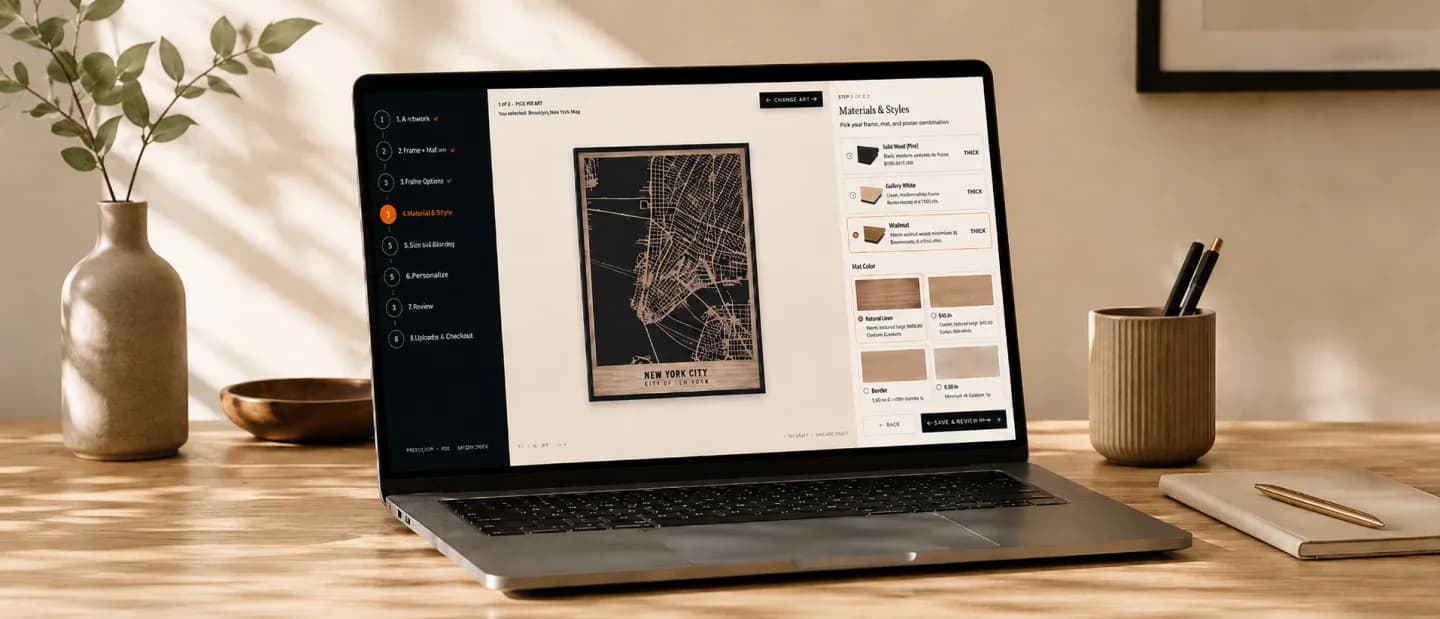
Still deciding?
Configure your motif in the studio and see how your city map will look in your space.