
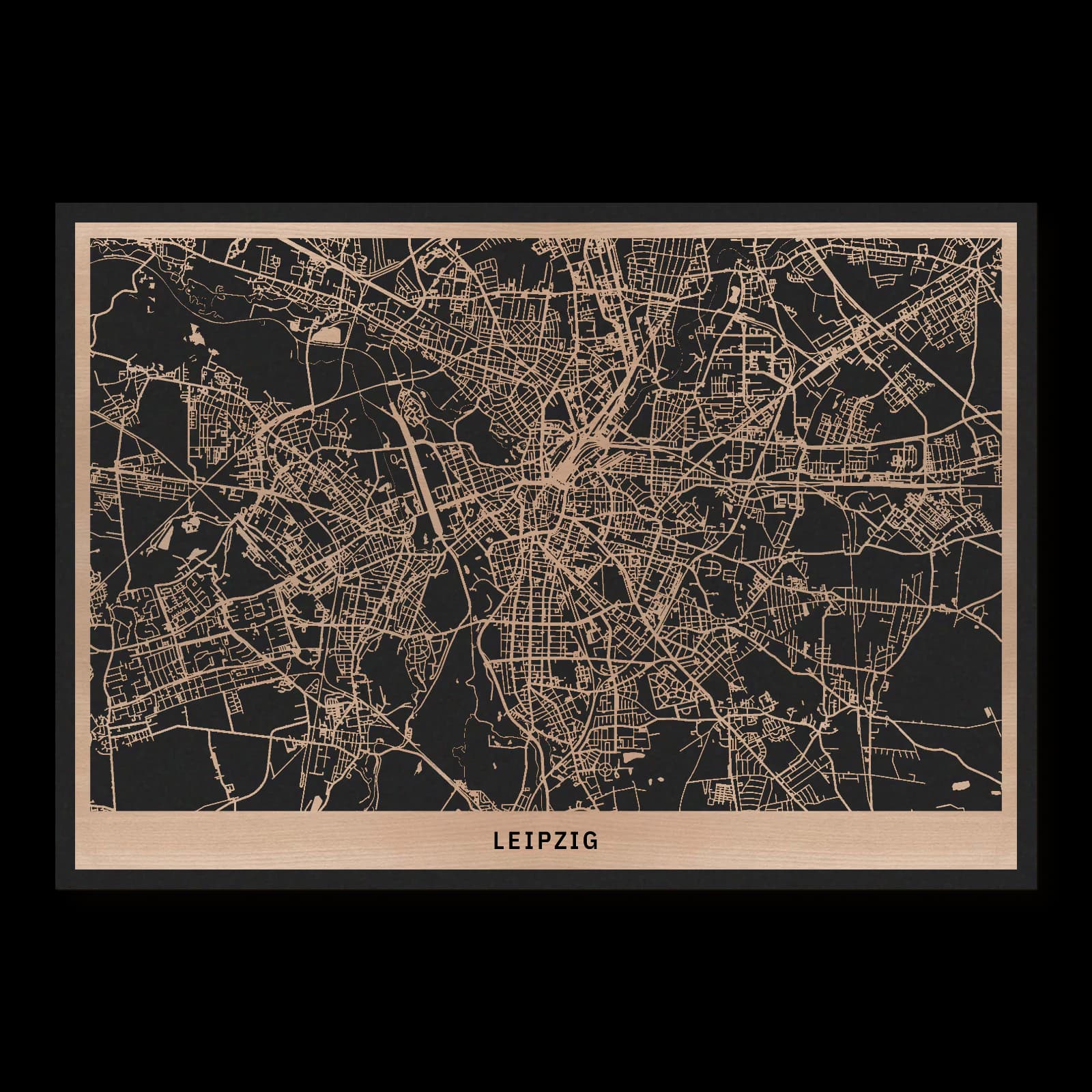
Leipzig.
Layered wooden city map in oiled beech, landscape format.
About the product
See Leipzig through the routes that connect its centre with the districts beyond. The main station, western cotton mill, stadium and southeastern Monument to the Battle of the Nations establish a broad set of reference points. Between them, neighbourhood streets meet green spaces and large institutional grounds. Beech gives the wide urban plan a quiet natural surface. With the cut streets raised above a backing panel, this layered map makes room for the distances between the cotton mill, station and monument.
What does the map show?
- Leipzig Hauptbahnhof
- Völkerschlachtdenkmal
- Stadion Leipzig
- Panometer Leipzig
- Precisely cut and engraved
- Fine laser details with clear depth
- Carefully inspected and securely packed
- Handmade in Germany
Configuration
Shape: Rectangular · Design: Layered · Material: Beech · Sizes: 20 × 30 cm, 35 × 50 cm, 50 × 70 cm
The configuration shown in the cart and at the time of ordering is authoritative. The preview is not a dimensioned technical drawing.
Availability & production
- Availability
- Made to order
- Production time
- Ships in 3-5 business days
Production starts after successful payment and complete product configuration.
Materials & care
Depending on the variant, lacquered or oiled MDF or oiled real-wood veneer on MDF; optional stainless-steel mounting screws. Acrylic lacquer spray, hard-wax oil and white glue are used in production.
Wood is a natural material. Grain and color may vary slightly from the product images.
Clean with a dry, soft cloth and protect from prolonged moisture and direct heat.
Included & installation
The selected product in the ordered configuration, securely packed and prepared for installation.
- Maximum dimensions 50 × 70 cm and maximum product weight 2 kg.
- Wall-fixing screws and wall plugs are not included. Use fixings suitable for the wall type, substrate and product weight.
- Installation must be carried out by an adult. Keep optional mounting screws and other small parts away from children until installation.
Shipping & returns
Securely packed shipping. Return and cancellation information is available in the legal section.
Shipping costs and delivery options depend on the destination and format. The published cancellation right applies to non-personalised standard goods; it may be excluded for individually made products.
Manufacturer & product identifier
- Manufacturer
- Benjamin Nöst - Lightworks
Rorichmoorer Str. 76
26802 Moormerland, Deutschland
kontakt@lightworks.de - Product identifier
- LW-CAT-7FE361867F0A-S, LW-CAT-7FE361867F0A-M, LW-CAT-7FE361867F0A-L
Together with the order or production batch, the relevant SKU enables traceability. Safety questions and incidents can be reported to the email address shown above.
Product safety
- Decorative product for dry indoor use only; not a toy and not intended for children.
- Protect from moisture, high heat and open flames.
- Do not continue to hang the product after a fall, breakage or visible damage. Keep damaged parts away from children.
Leipzig: arrivals, industrial spaces and public memory
Leipzig's compact centre belongs to a much broader urban pattern. The main station, former factories, stadium and Monument to the Battle of the Nations represent different stages of expansion. Reading their positions together explains why the western districts and the southeastern city have such different structures and historical associations.
A station at the edge of the centre
Leipzig Hauptbahnhof stands beside the northeastern section of the inner ring. Its broad frontage contrasts with the smaller streets of the historic centre. Completed in 1915, the station brought formerly separate railway arrangements into a shared terminal. Its position remains useful for orientation: passengers arrive close to the older city, while extensive railway land introduces a very different urban scale behind the building.
From this point, Leipzig opens in several directions. Routes west lead towards sporting grounds and former industrial areas; routes southeast approach a major commemorative landscape. This is not simply a compact centre surrounded by uniform residential rings. Different activities have established distinct concentrations of buildings and open space.
Industrial architecture put to new use
The cotton mill in Lindenau began operating in 1884. Production buildings, courtyards and associated facilities preserve the scale of industrial textile manufacture. After production ended, artists, galleries and other users took over parts of the site. Its meaning changed without erasing the substantial physical framework inherited from the factory.
South of the centre, the Panometer provides another example of reuse. A former gas holder became a setting for large panoramic images. The circular industrial shell remains essential to the experience of the exhibition. Comparing it with the cotton mill reveals two different approaches to keeping obsolete production architecture active within a changing city. The stadium to the northwest adds yet another extensive area organised around collective activity.
The geography of remembrance
The Monument to the Battle of the Nations was inaugurated in 1913, a century after the battle it commemorates. Its southeastern position relates to the former battlefield. Unlike a monument inserted into an existing central square, it occupies a deliberately spacious setting. Open ground and the approach to the structure contribute to its effect.
These reference points reveal several Leipzig histories together: movement and commerce, industrial labour, cultural reinvention and public memory. Their differences deserve attention. A gallery does not remove the earlier life of a factory, just as a familiar landmark still requires historical interpretation.
The distances between the main station, western factories and the Monument to the Battle of the Nations belong to Leipzig's history. Industry required different sites from central commerce; a major memorial made another claim on urban space. A journey from the station towards Plagwitz consequently encounters a different city from one heading southeast towards the monument. Alongside the familiar trading centre lies a more expansive arrangement in which production, transport and public remembrance established separate and still recognisable locations.
Sources
- Leipzig Tourismus: Völkerschlachtdenkmal — https://www.leipzig.travel/poi/voelkerschlachtdenkmal
- Wikipedia: Leipzig Hauptbahnhof — https://en.wikipedia.org/wiki/Leipzig_Hauptbahnhof
- Wikipedia: Baumwollspinnerei — https://en.wikipedia.org/wiki/Leipzig_Cotton_Mill
- Wikipedia: Panometer Leipzig — https://en.wikipedia.org/wiki/Leipzig_Panometer
- Wikipedia: Stadion Leipzig — https://en.wikipedia.org/wiki/Red_Bull_Arena_(Leipzig)

Still deciding?
Configure your motif in the studio and see how your city map will look in your space.



