
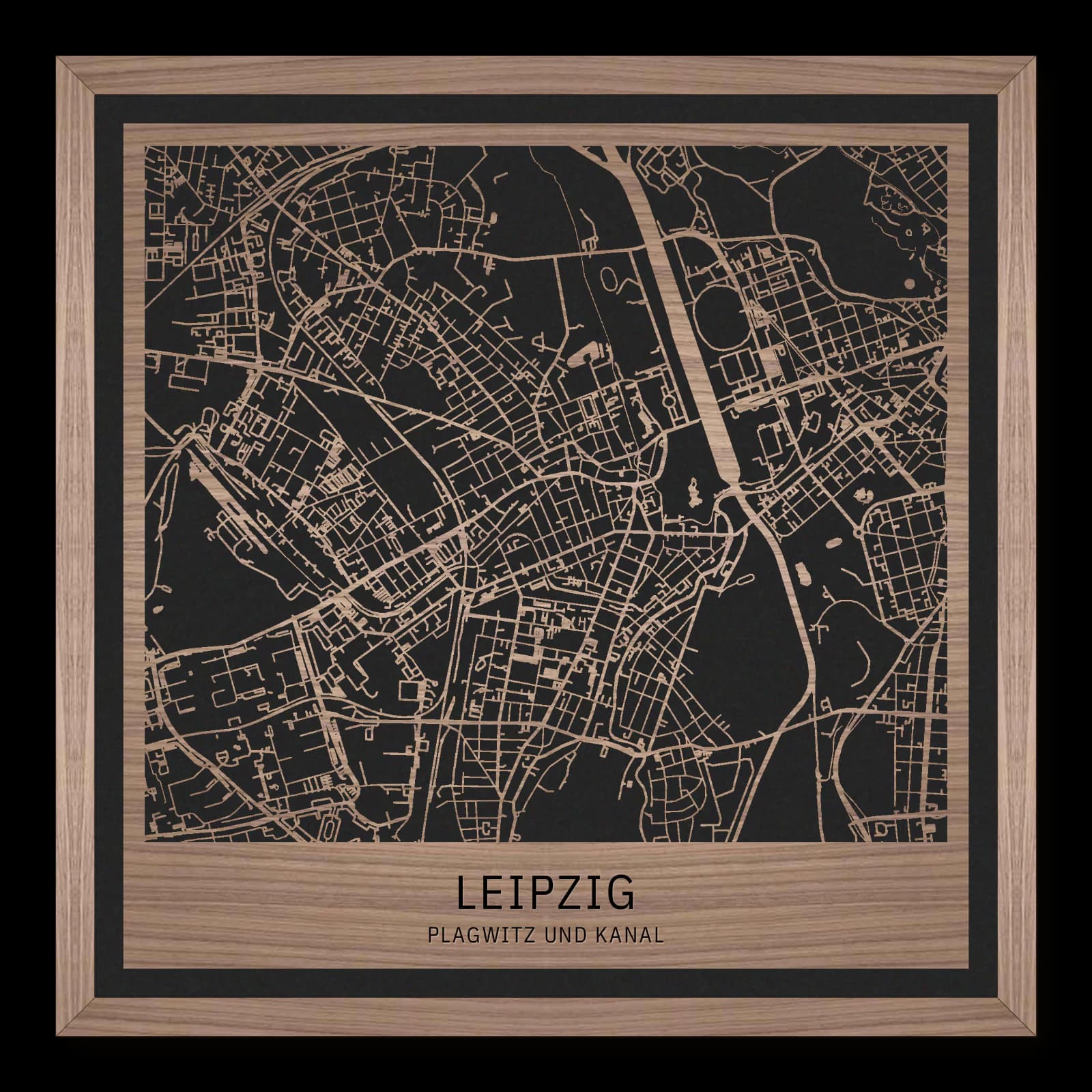
Leipzig.Plagwitz and Canal
Framed wooden city map in oiled walnut, square format.
About the product
Western Leipzig comes into focus through factory courtyards, neighbourhood streets and the winding Karl Heine Canal. The cotton mill, Konsumzentrale and Felsenkeller each contribute a different part of the district's character. Large former working sites remain visible even as galleries and cultural activities give them new roles. A square frame keeps the focus on Plagwitz and its routes towards the canal. Oiled walnut surrounds the cut street layer, and the backing panel adds depth to a district shaped by former works and everyday streets.
What does the map show?
- Baumwollspinnerei
- Konsumzentrale
- Felsenkeller
- Precisely cut and engraved
- Fine laser details with clear depth
- Carefully inspected and securely packed
- Handmade in Germany
Configuration
Shape: Square · Design: Framed · Material: Walnut · Sizes: 23 × 23 cm, 35 × 35 cm, 50 × 50 cm
The configuration shown in the cart and at the time of ordering is authoritative. The preview is not a dimensioned technical drawing.
Availability & production
- Availability
- Made to order
- Production time
- Ships in 3-5 business days
Production starts after successful payment and complete product configuration.
Materials & care
Depending on the variant, lacquered or oiled MDF or oiled real-wood veneer on MDF; optional stainless-steel mounting screws. Acrylic lacquer spray, hard-wax oil and white glue are used in production.
Wood is a natural material. Grain and color may vary slightly from the product images.
Clean with a dry, soft cloth and protect from prolonged moisture and direct heat.
Included & installation
The selected product in the ordered configuration, securely packed and prepared for installation.
- Maximum dimensions 50 × 70 cm and maximum product weight 2 kg.
- Wall-fixing screws and wall plugs are not included. Use fixings suitable for the wall type, substrate and product weight.
- Installation must be carried out by an adult. Keep optional mounting screws and other small parts away from children until installation.
Shipping & returns
Securely packed shipping. Return and cancellation information is available in the legal section.
Shipping costs and delivery options depend on the destination and format. The published cancellation right applies to non-personalised standard goods; it may be excluded for individually made products.
Manufacturer & product identifier
- Manufacturer
- Benjamin Nöst - Lightworks
Rorichmoorer Str. 76
26802 Moormerland, Deutschland
kontakt@lightworks.de - Product identifier
- LW-CAT-9392A3F8A525-S, LW-CAT-9392A3F8A525-M, LW-CAT-9392A3F8A525-L
Together with the order or production batch, the relevant SKU enables traceability. Safety questions and incidents can be reported to the email address shown above.
Product safety
- Decorative product for dry indoor use only; not a toy and not intended for children.
- Protect from moisture, high heat and open flames.
- Do not continue to hang the product after a fall, breakage or visible damage. Keep damaged parts away from children.
Leipzig's western districts: work, water and cultural reuse
Factories, residential streets and an artificial waterway meet in western Leipzig. Between the cotton mill, Konsumzentrale and Felsenkeller, the former geography of work remains visible beneath newer uses. Understanding these different sites helps explain a neighbourhood whose cultural identity is inseparable from the industrial spaces it inherited and continues to adapt.
An artificial waterway through the west
The Karl Heine Canal links the White Elster with Lindenau Harbour. Its course passes through a part of Leipzig strongly shaped by industrial development. Repeated bridges make the meeting of streets and water particularly legible. The section considered here represents this relationship rather than showing the entire canal from one end to the other.
Large plots and deep building complexes remain prominent beside the water. Even where their occupants have changed, these sites differ from neighbouring residential blocks. The canal connects several kinds of urban space, making today's recreational landscape part of an older geography of work. Its surroundings become more interesting when both histories are kept in view.
The cotton mill's changing role
Founded in 1884, the cotton mill developed into an extensive industrial establishment. Following the end of yarn production in 1993, artists and galleries were among the new users of its buildings. Large rooms and courtyards offered possibilities that ordinary shop premises could not. The inherited architecture helped make cultural reuse possible.
The earlier purpose of the site still deserves attention. Its buildings were arranged around machinery, materials and the labour of many people. Contemporary art adds another chapter rather than explaining away that history. Looking at entrances, courtyards and elongated buildings can reveal how the site once organised movement and production.
More than a collection of factories
The Konsumzentrale introduces the history of cooperative distribution. Although it belongs to the district's economic architecture, its purpose differed from that of the cotton mill. Manufacturing and supplying goods were separate activities, each requiring substantial premises. Recognising this distinction avoids treating every older commercial building as an interchangeable industrial relic.
Felsenkeller contributes another kind of shared space through its role as an entertainment and events venue. Ordinary homes and streets lie between these prominent addresses. The district is consequently a working neighbourhood with several overlapping uses, rather than a self-contained cultural campus.
The cotton mill and Felsenkeller both contribute to cultural life today, but they inherited very different settings. An extensive production site with courtyards offers possibilities unlike those of a building designed for social gatherings. The Konsumzentrale adds the organisation of cooperative trade to that comparison. Passing through this landscape, the canal keeps the industrial origins of the district in view. Plagwitz and Lindenau are therefore more specific than a generic former factory quarter: different kinds of work left different spaces for later use.
Sources
- Leipzig Tourismus: Karl-Heine-Kanal — https://www.leipzig.travel/poi/karl-heine-kanal
- Wikipedia: Baumwollspinnerei — https://en.wikipedia.org/wiki/Leipzig_Cotton_Mill
- Wikipedia: Konsumzentrale — https://de.wikipedia.org/wiki/Konsumzentrale
- Wikipedia: Felsenkeller — https://de.wikipedia.org/wiki/Felsenkeller_(Leipzig)

Still deciding?
Configure your motif in the studio and see how your city map will look in your space.



