
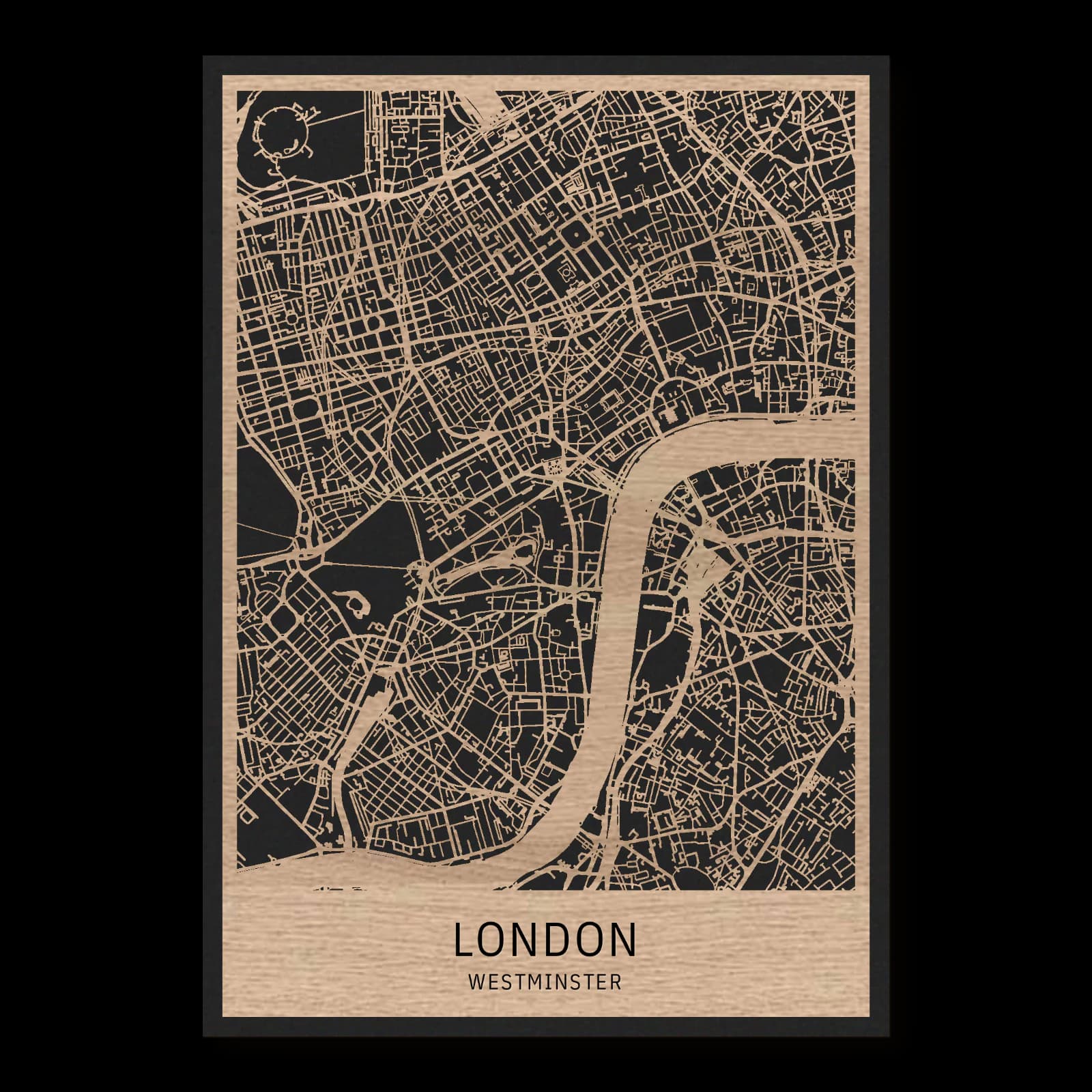
London.Westminster
Layered wooden city map in oiled oak, portrait format.
About the product
Westminster gathers familiar London places within a connected district. Parliament and Westminster Abbey stand near the Thames, while St James's Park and Trafalgar Square extend the view westward and northward. The composition recalls movement between substantial institutional buildings, open squares and green paths. The portrait view holds Parliament, abbey, park and Trafalgar Square within one street network. Oiled oak forms the cut upper layer, raised above a backing panel to give routes from the Thames towards the western green spaces depth.
What does the map show?
- Palace of Westminster
- Westminster Abbey
- St James's Park
- Trafalgar Square
- Precisely cut and engraved
- Fine laser details with clear depth
- Carefully inspected and securely packed
- Handmade in Germany
Configuration
Shape: Rectangular · Design: Layered · Material: Oak · Sizes: 20 × 30 cm, 35 × 50 cm, 50 × 70 cm
The configuration shown in the cart and at the time of ordering is authoritative. The preview is not a dimensioned technical drawing.
Availability & production
- Availability
- Made to order
- Production time
- Ships in 3-5 business days
Production starts after successful payment and complete product configuration.
Materials & care
Depending on the variant, lacquered or oiled MDF or oiled real-wood veneer on MDF; optional stainless-steel mounting screws. Acrylic lacquer spray, hard-wax oil and white glue are used in production.
Wood is a natural material. Grain and color may vary slightly from the product images.
Clean with a dry, soft cloth and protect from prolonged moisture and direct heat.
Included & installation
The selected product in the ordered configuration, securely packed and prepared for installation.
- Maximum dimensions 50 × 70 cm and maximum product weight 2 kg.
- Wall-fixing screws and wall plugs are not included. Use fixings suitable for the wall type, substrate and product weight.
- Installation must be carried out by an adult. Keep optional mounting screws and other small parts away from children until installation.
Shipping & returns
Securely packed shipping. Return and cancellation information is available in the legal section.
Shipping costs and delivery options depend on the destination and format. The published cancellation right applies to non-personalised standard goods; it may be excluded for individually made products.
Manufacturer & product identifier
- Manufacturer
- Benjamin Nöst - Lightworks
Rorichmoorer Str. 76
26802 Moormerland, Deutschland
kontakt@lightworks.de - Product identifier
- LW-CAT-B2D69745C60A-S, LW-CAT-B2D69745C60A-M, LW-CAT-B2D69745C60A-L
Together with the order or production batch, the relevant SKU enables traceability. Safety questions and incidents can be reported to the email address shown above.
Product safety
- Decorative product for dry indoor use only; not a toy and not intended for children.
- Protect from moisture, high heat and open flames.
- Do not continue to hang the product after a fall, breakage or visible damage. Keep damaged parts away from children.
Westminster: parliament, abbey and public space
Westminster places political institutions beside a long religious history. Between Parliament, the abbey, St James's Park and Trafalgar Square, enclosed complexes alternate with open public spaces. Their proximity reveals how ceremonial routes, everyday movement and national remembrance occupy a relatively compact part of London without serving exactly the same purposes.
Neighbours with different histories
The Palace of Westminster and Westminster Abbey stand close together but belong to different institutions. Parliament is associated with the palace, while the abbey combines religious life, coronations and national remembrance. Their shared World Heritage designation recognises a historical relationship without removing those distinctions. Their proximity gives Westminster an unusual concentration of public significance.
Much of the present parliamentary building followed the fire of 1834. Charles Barry and Augustus Welby Pugin shaped its Gothic Revival reconstruction. Its medieval-looking forms therefore largely belong to a nineteenth-century project. The extended Thames frontage and prominent towers connect political representation with a highly legible riverside position.
The abbey has a much earlier architectural history. Its role in coronations and its monuments combine religious purpose with remembrance of monarchs and other figures. Comparing the two complexes shows why historical importance cannot always be read directly from the apparent age of a façade.
A change of scale in the park
St James's Park introduces a different environment to the west. Paths and water open the urban setting and interrupt the sequence of major buildings. The park belongs to a designed landscape within the political and ceremonial centre. Its contrast with busy streets and substantial institutions is essential to its effect.
Moving between park and parliamentary surroundings also reveals different kinds of public access. Open grounds permit movement unlike that of a church approach or a government building's frontage. These distinctions help explain Westminster as an actual district, not merely a collection of national symbols.
A public square to the north
Trafalgar Square provides a substantial northern reference. Its name and Nelson's Column connect it with naval history and commemoration of the Battle of Trafalgar. At the same time, it belongs to contemporary movement and public gathering. Historical meaning and present use occupy the same place.
The route linking the square with Parliament passes through an unusually dense institutional landscape. Yet crossings, distances and the opening of individual spaces remain central to the experience. A closer walk can attend to these transitions: from river to street, from the abbey's surroundings towards the park, and onwards to a broad square. This sequence makes Westminster spatially understandable. It also demonstrates how political history remains embedded in the everyday workings of a living metropolis rather than existing only within its most celebrated buildings.
Sources
- UNESCO World Heritage Centre: Palace of Westminster and Westminster Abbey including Saint Margaret’s Church — https://whc.unesco.org/en/list/426/
- Wikipedia: Palace of Westminster — https://en.wikipedia.org/wiki/Palace_of_Westminster
- Wikipedia: Westminster Abbey — https://en.wikipedia.org/wiki/Westminster_Abbey
- Wikipedia: St James's Park — https://en.wikipedia.org/wiki/St_James%27s_Park
- Wikipedia: Trafalgar Square — https://en.wikipedia.org/wiki/Trafalgar_Square

Still deciding?
Configure your motif in the studio and see how your city map will look in your space.



