
London.
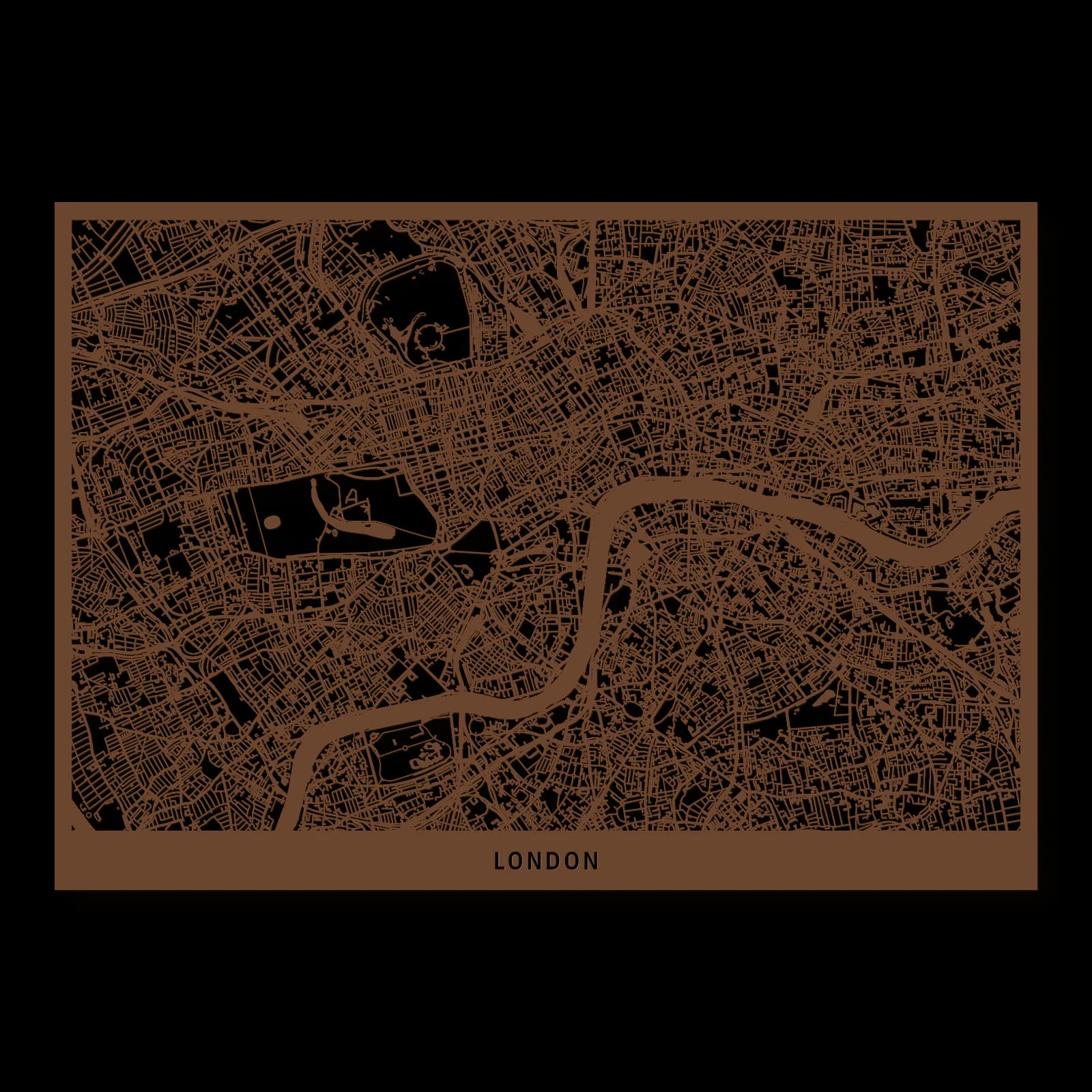
Classic wooden city map in brown lacquered MDF, landscape format.
About the product
This London view stretches from Kensington to Tower Bridge and from Regent's Park to Battersea. The Thames passes through districts with markedly different identities. Parks, museums and former industrial buildings meet close street networks and familiar crossings. Brown lacquered MDF forms this Classic map as one cut layer. Its landscape format gives the Thames and contrasting districts room, while the streets stand on their own without an additional backing panel.
What does the map show?
- Kensington Palace
- Tower Bridge
- British Museum
- Battersea Power Station
- Precisely cut and engraved
- Fine laser details with clear depth
- Carefully inspected and securely packed
- Handmade in Germany
Configuration
Shape: Rectangular · Design: Classic · Material: Brown · Sizes: 20 × 30 cm, 35 × 50 cm, 50 × 70 cm
The configuration shown in the cart and at the time of ordering is authoritative. The preview is not a dimensioned technical drawing.
Availability & production
- Availability
- Made to order
- Production time
- Ships in 3-5 business days
Production starts after successful payment and complete product configuration.
Materials & care
Depending on the variant, lacquered or oiled MDF or oiled real-wood veneer on MDF; optional stainless-steel mounting screws. Acrylic lacquer spray, hard-wax oil and white glue are used in production.
Wood is a natural material. Grain and color may vary slightly from the product images.
Clean with a dry, soft cloth and protect from prolonged moisture and direct heat.
Included & installation
The selected product in the ordered configuration, securely packed and prepared for installation.
- Maximum dimensions 50 × 70 cm and maximum product weight 2 kg.
- Wall-fixing screws and wall plugs are not included. Use fixings suitable for the wall type, substrate and product weight.
- Installation must be carried out by an adult. Keep optional mounting screws and other small parts away from children until installation.
Shipping & returns
Securely packed shipping. Return and cancellation information is available in the legal section.
Shipping costs and delivery options depend on the destination and format. The published cancellation right applies to non-personalised standard goods; it may be excluded for individually made products.
Manufacturer & product identifier
- Manufacturer
- Benjamin Nöst - Lightworks
Rorichmoorer Str. 76
26802 Moormerland, Deutschland
kontakt@lightworks.de - Product identifier
- LW-CAT-8D79005F7BC6-S, LW-CAT-8D79005F7BC6-M, LW-CAT-8D79005F7BC6-L
Together with the order or production batch, the relevant SKU enables traceability. Safety questions and incidents can be reported to the email address shown above.
Product safety
- Decorative product for dry indoor use only; not a toy and not intended for children.
- Protect from moisture, high heat and open flames.
- Do not continue to hang the product after a fall, breakage or visible damage. Keep damaged parts away from children.
London: parks, Thames bends and several centres
Inner London contains neighbourhoods whose main reference points are widely separated. Kensington, Regent's Park, the British Museum, Tower Bridge and Battersea represent different parts of that arrangement. The Thames connects them through its bends and crossings, while parks and large institutions establish spaces that repeatedly change the rhythm of ordinary streets.
More than one centre
Understanding London requires relating several districts and centres to one another. Kensington Palace in the west represents a history of royal residence and display. Farther east, museum areas, business districts and river crossings create different concentrations of activity. No single point supplies an arrangement that explains all of inner London.
The Thames helps with orientation, although its bends do not always simplify journeys. Neighbourhoods may face each other across the water while remaining differently connected by land. Bridges become important points of choice. The river gives London a shared landscape while also dividing particular movement networks.
Parks and public collections
Regent's Park establishes a large open area in the north among densely built districts. Its designed grounds are distinct from land simply left undeveloped. Paths and surrounding roads create another spatial order, noticeably changing the experience of a walk. Kensington also connects representative architecture with substantial garden landscapes.
The British Museum in Bloomsbury introduces a different public institution. Founded in 1753 and opened in 1759, it links London with many regions through its collections and the histories of their formation. Within the city, the museum occupies a substantial connected complex, contrasting with neighbouring streets and rows of smaller buildings.
A bridge and a former power station
Tower Bridge opened in 1894. Its movable sections responded to the need for road traffic and shipping to use the same location. The structure is therefore a technical solution to urban requirements as well as a familiar visual emblem. Its eastern position helps explain another part of the river's role within London.
Battersea Power Station south of the Thames recalls the energy infrastructure of the modern metropolis. The former generating complex later acquired new uses. Its large industrial forms differ sharply from those of a palace or museum, even though all have become recognisable London addresses. Comparing them shows how varied the origins of urban landmarks can be.
Tower Bridge concentrates a Thames crossing at an unmistakable location. Regent's Park instead creates separation within the built city, while the British Museum accommodates an extensive collection in an inner neighbourhood. Battersea adds the changed role of a former power station. London cannot therefore be explained through the course of the river alone. Bridge, park, museum and reused industrial building interrupt or direct urban routes in distinct ways, giving different neighbourhoods their own reference points within the larger metropolitan landscape.
Sources
- Tower Bridge: History — https://www.towerbridge.org.uk/discover/history
- Wikipedia: Kensington Palace — https://en.wikipedia.org/wiki/Kensington_Palace
- Wikipedia: British Museum — https://en.wikipedia.org/wiki/British_Museum
- Wikipedia: Battersea Power Station — https://en.wikipedia.org/wiki/Battersea_Power_Station
- Wikipedia: Regent's Park — https://en.wikipedia.org/wiki/Regent%27s_Park

Still deciding?
Configure your motif in the studio and see how your city map will look in your space.