
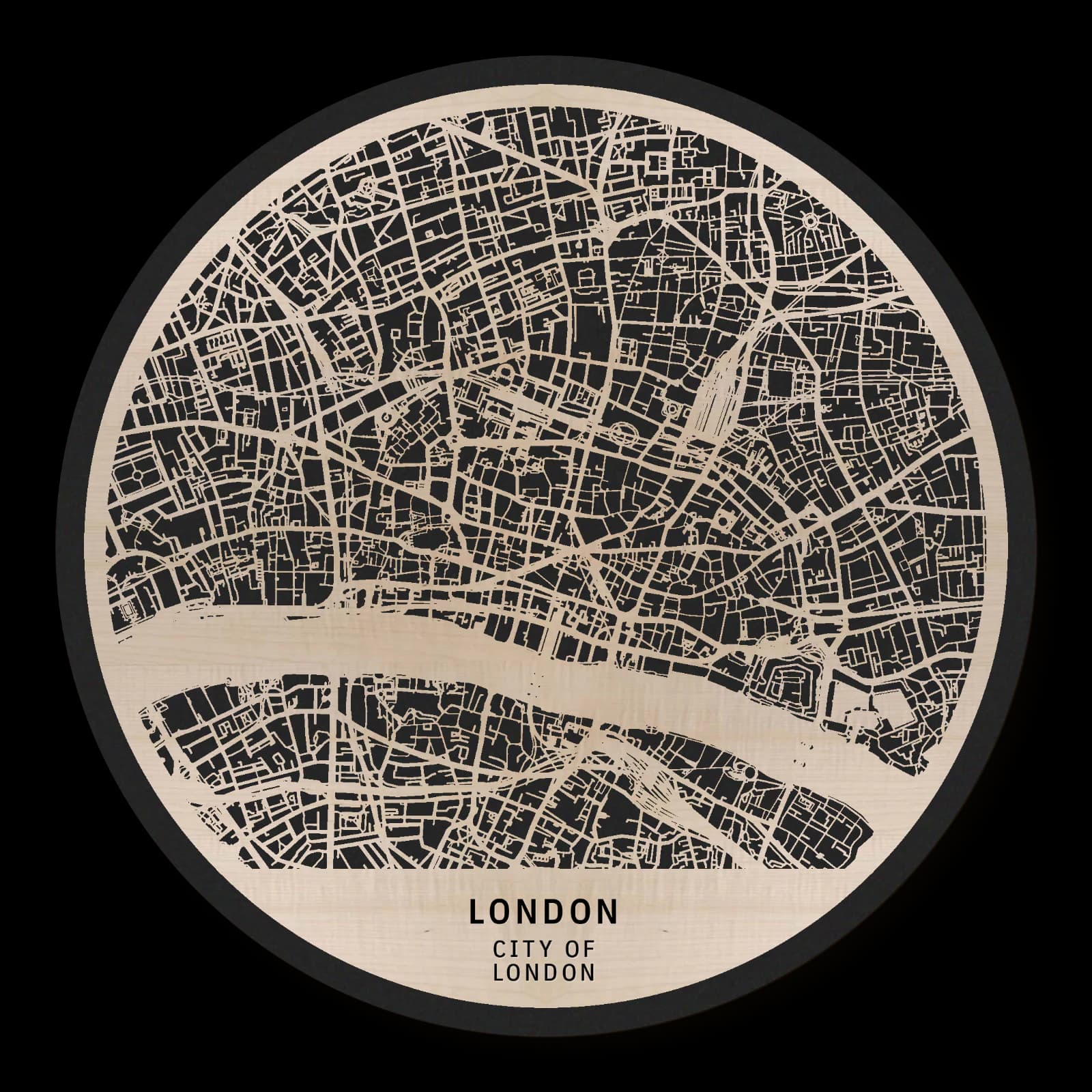
London.The City
Layered wooden city map in oiled maple, round format.
About the product
The City of London takes shape between St Paul's Cathedral, Guildhall, Leadenhall Market and the Monument. Short routes connect major religious and civic buildings with trading spaces and a memorial to the Great Fire. This view recalls London through turning streets, sudden openings and landmarks glimpsed between neighbouring buildings. The circular outline concentrates the City’s short routes. Oiled maple forms a cut street layer above its backing panel, preserving the close network between market, civic buildings and cathedral.
What does the map show?
- St Paul's Cathedral
- Guildhall
- Leadenhall Market
- The Monument
- Precisely cut and engraved
- Fine laser details with clear depth
- Carefully inspected and securely packed
- Handmade in Germany
Configuration
Shape: Round · Design: Layered · Material: Maple · Diameter: Ø 23 cm, Ø 35 cm, Ø 50 cm
The configuration shown in the cart and at the time of ordering is authoritative. The preview is not a dimensioned technical drawing.
Availability & production
- Availability
- Made to order
- Production time
- Ships in 3-5 business days
Production starts after successful payment and complete product configuration.
Materials & care
Depending on the variant, lacquered or oiled MDF or oiled real-wood veneer on MDF; optional stainless-steel mounting screws. Acrylic lacquer spray, hard-wax oil and white glue are used in production.
Wood is a natural material. Grain and color may vary slightly from the product images.
Clean with a dry, soft cloth and protect from prolonged moisture and direct heat.
Included & installation
The selected product in the ordered configuration, securely packed and prepared for installation.
- Maximum dimensions 50 × 70 cm and maximum product weight 2 kg.
- Wall-fixing screws and wall plugs are not included. Use fixings suitable for the wall type, substrate and product weight.
- Installation must be carried out by an adult. Keep optional mounting screws and other small parts away from children until installation.
Shipping & returns
Securely packed shipping. Return and cancellation information is available in the legal section.
Shipping costs and delivery options depend on the destination and format. The published cancellation right applies to non-personalised standard goods; it may be excluded for individually made products.
Manufacturer & product identifier
- Manufacturer
- Benjamin Nöst - Lightworks
Rorichmoorer Str. 76
26802 Moormerland, Deutschland
kontakt@lightworks.de - Product identifier
- LW-CAT-4FC6D9FDAA0F-S, LW-CAT-4FC6D9FDAA0F-M, LW-CAT-4FC6D9FDAA0F-L
Together with the order or production batch, the relevant SKU enables traceability. Safety questions and incidents can be reported to the email address shown above.
Product safety
- Decorative product for dry indoor use only; not a toy and not intended for children.
- Protect from moisture, high heat and open flames.
- Do not continue to hang the product after a fall, breakage or visible damage. Keep damaged parts away from children.
The City of London: rebuilding, commerce and civic authority
St Paul's Cathedral, Guildhall, Leadenhall Market and the Monument stand within a compact part of the City. Fire, civic government and trade each left distinct places here. Their relationships reveal a dense street network in which historic structures remain useful points of orientation among later buildings and continuing commercial activity.
Rebuilding after the Great Fire
The Great Fire of 1666 destroyed much of the City of London. The Monument commemorates the event near its starting point in Pudding Lane. The column attaches memory to a particular location rather than treating the fire as an abstract historical turning point. It stands within a district that remains densely built and actively used.
St Paul's Cathedral also belongs to the history of reconstruction. Christopher Wren's cathedral replaced the earlier building destroyed in the fire. Its dome establishes a substantial point of orientation above the closer street network. The relationship between cathedral and Monument therefore extends beyond their shared fame. They represent different responses to the same urban disaster: remembrance at one location and the rebuilding of a major institution at another.
Guildhall and the City's civic history
Guildhall expresses the history of municipal government. Its great historic hall belongs to a complex altered and expanded over time. Unlike Westminster, this setting represents the civic institutions of the City itself. Proximity to the cathedral means the coexistence of different forms of authority rather than a shared institutional purpose.
Around Guildhall, larger open approaches alternate with narrower streets. These changes demonstrate how an important building can establish a presence within dense development. A long, straight avenue is not the only way to create significance; an unexpected opening can be equally effective.
A market within the street network
Leadenhall Market introduces commerce. Although the market has older origins, its familiar covered architecture largely dates from the late nineteenth century and was designed by Horace Jones. Its passages provide movement routes inside a building ensemble. This setting differs from both an open square and an ordinary street.
Religious architecture, civic government, trade and commemoration consequently occupy a small area without belonging to one historical period. Later buildings and current activities remain part of the same environment. The City is better understood as a functioning district with accumulated histories than as a closed collection of old monuments.
Beneath Leadenhall Market's roof, the route itself becomes an interior. In front of the Guildhall, a civic institution gains a recognisable foreground; St Paul's makes its presence felt beyond its immediate site. The Monument gives remembrance a narrow, upward-reaching form. These different kinds of public presence stand close together in the City. Their importance lies less in a uniform historical appearance than in the way trade, municipal government and memory retain separate spatial expressions among the surrounding streets and later buildings.
Sources
- The Monument: History — https://www.themonument.org.uk/history
- Wikipedia: St Paul's Cathedral — https://en.wikipedia.org/wiki/St_Paul%27s_Cathedral
- Wikipedia: Guildhall — https://en.wikipedia.org/wiki/Guildhall,_London
- Wikipedia: Leadenhall Market — https://en.wikipedia.org/wiki/Leadenhall_Market

Still deciding?
Configure your motif in the studio and see how your city map will look in your space.