
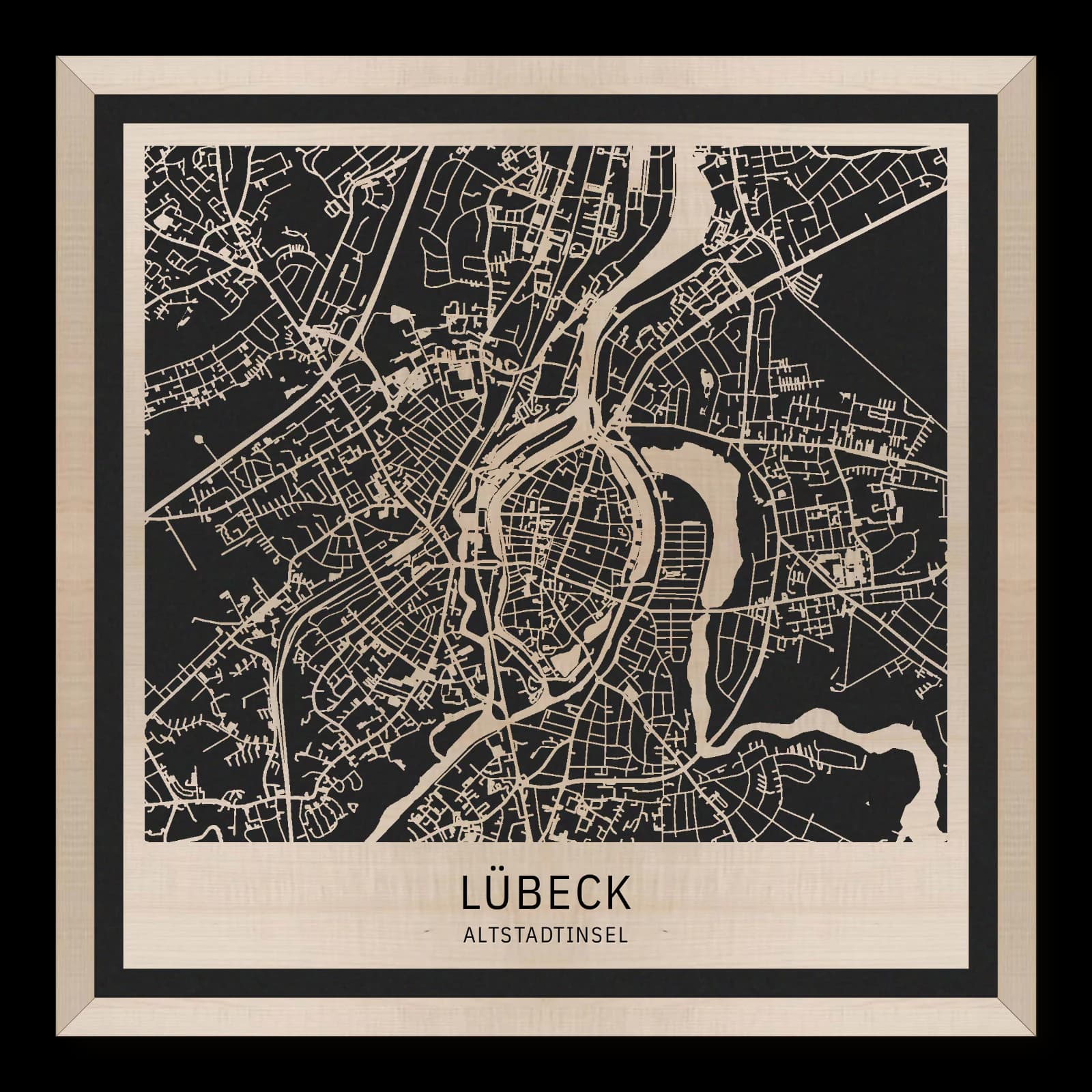
Lübeck.Old Town Island
Framed wooden city map in oiled maple, square format.
About the product
Lübeck's old town island takes shape between Holstentor, St Mary's Church, the cathedral and Burgtor. Streets connect these landmarks while repeatedly meeting water, squares and substantial church buildings. Walking memories return through the Hanseatic street pattern: enclosed rows of houses, sudden openings and gateways that still identify the main approaches to the island. Four major landmarks sit within this square view. An oiled maple frame and backing panel give the cut lanes a quiet sense of space, retaining the connections across the island rather than reducing it to an outline.
What does the map show?
- Holstentor
- Lübecker Dom
- Marienkirche Lübeck
- Burgtor
- Precisely cut and engraved
- Fine laser details with clear depth
- Carefully inspected and securely packed
- Handmade in Germany
Configuration
Shape: Square · Design: Framed · Material: Maple · Sizes: 23 × 23 cm, 35 × 35 cm, 50 × 50 cm
The configuration shown in the cart and at the time of ordering is authoritative. The preview is not a dimensioned technical drawing.
Availability & production
- Availability
- Made to order
- Production time
- Ships in 3-5 business days
Production starts after successful payment and complete product configuration.
Materials & care
Depending on the variant, lacquered or oiled MDF or oiled real-wood veneer on MDF; optional stainless-steel mounting screws. Acrylic lacquer spray, hard-wax oil and white glue are used in production.
Wood is a natural material. Grain and color may vary slightly from the product images.
Clean with a dry, soft cloth and protect from prolonged moisture and direct heat.
Included & installation
The selected product in the ordered configuration, securely packed and prepared for installation.
- Maximum dimensions 50 × 70 cm and maximum product weight 2 kg.
- Wall-fixing screws and wall plugs are not included. Use fixings suitable for the wall type, substrate and product weight.
- Installation must be carried out by an adult. Keep optional mounting screws and other small parts away from children until installation.
Shipping & returns
Securely packed shipping. Return and cancellation information is available in the legal section.
Shipping costs and delivery options depend on the destination and format. The published cancellation right applies to non-personalised standard goods; it may be excluded for individually made products.
Manufacturer & product identifier
- Manufacturer
- Benjamin Nöst - Lightworks
Rorichmoorer Str. 76
26802 Moormerland, Deutschland
kontakt@lightworks.de - Product identifier
- LW-CAT-BBB4F77F2D93-S, LW-CAT-BBB4F77F2D93-M, LW-CAT-BBB4F77F2D93-L
Together with the order or production batch, the relevant SKU enables traceability. Safety questions and incidents can be reported to the email address shown above.
Product safety
- Decorative product for dry indoor use only; not a toy and not intended for children.
- Protect from moisture, high heat and open flames.
- Do not continue to hang the product after a fall, breakage or visible damage. Keep damaged parts away from children.
Lübeck's old town island: trade, churches and gateways
Gateways, churches and trading streets form a closely connected pattern on Lübeck's old town island. Holstentor, St Mary's, the cathedral and Burgtor represent different historical functions. The routes between them reveal how arrival, commerce, religious life and civic authority helped organise the Hanseatic city and still make its centre easy to recognise.
Gateways to a trading centre
Holstentor and Burgtor stand at different entrances to Lübeck's old town. The western Holstentor is among the city's most recognisable brick buildings, while Burgtor marks the northern approach. Both recall the importance of controlled access in a medieval city. People and goods followed particular routes whose relationships remain visible in the present street pattern.
The island setting reinforces this arrangement. Water defines the historic centre without cutting off its connections. Bridges and gateways show how protection and exchange belonged together: a trading city required boundaries, but depended on regular movement across them.
Two churches with different roles
St Mary's stands near the town hall and market area. As the great church associated with Lübeck's citizens and council, it expressed the confidence of the merchant community. Its Brick Gothic architecture influenced many churches around the Baltic. Routes through smaller streets lead towards a building whose scale exceeds that of its immediate surroundings.
The cathedral in the south has a different institutional origin. Henry the Lion founded it in 1173 as a bishop's church. Its role and position therefore differ from those of St Mary's, even though both now contribute to the familiar skyline. Comparing them reveals several centres of authority within the old town rather than one city organised around a single church.
What lies between the monuments
Lübeck's World Heritage recognition concerns an urban ensemble. Merchants' houses, warehouses, churches and public buildings belong to that relationship, together with the inherited street structure. A walk becomes more revealing when the spaces between landmarks receive attention. Routes from the waterfront towards higher ground help explain how different activities were connected.
Twentieth-century destruction and reconstruction changed the historic fabric. Today's city is not a completely preserved medieval snapshot. Important relationships between streets, plots and major buildings nevertheless remain legible. This continuity is central to the experience of the island.
Entering through the Holstentor and approaching through the Burgtor lead onto the same island but into different sequences of streets. Between them, St Mary's and the cathedral stand as separate religious reference points. The island has no simple centre towards which every connection runs. Trading routes, church sites and residential streets overlap within tight boundaries. Lübeck's distinctive silhouette grows from that distribution: several substantial buildings give orientation to a much finer urban fabric connected in more than one direction.
Sources
- UNESCO World Heritage Centre: Hanseatic City of Lübeck — https://whc.unesco.org/en/list/272/
- Wikipedia: Holstentor — https://en.wikipedia.org/wiki/Holstentor
- Wikipedia: Burgtor — https://en.wikipedia.org/wiki/Burgtor
- Wikipedia: Lübecker Dom — https://en.wikipedia.org/wiki/Lübeck_Cathedral
- Wikipedia: Marienkirche Lübeck — https://en.wikipedia.org/wiki/St._Mary%27s_Church,_Lübeck

Still deciding?
Configure your motif in the studio and see how your city map will look in your space.