
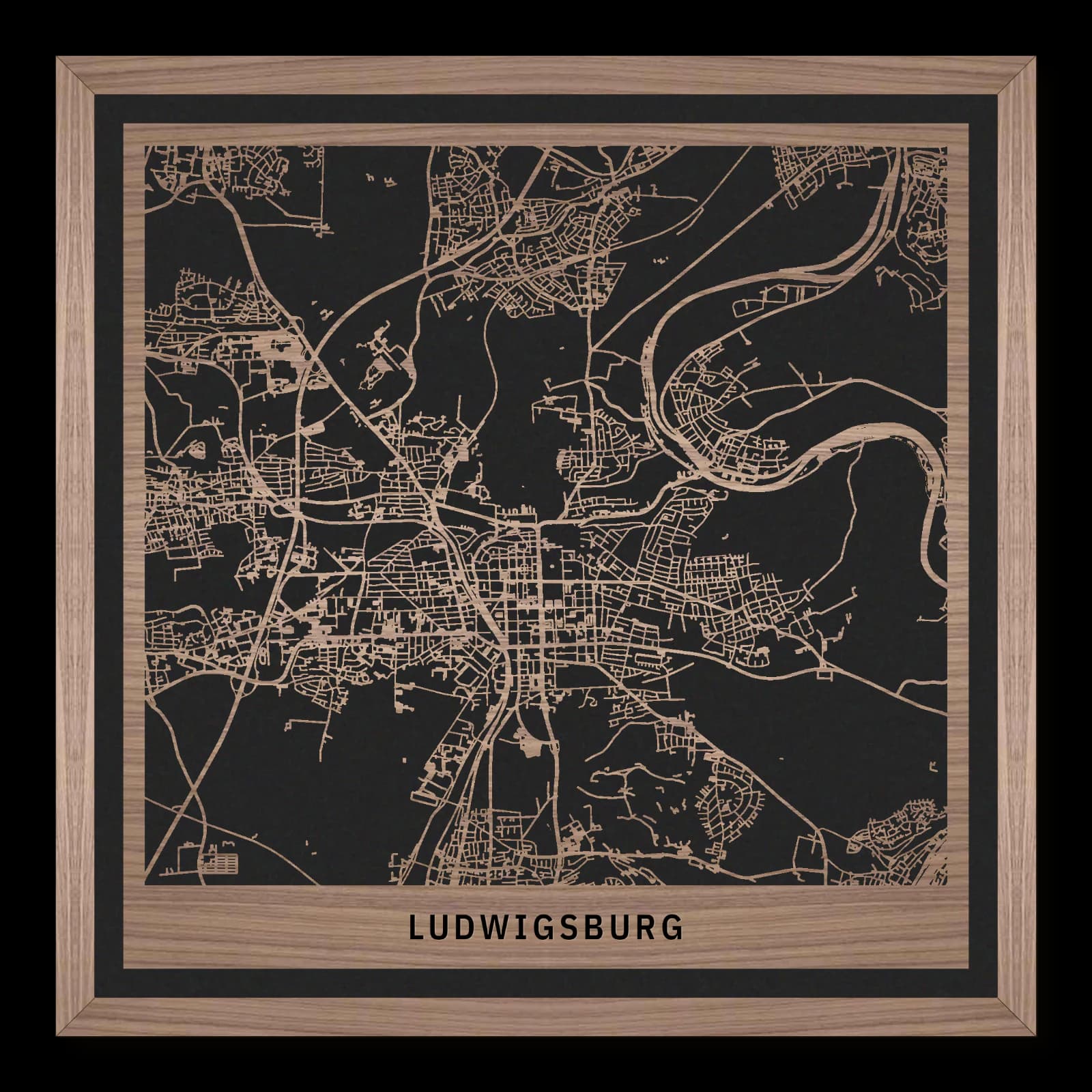
Ludwigsburg.City Overview
Square wooden city map made from oiled walnut – two layers with a black back plate and frame.
About the product
Straight streets and expansive gardens give Ludwigsburg its recognisable structure. The Residential Palace, market square and Monrepos connect compact building blocks with open landscape. Their relationship comes through clearly in this wooden city map, which also includes later urban growth. The railway station and northern education sites complete a view of a planned royal residence that developed into a varied modern city.
What does the map show?
- Regular streets around the market
- Expansive palace gardens
- Northern landscape setting at Monrepos
- Precisely cut and engraved
- Fine laser details with clear depth
- Carefully inspected and securely packed
- Handmade in Germany
Configuration
Shape: Square · Design: Framed · Material: Walnut · Sizes: 23 × 23 cm, 35 × 35 cm, 50 × 50 cm
The configuration shown in the cart and at the time of ordering is authoritative. The preview is not a dimensioned technical drawing.
Availability & production
- Availability
- Made to order
- Production time
- Ships in 3-5 business days
Production starts after successful payment and complete product configuration.
Materials & care
Depending on the variant, lacquered or oiled MDF or oiled real-wood veneer on MDF; optional stainless-steel mounting screws. Acrylic lacquer spray, hard-wax oil and white glue are used in production.
Wood is a natural material. Grain and color may vary slightly from the product images.
Clean with a dry, soft cloth and protect from prolonged moisture and direct heat.
Included & installation
The selected product in the ordered configuration, securely packed and prepared for installation.
- Maximum dimensions 50 × 70 cm and maximum product weight 2 kg.
- Wall-fixing screws and wall plugs are not included. Use fixings suitable for the wall type, substrate and product weight.
- Installation must be carried out by an adult. Keep optional mounting screws and other small parts away from children until installation.
Shipping & returns
Securely packed shipping. Return and cancellation information is available in the legal section.
Shipping costs and delivery options depend on the destination and format. The published cancellation right applies to non-personalised standard goods; it may be excluded for individually made products.
Manufacturer & product identifier
- Manufacturer
- Benjamin Nöst - Lightworks
Rorichmoorer Str. 76
26802 Moormerland, Deutschland
kontakt@lightworks.de - Product identifier
- LW-CAT-BEAC56A4B97D-S, LW-CAT-BEAC56A4B97D-M, LW-CAT-BEAC56A4B97D-L
Together with the order or production batch, the relevant SKU enables traceability. Safety questions and incidents can be reported to the email address shown above.
Product safety
- Decorative product for dry indoor use only; not a toy and not intended for children.
- Protect from moisture, high heat and open flames.
- Do not continue to hang the product after a fall, breakage or visible damage. Keep damaged parts away from children.
Ludwigsburg: Baroque streets opening into gardens
Founded as a Baroque residence, Ludwigsburg retains a strong sense of deliberate urban order. Palaces, streets and squares belong to that original idea, while military history and later institutions added further layers. Looking across the gardens and surrounding neighbourhoods reveals how the planned town continued to grow without losing its underlying structure.
Planning on a city scale
Ludwigsburg's origins as a royal residence remain unusually clear in its layout. Palace and town developed together in the early eighteenth century. Straight streets, regular blocks and carefully positioned squares distinguish the centre from a medieval settlement that expanded gradually along older routes. The planning becomes most apparent when attention moves from individual façades to the spaces between them. Streets organise movement and establish relationships between public places. The palace is therefore best understood within an extensive urban idea, rather than as a single exceptional building surrounded by an otherwise unrelated town.
Civic life beside the court
The market square establishes a civic focus within this planned structure. To the east, the Residential Palace occupies a much larger area. Their contrasting dimensions reflect different roles: everyday exchange and urban life around the square, ceremonial display and courtly activity around the palace. Gardens extend the palace's setting beyond its walls. The Blühendes Barock belongs to this landscape and makes the transition between architecture and designed outdoor space particularly visible. The centre's character emerges from the close relationship between tightly arranged building blocks and much more expansive grounds.
A landscape of several residences
Schloss Favorite and Monrepos take the story beyond the main palace complex. Together they suggest a residential landscape organised around more than one destination. Paths and open spaces matter because they connect sites that cannot be understood fully from a single viewpoint. Monrepos establishes a separate landscape focus to the northwest. Comparing its setting with the market square and the main palace gardens reveals several scales of design. The larger view makes clear how royal ambitions influenced land well beyond the immediate palace boundary and helped shape the surrounding city's spatial identity.
Continuing the original framework
Ludwigsburg did not stop developing after its Baroque foundation. Its long garrison history and later expansion introduced new functions, while the railway station and northern educational sites provide further points of reference today. The Film Academy adds a contemporary cultural role within the established urban area. Such institutions work within inherited spaces while changing how those spaces are used. A citywide view consequently reveals continuity alongside adaptation. Regular streets still provide orientation, but railway land, education buildings and gardens show how varied the town has become. The interest lies in following the original order as it passes through different uses and periods. Ludwigsburg remains a planned city, yet the plan has become a framework for many kinds of everyday life rather than a frozen image of its founding era.
Sources
- Visit Ludwigsburg: Stadtgeschichte — https://visit.ludwigsburg.de/start/entdecken/stadtgeschichte.html
- Ludwigsburg Museum: Idealstadt — https://ludwigsburgmuseum.ludwigsburg.de/besuch/stadtspaziergaenge/idealstadt
- Visit Ludwigsburg: Sehenswürdigkeiten — https://visit.ludwigsburg.de/start/entdecken/sehenswuerdigkeiten.html
- Wikivoyage: Ludwigsburg — https://de.wikivoyage.org/wiki/Ludwigsburg

Still deciding?
Configure your motif in the studio and see how your city map will look in your space.