
Wittenberg.Old Town and Schlossplatz
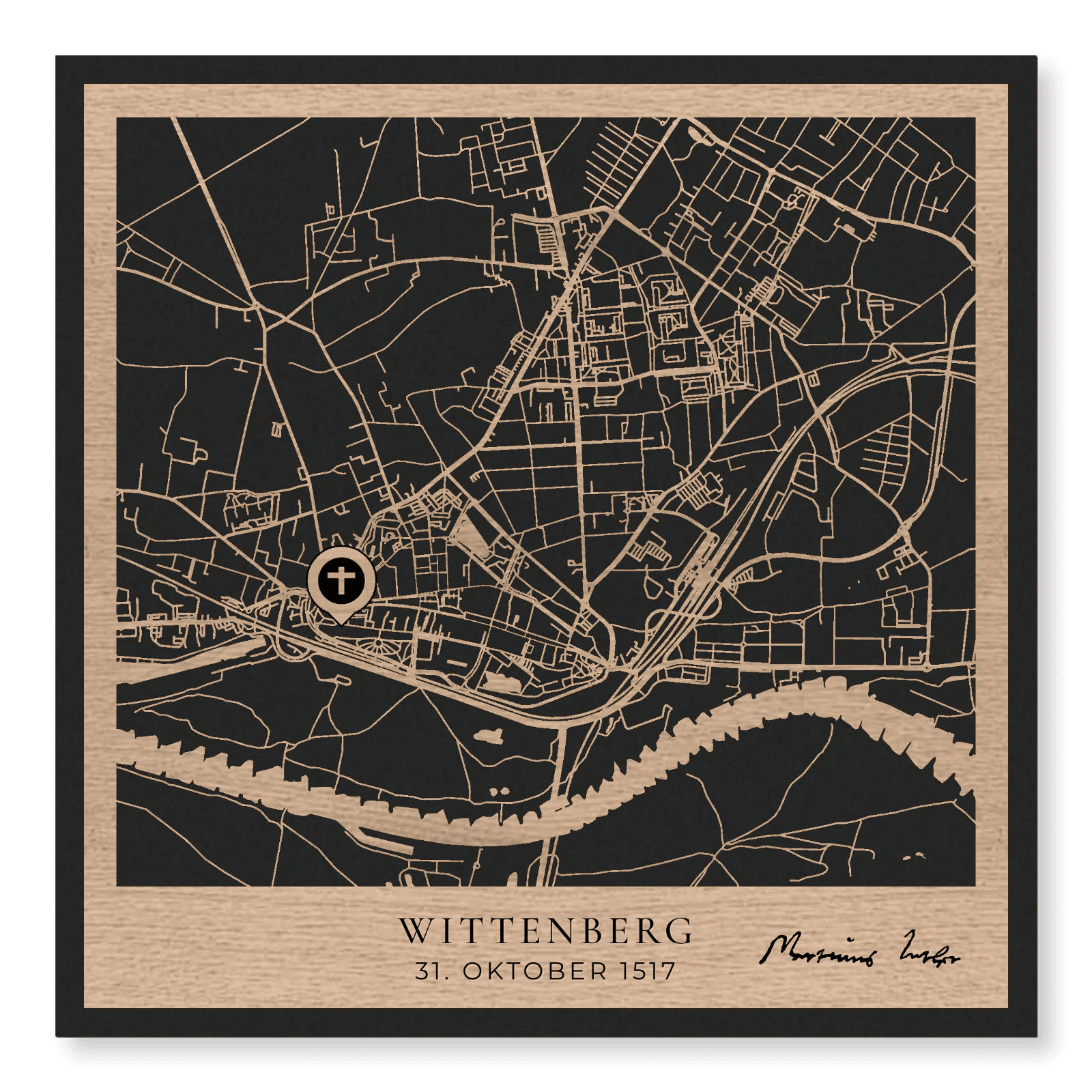
Square wooden city map in oiled oak, with a black back plate and two-layer construction, without an outer frame.
About the product
Teaching, preaching and work on biblical texts made Wittenberg the centre of Martin Luther’s life as a reformer. His criticism of indulgences in 1517 reached far beyond the town. The date 31 October recalls the Ninety-five Theses and the beginning of the Reformation. This map covers the Old Town around the Castle Church and Schlossplatz, St Mary’s Town Church, Lutherhaus and Melanchthonhaus. Their proximity places the history of the university alongside the parish and the homes of the reformers. A cross marker at Schlossplatz provides a point of reference. Luther’s work here continued long after 1517. He lived and wrote in the former Augustinian monastery, addressed the congregation in the Town Church and revised his biblical translations with fellow scholars. Wittenberg was where the complete Luther Bible was printed in 1534. The present-day street layout gives these events a geographical setting.
What does the map show?
- Castle Church and Schlossplatz in the western Old Town
- St Mary’s Town Church in the historic centre
- Lutherhaus and Melanchthonhaus within the mapped area
- Cross marker at Schlossplatz as a point of reference
- Present-day street network across the Old Town and neighbouring areas
- Precisely cut and engraved
- Fine laser details with clear depth
- Carefully inspected and securely packed
- Handmade in Germany
Configuration
Shape: Square · Design: Layered · Material: Oak · Sizes: 23 × 23 cm, 35 × 35 cm, 50 × 50 cm
The configuration shown in the cart and at the time of ordering is authoritative. The preview is not a dimensioned technical drawing.
Availability & production
- Availability
- Made to order
- Production time
- Ships in 3-5 business days
Production starts after successful payment and complete product configuration.
Materials & care
Depending on the variant, lacquered or oiled MDF or oiled real-wood veneer on MDF; optional stainless-steel mounting screws. Acrylic lacquer spray, hard-wax oil and white glue are used in production.
Wood is a natural material. Grain and color may vary slightly from the product images.
Clean with a dry, soft cloth and protect from prolonged moisture and direct heat.
Included & installation
The selected product in the ordered configuration, securely packed and prepared for installation.
- Maximum dimensions 50 × 70 cm and maximum product weight 2 kg.
- Wall-fixing screws and wall plugs are not included. Use fixings suitable for the wall type, substrate and product weight.
- Installation must be carried out by an adult. Keep optional mounting screws and other small parts away from children until installation.
Shipping & returns
Securely packed shipping. Return and cancellation information is available in the legal section.
Shipping costs and delivery options depend on the destination and format. The published cancellation right applies to non-personalised standard goods; it may be excluded for individually made products.
Manufacturer & product identifier
- Manufacturer
- Benjamin Nöst - Lightworks
Rorichmoorer Str. 76
26802 Moormerland, Deutschland
kontakt@lightworks.de - Product identifier
- LW-CAT-678D38E83D48-S, LW-CAT-678D38E83D48-M, LW-CAT-678D38E83D48-L
Together with the order or production batch, the relevant SKU enables traceability. Safety questions and incidents can be reported to the email address shown above.
Product safety
- Decorative product for dry indoor use only; not a toy and not intended for children.
- Protect from moisture, high heat and open flames.
- Do not continue to hang the product after a fall, breakage or visible damage. Keep damaged parts away from children.
Luther’s Wittenberg: places of work and everyday life
Wittenberg connects the history of the Reformation with the places where it took shape. Its churches, university and scholars’ homes tell a story of teaching and public debate that extends well beyond the events of October 1517.
A university town and a new debate
Founded in 1502, the University of Wittenberg, known as the Leucorea, provided the setting for Luther’s academic career. He became a professor of theology here in 1512. Philipp Melanchthon joined the university as professor of Greek in 1518 and became a close colleague. Their discussions of Scripture and its interpretation were part of the intellectual life from which the Reformation developed.
The date behind the Ninety-five Theses
Luther challenged abuses associated with indulgences in his Ninety-five Theses. His letter to Archbishop Albrecht, dated 31 October 1517, survives. The familiar account of the theses being nailed to the Castle Church door is a tradition whose precise circumstances remain disputed by historians. The church became one of the principal places through which the Reformation is remembered.
Preaching in the Town Church
St Mary’s Town Church brought Luther’s ideas into contact with the life of the parish. After returning from the Wartburg, he delivered the Invocavit sermons here in March 1522. Amid disputes about the direction of reform, he opposed violent changes and argued for persuasion through preaching. These sermons show how questions debated by theologians also affected everyday worship.
Home, household and conversation
Lutherhaus began as an Augustinian monastery. It was first Luther’s monastic home and later the household he shared with Katharina von Bora and their family. He wrote, taught students and took part in the conversations preserved as his Table Talk. Katharina managed the large household. Nearby, Melanchthonhaus recalls the scholar who worked closely with Luther on questions of theology and language.
Translating and revising the Bible
The New Testament translation begun at the Wartburg was published in Wittenberg in 1522. Melanchthon and other scholars contributed to the work that followed. Hans Lufft printed the first complete edition of the Luther Bible in Wittenberg in 1534. Publication did not end the project: Luther and his collaborators continued to review and revise the text.
Reading the places on the map
The Castle Church, Town Church, Lutherhaus and Melanchthonhaus all fall within this map’s extent. Since 1996 they have formed part of the UNESCO World Heritage property comprising the Luther memorials in Eisleben and Wittenberg. The map uses the present-day street network to locate the places associated with Luther’s work.

Still deciding?
Configure your motif in the studio and see how your city map will look in your space.



