
Madrid.City overview
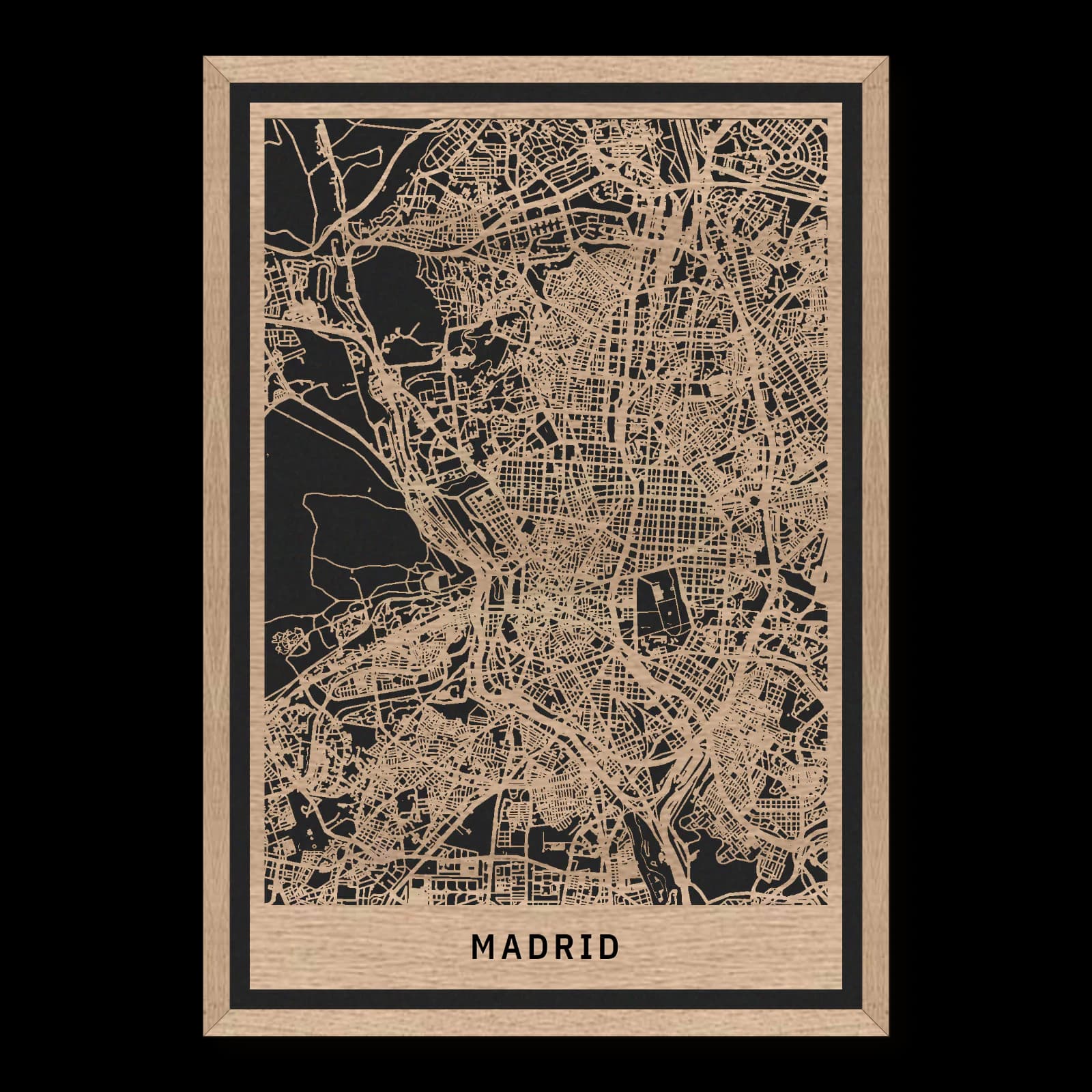
A framed city map in oiled oak, setting Madrid's broad parks beside its dense centre in two wooden layers.
About the product
Central Madrid brings dense neighbourhoods into contact with exceptionally large open spaces. The Royal Palace establishes a western focus, while the Prado and Retiro shape the eastern side. Beyond the Manzanares, Casa de Campo opens a much broader green landscape. The Bernabéu extends the picture northwards, and Matadero adds a cultural destination in southern Madrid. The contrast reveals the changing functions of a capital: courtly representation, public gardens, sport, housing and the reuse of working sites. Narrower historic streets coexist with extensive grounds and major urban routes. Madrid’s identity emerges from the connections between these different settings rather than from a single monumental centre. The framed oak cut brings these broad contrasts into one composition. Its black back plate gives the routes between park and city a clear outline.
What does the map show?
- Casa de Campo beyond the Manzanares
- Royal Palace and Prado as distinct focal points
- Retiro to the east, Matadero to the south
- Framed oak over a black back plate
- Precisely cut and engraved
- Fine laser details with clear depth
- Carefully inspected and securely packed
- Handmade in Germany
Configuration
Shape: Rectangular · Design: Framed · Material: Oak · Sizes: 20 × 30 cm, 35 × 50 cm, 50 × 70 cm
The configuration shown in the cart and at the time of ordering is authoritative. The preview is not a dimensioned technical drawing.
Availability & production
- Availability
- Made to order
- Production time
- Ships in 3-5 business days
Production starts after successful payment and complete product configuration.
Materials & care
Depending on the variant, lacquered or oiled MDF or oiled real-wood veneer on MDF; optional stainless-steel mounting screws. Acrylic lacquer spray, hard-wax oil and white glue are used in production.
Wood is a natural material. Grain and color may vary slightly from the product images.
Clean with a dry, soft cloth and protect from prolonged moisture and direct heat.
Included & installation
The selected product in the ordered configuration, securely packed and prepared for installation.
- Maximum dimensions 50 × 70 cm and maximum product weight 2 kg.
- Wall-fixing screws and wall plugs are not included. Use fixings suitable for the wall type, substrate and product weight.
- Installation must be carried out by an adult. Keep optional mounting screws and other small parts away from children until installation.
Shipping & returns
Securely packed shipping. Return and cancellation information is available in the legal section.
Shipping costs and delivery options depend on the destination and format. The published cancellation right applies to non-personalised standard goods; it may be excluded for individually made products.
Manufacturer & product identifier
- Manufacturer
- Benjamin Nöst - Lightworks
Rorichmoorer Str. 76
26802 Moormerland, Deutschland
kontakt@lightworks.de - Product identifier
- LW-CAT-06A77D5FFE7A-S, LW-CAT-06A77D5FFE7A-M, LW-CAT-06A77D5FFE7A-L
Together with the order or production batch, the relevant SKU enables traceability. Safety questions and incidents can be reported to the email address shown above.
Product safety
- Decorative product for dry indoor use only; not a toy and not intended for children.
- Protect from moisture, high heat and open flames.
- Do not continue to hang the product after a fall, breakage or visible damage. Keep damaged parts away from children.
Madrid between royal ground and a changing capital
Madrid’s central area is organised through relationships between large parks, historic districts and long urban connections. Casa de Campo and Retiro provide different green settings, while the Bernabéu and Matadero indicate the north–south extent. The Royal Palace belongs to this broader capital of several distinct public and cultural centres.
The western edge of the royal city
The Royal Palace stands on the western side of Madrid’s older centre. Its setting differs from that of a monument enclosed equally by streets on every side. Closely built neighbourhoods extend towards the city, while the land to the west introduces a more open relationship. The former royal residence occupies a transition between dense urban fabric and broader landscape.
Beyond the Manzanares lies Casa de Campo. Once royal hunting land, it was opened to the public in the twentieth century. Its extensive continuous grounds give central Madrid a remarkably large green neighbour. Seen beside the built districts, the park reveals how earlier patterns of ownership and use continue to shape the capital’s public spaces.
Culture and greenery on the eastern side
The Prado and Retiro form a different kind of landscape. Designed gardens, cultural institutions and places associated with knowledge developed in close relationship here. Their UNESCO recognition concerns this combined urban setting rather than a park considered in isolation. Green space is connected with the intellectual and public functions of the city, not simply placed beyond its edge.
Compared with Casa de Campo, these eastern grounds have a closer relationship with museums, formal streets and immediately adjoining neighbourhoods. The two sides of Madrid therefore offer distinct histories of open space. Each shows a different way in which royal landscapes became part of public urban life. Between them stretches a largely built-up city with changing street patterns, squares and local centres.
Northern sport and southern cultural reuse
The Bernabéu establishes a conspicuous reference in the northern central area. A major stadium works at a different scale from the historic streets around the palace. Its position helps explain Madrid’s extension along important northern routes. Sport and large public gatherings are embedded within a densely developed urban environment rather than separated from the city altogether.
To the south, Matadero represents the reuse of a former working site. The old slaughterhouse complex in Arganzuela became a place for culture, extending Madrid’s creative geography beyond its traditional museums. Stadium, palace, parks and reused industrial grounds consequently reveal several kinds of public space. Their connections show a capital that has repeatedly added new places for collective activity. The alternation between extensive sites and inhabited neighbourhoods is central to understanding the shape and variety of its urban core.
Sources
- Wikipedia – Madrid — https://de.wikipedia.org/wiki/Madrid
- Wikipedia – Casa de Campo — https://en.wikipedia.org/wiki/Casa_de_Campo
- Wikipedia – Matadero Madrid — https://en.wikipedia.org/wiki/Matadero_Madrid
- Madrid Destino – Palacio Real — https://www.esmadrid.com/en/tourist-information/royal-palace
- UNESCO – Paseo del Prado und Buen Retiro — https://whc.unesco.org/en/list/1618/
- Wikipedia – Estadio Santiago Bernabéu — https://de.wikipedia.org/wiki/Estadio_Santiago_Bernab%C3%A9u

Still deciding?
Configure your motif in the studio and see how your city map will look in your space.