
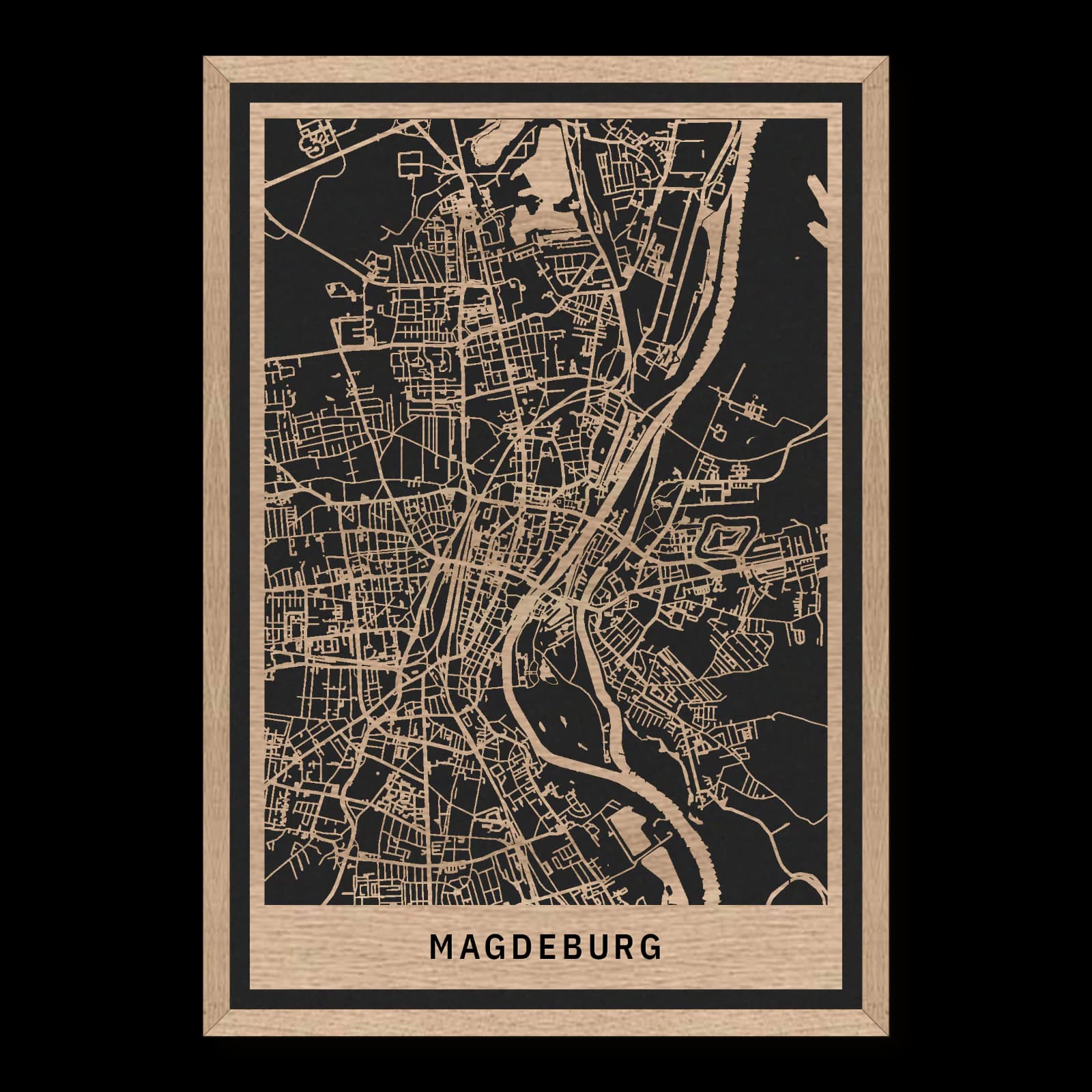
Magdeburg.
Framed wooden city map in oiled oak, portrait format.
About the product
Magdeburg stretches beside the Elbe between dense central streets and generous garden landscapes. The cathedral, main station and Gruson Greenhouses provide western and southern reference points, while Elbauenpark and Herrenkrug extend the view across the river. This composition connects familiar routes with open spaces that strongly influence the city's character. An oak frame contains this long portrait of the city. Raised above its backing panel, the cut streets connect denser neighbourhoods with larger parks on both sides of the Elbe while preserving their different scales.
What does the map show?
- Magdeburger Dom
- Elbauenpark
- Herrenkrugpark
- Gruson-Gewächshäuser
- Precisely cut and engraved
- Fine laser details with clear depth
- Carefully inspected and securely packed
- Handmade in Germany
Configuration
Shape: Rectangular · Design: Framed · Material: Oak · Sizes: 20 × 30 cm, 35 × 50 cm, 50 × 70 cm
The configuration shown in the cart and at the time of ordering is authoritative. The preview is not a dimensioned technical drawing.
Availability & production
- Availability
- Made to order
- Production time
- Ships in 3-5 business days
Production starts after successful payment and complete product configuration.
Materials & care
Depending on the variant, lacquered or oiled MDF or oiled real-wood veneer on MDF; optional stainless-steel mounting screws. Acrylic lacquer spray, hard-wax oil and white glue are used in production.
Wood is a natural material. Grain and color may vary slightly from the product images.
Clean with a dry, soft cloth and protect from prolonged moisture and direct heat.
Included & installation
The selected product in the ordered configuration, securely packed and prepared for installation.
- Maximum dimensions 50 × 70 cm and maximum product weight 2 kg.
- Wall-fixing screws and wall plugs are not included. Use fixings suitable for the wall type, substrate and product weight.
- Installation must be carried out by an adult. Keep optional mounting screws and other small parts away from children until installation.
Shipping & returns
Securely packed shipping. Return and cancellation information is available in the legal section.
Shipping costs and delivery options depend on the destination and format. The published cancellation right applies to non-personalised standard goods; it may be excluded for individually made products.
Manufacturer & product identifier
- Manufacturer
- Benjamin Nöst - Lightworks
Rorichmoorer Str. 76
26802 Moormerland, Deutschland
kontakt@lightworks.de - Product identifier
- LW-CAT-79477367A5ED-S, LW-CAT-79477367A5ED-M, LW-CAT-79477367A5ED-L
Together with the order or production batch, the relevant SKU enables traceability. Safety questions and incidents can be reported to the email address shown above.
Product safety
- Decorative product for dry indoor use only; not a toy and not intended for children.
- Protect from moisture, high heat and open flames.
- Do not continue to hang the product after a fall, breakage or visible damage. Keep damaged parts away from children.
Magdeburg's Elbe: urban districts and designed landscapes
The Elbe provides a continuous reference through several different parts of Magdeburg. The cathedral and station lie west of the river, while extensive parks open to the east. The Gruson Greenhouses add a southern landmark. Together these places reveal green spaces with distinct histories, rather than empty ground between urban buildings.
Following the river through the city
Magdeburg's Elbe connects several urban areas without making them alike. Denser central districts and the main station lie to the west, while substantial parkland opens on the eastern side. The cathedral provides a conspicuous reference near the river. Its position is important, but explains only part of a city extending well beyond its older centre.
The main station developed along the western side of the former fortress. Railway expansion required extensive connected land and changed the way people arrived in Magdeburg. A broader view therefore brings together two significant systems: the length of the river corridor and transport infrastructure drawing movement from other directions.
Three histories behind the greenery
The Gruson Greenhouses preserve the botanical legacy of industrialist and plant collector Hermann Gruson. In the southern inner city, private collecting became the basis of a public institution. Plants from different regions require purpose-built accommodation and controlled conditions. This is greenery organised as a maintained collection, rather than an untouched natural landscape.
Elbauenpark, on the eastern side, was created for the 1999 federal garden exhibition. Earlier military uses and wartime debris formed part of the site's background. Its transformation demonstrates how land with a difficult past can acquire a new public role. Paths, attractions and open areas follow a deliberately developed landscape plan.
Farther north, Herrenkrugpark has a longer history. Economically used municipal land evolved into a park and excursion destination during the nineteenth century, with Peter Joseph Lenné involved in its design. The eastern riverside setting combines landscape effects with histories of cultivation, recreation and civic planning.
Connections across different kinds of space
These places should not be reduced to one general image of a green city. A botanical collection, a newly created park and an older landscape park have different origins. Their distribution across the inner city makes them useful reference points for a wider understanding of Magdeburg.
The Gruson greenhouses first present greenery through the collection of individual plants. In the larger parks east of the Elbe, that scale changes: extensive paths and open areas organise movement instead. The cathedral remains a quite different reference point on the western side. Magdeburg's green spaces are consequently neither interchangeable parks nor simple companions to the river. Their separate origins explain why a botanical collection, designed landscape and historical building occupy such different kinds of ground within the same urban overview.
Sources
- Gruson-Gewächshäuser: Botanisches Erbe Hermann Grusons — https://www.gruson-gewaechshaeuser.de/
- Wikipedia: Elbauenpark — https://en.wikipedia.org/wiki/Elbauenpark
- Wikipedia: Herrenkrugpark — https://de.wikipedia.org/wiki/Herrenkrugpark
- Wikipedia: Magdeburg Hauptbahnhof — https://en.wikipedia.org/wiki/Magdeburg_Hauptbahnhof
- Wikipedia: Magdeburger Dom — https://en.wikipedia.org/wiki/Magdeburg_Cathedral

Still deciding?
Configure your motif in the studio and see how your city map will look in your space.