
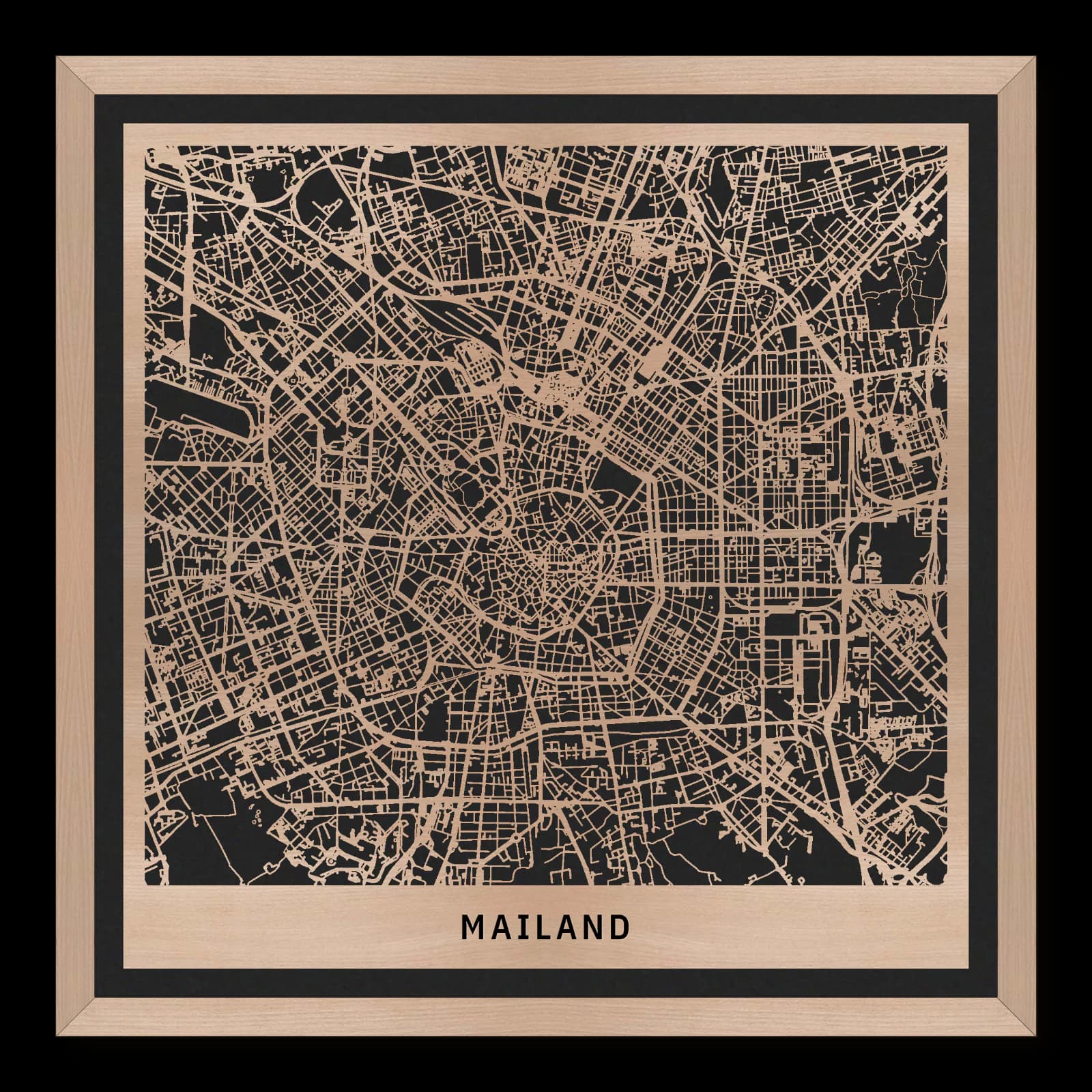
Milan.City Overview
Square wooden city map made from oiled beech – two layers with a black back plate and frame.
About the product
Streets radiate from Milan's cathedral into a closely connected urban fabric. Parco Sempione, Milano Centrale and Sant'Eustorgio extend the view north, west and south. This wooden city map places monumental public settings alongside smaller blocks and open parkland, revealing an inner city whose structure depends on historic centres and major transport connections operating together at very different scales.
What does the map show?
- Dense streets around the cathedral
- Open landscape at Parco Sempione
- Railway neighbourhoods around Milano Centrale
- Precisely cut and engraved
- Fine laser details with clear depth
- Carefully inspected and securely packed
- Handmade in Germany
Configuration
Shape: Square · Design: Framed · Material: Beech · Sizes: 23 × 23 cm, 35 × 35 cm, 50 × 50 cm
The configuration shown in the cart and at the time of ordering is authoritative. The preview is not a dimensioned technical drawing.
Availability & production
- Availability
- Made to order
- Production time
- Ships in 3-5 business days
Production starts after successful payment and complete product configuration.
Materials & care
Depending on the variant, lacquered or oiled MDF or oiled real-wood veneer on MDF; optional stainless-steel mounting screws. Acrylic lacquer spray, hard-wax oil and white glue are used in production.
Wood is a natural material. Grain and color may vary slightly from the product images.
Clean with a dry, soft cloth and protect from prolonged moisture and direct heat.
Included & installation
The selected product in the ordered configuration, securely packed and prepared for installation.
- Maximum dimensions 50 × 70 cm and maximum product weight 2 kg.
- Wall-fixing screws and wall plugs are not included. Use fixings suitable for the wall type, substrate and product weight.
- Installation must be carried out by an adult. Keep optional mounting screws and other small parts away from children until installation.
Shipping & returns
Securely packed shipping. Return and cancellation information is available in the legal section.
Shipping costs and delivery options depend on the destination and format. The published cancellation right applies to non-personalised standard goods; it may be excluded for individually made products.
Manufacturer & product identifier
- Manufacturer
- Benjamin Nöst - Lightworks
Rorichmoorer Str. 76
26802 Moormerland, Deutschland
kontakt@lightworks.de - Product identifier
- LW-CAT-87A66239FFE2-S, LW-CAT-87A66239FFE2-M, LW-CAT-87A66239FFE2-L
Together with the order or production batch, the relevant SKU enables traceability. Safety questions and incidents can be reported to the email address shown above.
Product safety
- Decorative product for dry indoor use only; not a toy and not intended for children.
- Protect from moisture, high heat and open flames.
- Do not continue to hang the product after a fall, breakage or visible damage. Keep damaged parts away from children.
Milan: A dense city between cathedral, park and station
Milan's history reaches far beyond its contemporary associations with fashion and business. Churches, public complexes and transport sites belong to different periods of development. Connecting the cathedral with western parkland, northern railway districts and southern historic places reveals several directions of growth within the dense and varied inner city.
Older institutions to the south
Sant'Ambrogio, San Lorenzo and Sant'Eustorgio recall different strands of the city's religious and urban history. Their distribution shows that important historical places are spread across several settings. The Ca' Granda adds the story of a major public complex whose use changed from hospital to university. Such adaptations reveal the city as a continuously revised environment. Buildings acquire new purposes while streets and plot boundaries preserve parts of an older framework. These sites broaden the familiar cathedral view and demonstrate how Milan repeatedly developed through existing structures rather than beginning again on empty ground.
The cathedral within a network
Milan's cathedral is an obvious point of reference, but the city cannot be understood through its monumental form alone. Surrounding streets connect different squares, neighbourhoods and public institutions. Their pattern reflects a city that developed through many historical layers. Large civic settings alternate with narrower routes even within the immediate centre. These changes shape the experience of Milan as much as individual façades do. The cathedral belongs to a network extending well beyond its square, and following those connections provides a stronger sense of the city than remaining around its most recognisable landmark.
Parkland to the west
Parco Sempione introduces an extensive open space west of the central streets. Its relationship with the Castello Sforzesco belongs to the historical development of the area, while the Arco della Pace establishes another reference at the opposite end. Fortified residence, public park and ceremonial monument create a sequence of different meanings. The landscape also changes the scale of the city. Longer views and broader distances replace the close divisions of densely developed blocks. The park therefore helps organise Milan, rather than serving merely as an attractive green addition to the historic centre.
Metropolitan connections
Milano Centrale introduces a very different scale north of the historic core. Station and surrounding streets create a transport focus unlike the older church squares. Arrival, onward travel and urban access occupy substantial spaces here. Neighbourhoods between station, cathedral and western parkland connect these contrasting settings. Together they form a coherent inner-city portrait without claiming to contain the entire metropolis. Milan's density comes from the close coexistence of periods and functions, with their routes crossing and their different scales appearing within surprisingly short distances.
Sources
- Comune di Milano: Castello Sforzesco — https://www.comune.milano.it/en/web/castello-sforzesco/visita/come-raggiungerci
- YesMilano: Porta Romana und Navigli — https://www.yesmilano.it/en/node/6905
- Musei del Castello Sforzesco — https://www.milanocastello.it/it/
- Wikivoyage: Mailand — https://de.wikivoyage.org/wiki/Mailand

Still deciding?
Configure your motif in the studio and see how your city map will look in your space.