
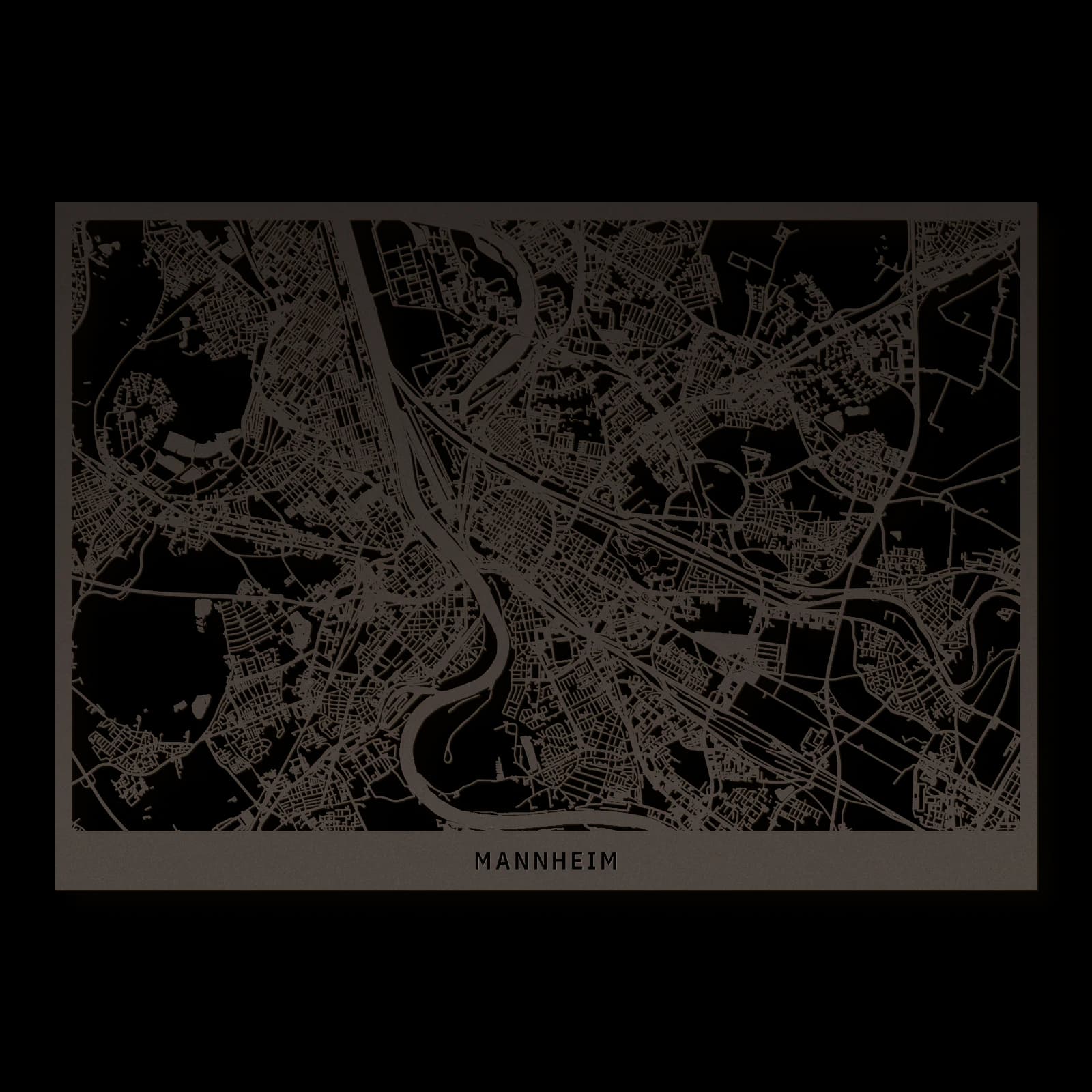
Mannheim.City overview
A black Classic wooden city map of Mannheim in landscape format, from the grid to Luisenpark.
About the product
Mannheim's regular grid meets very different surroundings at its edges. This overview includes the palace, water tower, Jungbusch and Luisenpark, extending from the planned centre into harbour-side and park neighbourhoods. Black lacquered MDF gives the connecting street pattern a dark, consistent surface. The landscape map uses a single Classic layer without a back plate, leaving the cut spaces open.
What does the map show?
- Mannheim Palace
- Mannheim Water Tower
- Jungbusch
- Luisenpark
- Single wooden layer without a back plate
- Precisely cut and engraved
- Fine laser details with clear depth
- Carefully inspected and securely packed
- Handmade in Germany
Configuration
Shape: Rectangular · Design: Classic · Material: Black · Sizes: 20 × 30 cm, 35 × 50 cm, 50 × 70 cm
The configuration shown in the cart and at the time of ordering is authoritative. The preview is not a dimensioned technical drawing.
Availability & production
- Availability
- Made to order
- Production time
- Ships in 3-5 business days
Production starts after successful payment and complete product configuration.
Materials & care
Depending on the variant, lacquered or oiled MDF or oiled real-wood veneer on MDF; optional stainless-steel mounting screws. Acrylic lacquer spray, hard-wax oil and white glue are used in production.
Wood is a natural material. Grain and color may vary slightly from the product images.
Clean with a dry, soft cloth and protect from prolonged moisture and direct heat.
Included & installation
The selected product in the ordered configuration, securely packed and prepared for installation.
- Maximum dimensions 50 × 70 cm and maximum product weight 2 kg.
- Wall-fixing screws and wall plugs are not included. Use fixings suitable for the wall type, substrate and product weight.
- Installation must be carried out by an adult. Keep optional mounting screws and other small parts away from children until installation.
Shipping & returns
Securely packed shipping. Return and cancellation information is available in the legal section.
Shipping costs and delivery options depend on the destination and format. The published cancellation right applies to non-personalised standard goods; it may be excluded for individually made products.
Manufacturer & product identifier
- Manufacturer
- Benjamin Nöst - Lightworks
Rorichmoorer Str. 76
26802 Moormerland, Deutschland
kontakt@lightworks.de - Product identifier
- LW-CAT-310E8DE925DD-S, LW-CAT-310E8DE925DD-M, LW-CAT-310E8DE925DD-L
Together with the order or production batch, the relevant SKU enables traceability. Safety questions and incidents can be reported to the email address shown above.
Product safety
- Decorative product for dry indoor use only; not a toy and not intended for children.
- Protect from moisture, high heat and open flames.
- Do not continue to hang the product after a fall, breakage or visible damage. Keep damaged parts away from children.
Mannheim beyond the grid
Mannheim's regular centre occupies a setting shaped by two rivers and several contrasting neighbourhoods. The palace, water tower, Jungbusch and Luisenpark provide a framework for exploring that wider city. Their relationships connect planned streets with harbour surroundings, representative public spaces and a substantial park to the east.
Mannheim's regular central grid is one of its most recognisable features. Streets and blocks were laid out in a planned arrangement between the palace and the Neckar. This geometry explains an important part of the city, but it does not describe every surrounding district. Neighbourhoods and open spaces at its edges follow other conditions and substantially extend the urban picture.
A planned centre with distinct landmarks
The Baroque palace stands along the southwestern side of the centre. Its extensive complex occupies a scale quite different from the repeated blocks nearby. The relationship is nevertheless close: the palace belongs to the city's planned development and supplies the grid with a major representative focus. The broad building and smaller recurring units of the centre can therefore be read together.
East of the grid, the water tower rises at Friedrichsplatz. Its setting introduces another prominent public space, with landscaped ground and a representative urban ensemble. The tower has a connection with municipal infrastructure, but also a powerful architectural presence. It demonstrates how a technical function can become part of a city's distinctive public identity.
The streets between palace and water tower link different kinds of urban space. The regular centre remains their common reference. Its character becomes especially clear where it meets other forms: a substantial palace complex, an open square, or the transition into a later neighbourhood. Those edges are as informative as the repeated blocks themselves.
River settings and an eastern landscape
Jungbusch lies northwest of the central grid, close to the harbour areas. Its position introduces a different aspect of Mannheim from the representative settings around palace and water tower. Waterways and working ground belong to the district's geographical and historical context. Here the city continues beyond the regular pattern into a neighbourhood with another set of influences.
The Rhine and Neckar supply the broader framework. Their courses define edges, enable movement and create open corridors through the urban area. This geography helps explain why Mannheim as a whole is more varied than its famous grid might suggest. Water and planned streets operate at different scales, influencing each other without producing a single uniform pattern.
Luisenpark adds a large designed green space to the east. Its paths and open areas differ from both central blocks and harbour ground. The connection from Jungbusch across the inner city to the park consequently reveals several distinct forms of urban development. Planned streets, infrastructure and public landscape retain separate roles within Mannheim's wider central area.
Sources
- Deutsche Zentrale für Tourismus – Mannheim — https://www.germany.travel/en/cities-culture/mannheim.html
- Wikipedia – Schloss Mannheim — https://de.wikipedia.org/wiki/Mannheimer_Schloss
- Wikipedia – Wasserturm (Mannheim) — https://de.wikipedia.org/wiki/Mannheimer_Wasserturm
- Wikipedia – Jungbusch — https://de.wikipedia.org/wiki/Jungbusch
- Wikipedia – Luisenpark — https://en.wikipedia.org/wiki/Luisenpark

Still deciding?
Configure your motif in the studio and see how your city map will look in your space.



