
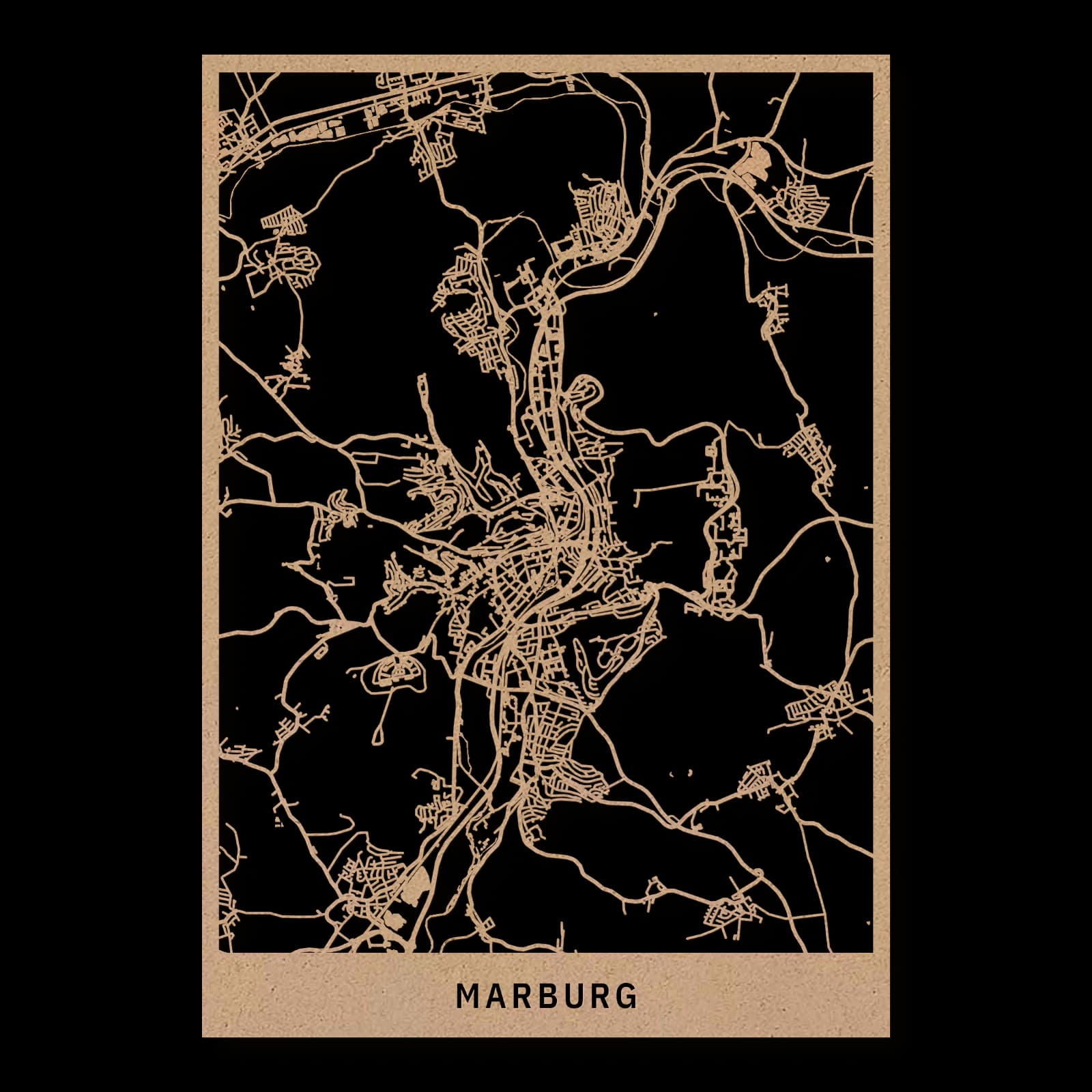
Marburg.Hillside town and valley corridor
Rectangular wooden city map made from natural oiled MDF.
About the product
Marburg is organised around an elevated castle, hillside streets and a long valley settlement. The Elisabethkirche adds another historical focus, while Wehrda and Cappel extend the city north and south. This wooden map follows that articulated geography. It connects familiar monuments with the wider urban corridor, revealing how strongly terrain and routes shape Marburg's form.
What does the map show?
- Marburg Castle
- Elisabethkirche
- Cappel
- Wehrda
- Precisely cut and engraved
- Fine laser details with clear depth
- Carefully inspected and securely packed
- Handmade in Germany
Configuration
Shape: Rectangular · Design: Classic · Material: Natural · Sizes: 20 × 30 cm, 35 × 50 cm, 50 × 70 cm
The configuration shown in the cart and at the time of ordering is authoritative. The preview is not a dimensioned technical drawing.
Availability & production
- Availability
- Made to order
- Production time
- Ships in 3-5 business days
Production starts after successful payment and complete product configuration.
Materials & care
Depending on the variant, lacquered or oiled MDF or oiled real-wood veneer on MDF; optional stainless-steel mounting screws. Acrylic lacquer spray, hard-wax oil and white glue are used in production.
Wood is a natural material. Grain and color may vary slightly from the product images.
Clean with a dry, soft cloth and protect from prolonged moisture and direct heat.
Included & installation
The selected product in the ordered configuration, securely packed and prepared for installation.
- Maximum dimensions 50 × 70 cm and maximum product weight 2 kg.
- Wall-fixing screws and wall plugs are not included. Use fixings suitable for the wall type, substrate and product weight.
- Installation must be carried out by an adult. Keep optional mounting screws and other small parts away from children until installation.
Shipping & returns
Securely packed shipping. Return and cancellation information is available in the legal section.
Shipping costs and delivery options depend on the destination and format. The published cancellation right applies to non-personalised standard goods; it may be excluded for individually made products.
Manufacturer & product identifier
- Manufacturer
- Benjamin Nöst - Lightworks
Rorichmoorer Str. 76
26802 Moormerland, Deutschland
kontakt@lightworks.de - Product identifier
- LW-CAT-7BB708CB6F20-S, LW-CAT-7BB708CB6F20-M, LW-CAT-7BB708CB6F20-L
Together with the order or production batch, the relevant SKU enables traceability. Safety questions and incidents can be reported to the email address shown above.
Product safety
- Decorative product for dry indoor use only; not a toy and not intended for children.
- Protect from moisture, high heat and open flames.
- Do not continue to hang the product after a fall, breakage or visible damage. Keep damaged parts away from children.
Marburg: Hillside town and valley corridor
Marburg's roles as a residence, pilgrimage destination and university town developed at different times. They overlap geographically while occupying different levels and urban settings. The castle and Elisabethkirche establish two historic focuses, and the valley districts show how the city expanded beyond its older centre through a longer network of connections.
A castle above the streets
Marburg's castle stands above the older town. That position explains much of the street pattern below: routes between the seat of power and the valley had to negotiate changes in level. The historic settlement could not develop as a simple regular grid. Narrower streets and changing directions respond to the hillside. The castle is therefore both a historical landmark and a key to the city's geography.
As a residence, Marburg held political importance beyond its immediate surroundings. The castle records that role, while the town below developed economic and social functions of its own. Their proximity did not make their organisation identical. A substantial governing complex and smaller urban properties occupied neighbouring positions on demanding terrain.
Religious and academic importance
The Elisabethkirche stands north of the older hillside town. It connects Marburg with the veneration of Saint Elisabeth and the history of pilgrimage. Its location establishes a distinct focus below the castle. Religious importance and political authority are close together while remaining spatially distinguishable.
The university, founded in 1527, added another lasting role. Its influence extends beyond individual teaching buildings to the wider relationship between study, housing and public life. Across generations, academic activity helped shape the town's development. Marburg's historical standing consequently rests on several overlapping functions rather than one institution alone.
A longer city along the valley
Wehrda to the north and Cappel to the south reveal the greater extent of the settlement. A long urban corridor follows the valley between them. Its form differs from the concentrated historic streets on the hillside. Broader transport routes and larger residential areas complement the older, tighter pattern.
These districts are essential to understanding Marburg as a functioning city rather than only a setting for monuments and university history. They carry everyday urban life and connect the centre with places farther north and south. The change of scale is part of the city's character.
From Wehrda through the castle and Elisabethkirche to Cappel, height and length work together. Terrain explains the form of the settlement, while political, religious and academic history explains the importance of its central places. Reading those relationships together gives a fuller picture of Marburg than either its hilltop silhouette or its valley streets can provide alone.
Sources
- Zahlen und Fakten zur Stadtgeschichte | Universitätsstadt Marburg — https://www.marburg.de/portal/seiten/zahlen-und-fakten-zur-stadtgeschichte-900000298-23001.html
- Erinnerungskultur | Universitätsstadt Marburg — https://www.marburg.de/portal/seiten/erinnerungskultur-900000235-23001.html
- Historischer Streifzug – Universitätskirche Marburg — https://universitaetskirche.de/geschichte/historischer-streifzug/
- Marburg entdecken — Schloss, Kirche, Altstadt | VisitMarburg.com — https://visitmarburg.com/de/discover/

Still deciding?
Configure your motif in the studio and see how your city map will look in your space.



