
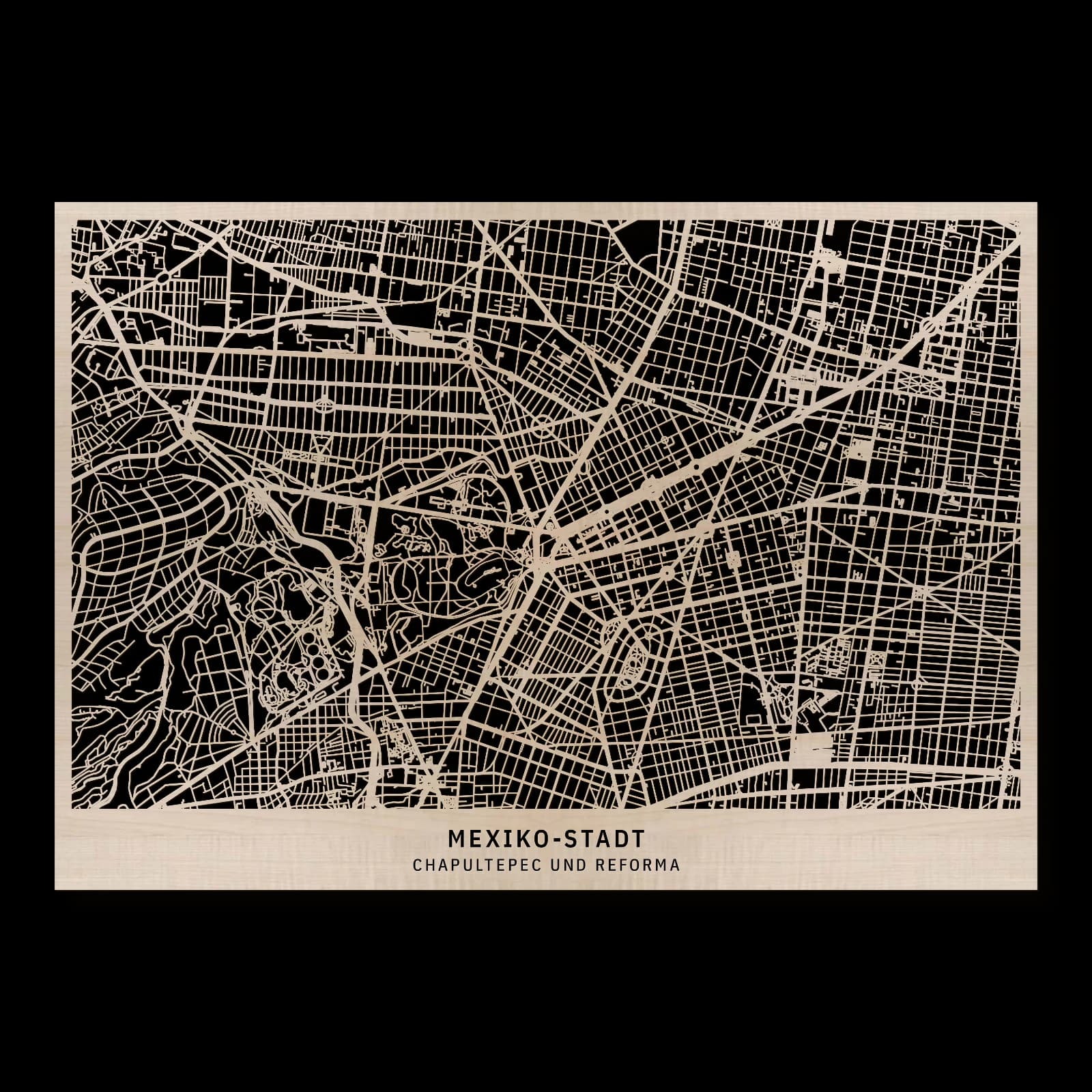
Mexico City.Chapultepec and Reforma
A single-layer Classic maple city map of Chapultepec and Reforma in Mexico City, in landscape format.
About the product
Chapultepec Castle, the National Museum of Anthropology and the Angel of Independence form three reference points within this crop. Their streets connect parkland with the denser districts beside Paseo de la Reforma. Cut from oiled maple, the landscape map follows that transition across western central Mexico City. Its single-layer Classic construction has no back plate, leaving the spaces between routes open.
What does the map show?
- Chapultepec Castle
- National Museum of Anthropology
- Angel of Independence
- Single wooden layer without a back plate
- Precisely cut and engraved
- Fine laser details with clear depth
- Carefully inspected and securely packed
- Handmade in Germany
Configuration
Shape: Rectangular · Design: Classic · Material: Maple · Sizes: 20 × 30 cm, 35 × 50 cm, 50 × 70 cm
The configuration shown in the cart and at the time of ordering is authoritative. The preview is not a dimensioned technical drawing.
Availability & production
- Availability
- Made to order
- Production time
- Ships in 3-5 business days
Production starts after successful payment and complete product configuration.
Materials & care
Depending on the variant, lacquered or oiled MDF or oiled real-wood veneer on MDF; optional stainless-steel mounting screws. Acrylic lacquer spray, hard-wax oil and white glue are used in production.
Wood is a natural material. Grain and color may vary slightly from the product images.
Clean with a dry, soft cloth and protect from prolonged moisture and direct heat.
Included & installation
The selected product in the ordered configuration, securely packed and prepared for installation.
- Maximum dimensions 50 × 70 cm and maximum product weight 2 kg.
- Wall-fixing screws and wall plugs are not included. Use fixings suitable for the wall type, substrate and product weight.
- Installation must be carried out by an adult. Keep optional mounting screws and other small parts away from children until installation.
Shipping & returns
Securely packed shipping. Return and cancellation information is available in the legal section.
Shipping costs and delivery options depend on the destination and format. The published cancellation right applies to non-personalised standard goods; it may be excluded for individually made products.
Manufacturer & product identifier
- Manufacturer
- Benjamin Nöst - Lightworks
Rorichmoorer Str. 76
26802 Moormerland, Deutschland
kontakt@lightworks.de - Product identifier
- LW-CAT-B5AF5C76B38E-S, LW-CAT-B5AF5C76B38E-M, LW-CAT-B5AF5C76B38E-L
Together with the order or production batch, the relevant SKU enables traceability. Safety questions and incidents can be reported to the email address shown above.
Product safety
- Decorative product for dry indoor use only; not a toy and not intended for children.
- Protect from moisture, high heat and open flames.
- Do not continue to hang the product after a fall, breakage or visible damage. Keep damaged parts away from children.
Chapultepec and Reforma: park, museums and remembrance
Chapultepec's castle hill, the National Museum of Anthropology and the Angel of Independence connect three distinct public places. Parkland and the broad Reforma avenue provide their shared setting. Together they reveal a western central district where historical residence, modern museum architecture and national remembrance occupy neighbouring but different forms of ground.
A hill with a history before the castle
Chapultepec was significant long before construction of the present castle. Its springs supplied Tenochtitlan with water, giving the area a strategic role as well as religious importance. Landscape and urban supply were closely connected here. The park should therefore not be understood simply as a green space added to a modern metropolis, but as ground with a much longer geographical history.
Construction of the hilltop castle began in the late eighteenth century. The complex later served several political and representative purposes, including residence for Maximilian and subsequent use by Mexican presidents. It now houses the National History Museum. Different institutions have therefore occupied the same elevated site, whose position remained important through changes in government and function.
A modern museum of Mexico's cultures
The National Museum of Anthropology stands north of the castle hill. Its present building opened in 1964 and is an important work of modern Mexican architecture. The collections address the country's archaeological and ethnographic heritage. This purpose differs from that of the historical museum in the castle, although both belong to the same wider cultural landscape.
A substantial central courtyard organises the museum. The roof supported by a central column, known as the Paraguas, is a defining architectural feature. Another part of the courtyard contains a pool. Open ground, water and exhibition spaces are consequently integrated within a coherent design. The building itself contributes significantly to the cultural importance of the institution and its setting.
Reforma reconnects the park with the city
The Angel of Independence stands east of Chapultepec on Paseo de la Reforma. Its position within a broad avenue gives it surroundings different from those of castle and museum. Column and elevated figure belong to a commemorative place that also supplies a prominent reference within the city's routes and long lines of orientation.
The connection along Reforma leads from parkland towards more densely built districts. This transition is characteristic of the western central city. Large cultural grounds do not remain isolated from the surrounding urban area; a substantial representative avenue links them with further neighbourhoods. The places are geographically connected while retaining clearly different purposes.
Castle, anthropology museum and independence monument introduce three distinct scales. The hill organises the landscape, the courtyard orders the museum complex, and the monument marks a section of the avenue. Their relationships make Chapultepec and Reforma understandable as a connected public setting, where an older history of landscape and water meets political remembrance and modern architecture.
Sources
- INAH – Historia de Chapultepec — https://mnh.inah.gob.mx/historia
- INAH – Arquitectura y construcción del Museo Nacional de Antropología — https://mna.inah.gob.mx/historia_detalle.php?id=2
- INAH – Museo Nacional de Antropología: El Museo — https://mna.inah.gob.mx/el_museo.php
- Wikipedia – Schloss Chapultepec — https://de.wikipedia.org/wiki/Schloss_Chapultepec
- Wikipedia – Angel of Independence — https://en.wikipedia.org/wiki/%C3%81ngel_de_la_Independencia

Still deciding?
Configure your motif in the studio and see how your city map will look in your space.