
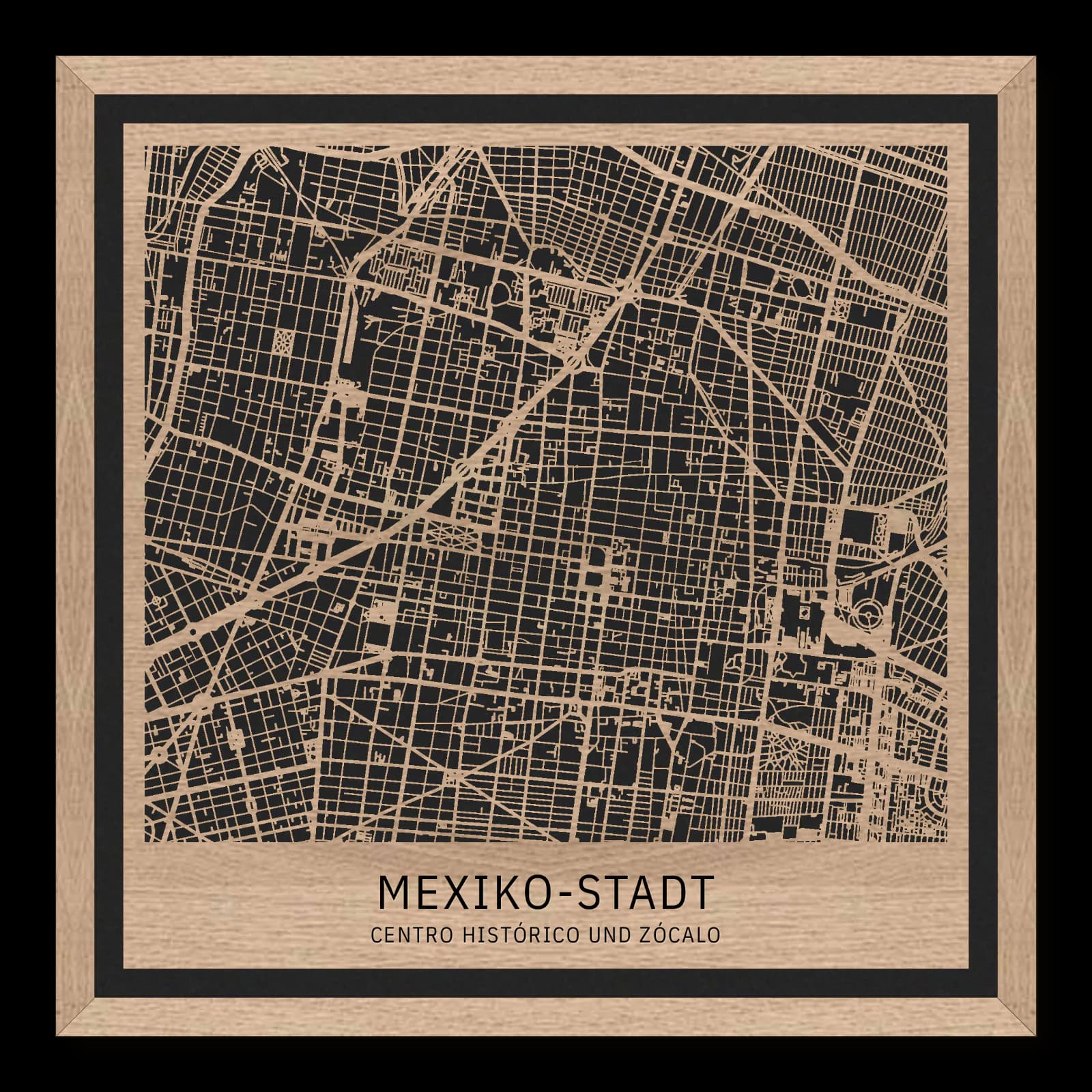
Mexico City.Historic Centre and Zócalo
A square framed oak city map of Mexico City's Centro Histórico around the Zócalo.
About the product
Mexico City's historic centre brings the Zócalo close to the remains of the Templo Mayor. The Palacio de Bellas Artes lies farther west within the same crop, linked by the centre's regular streets. This square wooden map follows those connections across different historical settings. Framed in oiled oak, it combines a cut upper layer with a black back plate.
What does the map show?
- Zócalo
- Templo Mayor
- Palacio de Bellas Artes
- Two wooden layers with a black back plate
- Precisely cut and engraved
- Fine laser details with clear depth
- Carefully inspected and securely packed
- Handmade in Germany
Configuration
Shape: Square · Design: Framed · Material: Oak · Sizes: 23 × 23 cm, 35 × 35 cm, 50 × 50 cm
The configuration shown in the cart and at the time of ordering is authoritative. The preview is not a dimensioned technical drawing.
Availability & production
- Availability
- Made to order
- Production time
- Ships in 3-5 business days
Production starts after successful payment and complete product configuration.
Materials & care
Depending on the variant, lacquered or oiled MDF or oiled real-wood veneer on MDF; optional stainless-steel mounting screws. Acrylic lacquer spray, hard-wax oil and white glue are used in production.
Wood is a natural material. Grain and color may vary slightly from the product images.
Clean with a dry, soft cloth and protect from prolonged moisture and direct heat.
Included & installation
The selected product in the ordered configuration, securely packed and prepared for installation.
- Maximum dimensions 50 × 70 cm and maximum product weight 2 kg.
- Wall-fixing screws and wall plugs are not included. Use fixings suitable for the wall type, substrate and product weight.
- Installation must be carried out by an adult. Keep optional mounting screws and other small parts away from children until installation.
Shipping & returns
Securely packed shipping. Return and cancellation information is available in the legal section.
Shipping costs and delivery options depend on the destination and format. The published cancellation right applies to non-personalised standard goods; it may be excluded for individually made products.
Manufacturer & product identifier
- Manufacturer
- Benjamin Nöst - Lightworks
Rorichmoorer Str. 76
26802 Moormerland, Deutschland
kontakt@lightworks.de - Product identifier
- LW-CAT-039F2F4E2130-S, LW-CAT-039F2F4E2130-M, LW-CAT-039F2F4E2130-L
Together with the order or production batch, the relevant SKU enables traceability. Safety questions and incidents can be reported to the email address shown above.
Product safety
- Decorative product for dry indoor use only; not a toy and not intended for children.
- Protect from moisture, high heat and open flames.
- Do not continue to hang the product after a fall, breakage or visible damage. Keep damaged parts away from children.
Centro Histórico: successive capitals on shared ground
Around the Zócalo, the history of Tenochtitlan meets the development of the later capital. The Templo Mayor stands close to the great square, while Bellas Artes provides a western cultural reference. This detailed setting brings archaeological remains, representative architecture and the regular streets of the historic centre into close geographical relationship.
An earlier capital within the later city
Tenochtitlan was the capital of the Mexica. Following the Spanish conquest, a colonial city developed on its site and became the foundation of the later national capital. This transition involved profound destruction and reorganisation. In the Centro Histórico, however, the earlier city is known through more than written accounts. Archaeological remains occupy ground within the subsequently built urban centre.
The Templo Mayor lies near the northeastern side of the Zócalo. Remains of the major temple complex provide a reference to Tenochtitlan's religious centre. Their position beside the later city centre makes the historical superimposition particularly clear. Two very different arrangements of authority and belief meet within an immediate neighbourhood rather than in distant archaeological and urban zones.
The square organises public ground
The Zócalo creates a large open focus within dense streets. Its surroundings connect major public and religious buildings with the continuing use of the central city. The colonial settlement developed a regular grid that still strongly influences the arrangement of blocks and routes. The square differs from that repeated pattern through its scale and particular civic significance.
The relationship between Zócalo and Templo Mayor therefore involves more than a contrast between open space and ruins. It raises the history of one capital being built over another. Their present proximity records both a major rupture and the continuing importance of the central location. The ground remained significant even as political and religious institutions changed.
A later cultural institution to the west
The Palacio de Bellas Artes stands west of the Zócalo. Begun in the early twentieth century and completed later, the cultural building combines a representative exterior with an interior developed in a different architectural language. Its history belongs to a period when the capital was creating new public institutions and new settings for artistic and cultural expression.
The space between Bellas Artes and the eastern temple area is a continuing part of the city. Streets and blocks keep these historical places within one inhabited centre. Urban continuity comes from the use and connection of those spaces, rather than from every building having the same age or architectural appearance.
The Centro Histórico can consequently be read through several periods at once. Templo Mayor, Zócalo and Bellas Artes give those periods different physical forms: archaeological remains, a major civic square and a monumental cultural building. Their close relationship makes the capital's layered history tangible, revealing how earlier and later urban arrangements remain intertwined within its central ground.
Sources
- UNESCO – Historic Centre of Mexico City and Xochimilco — https://whc.unesco.org/en/list/412/
- Wikipedia – Templo Mayor — https://de.wikipedia.org/wiki/Templo_Mayor
- Wikipedia – Zócalo — https://en.wikipedia.org/wiki/Z%C3%B3calo
- Wikipedia – Palacio de Bellas Artes — https://en.wikipedia.org/wiki/Palacio_de_Bellas_Artes

Still deciding?
Configure your motif in the studio and see how your city map will look in your space.