
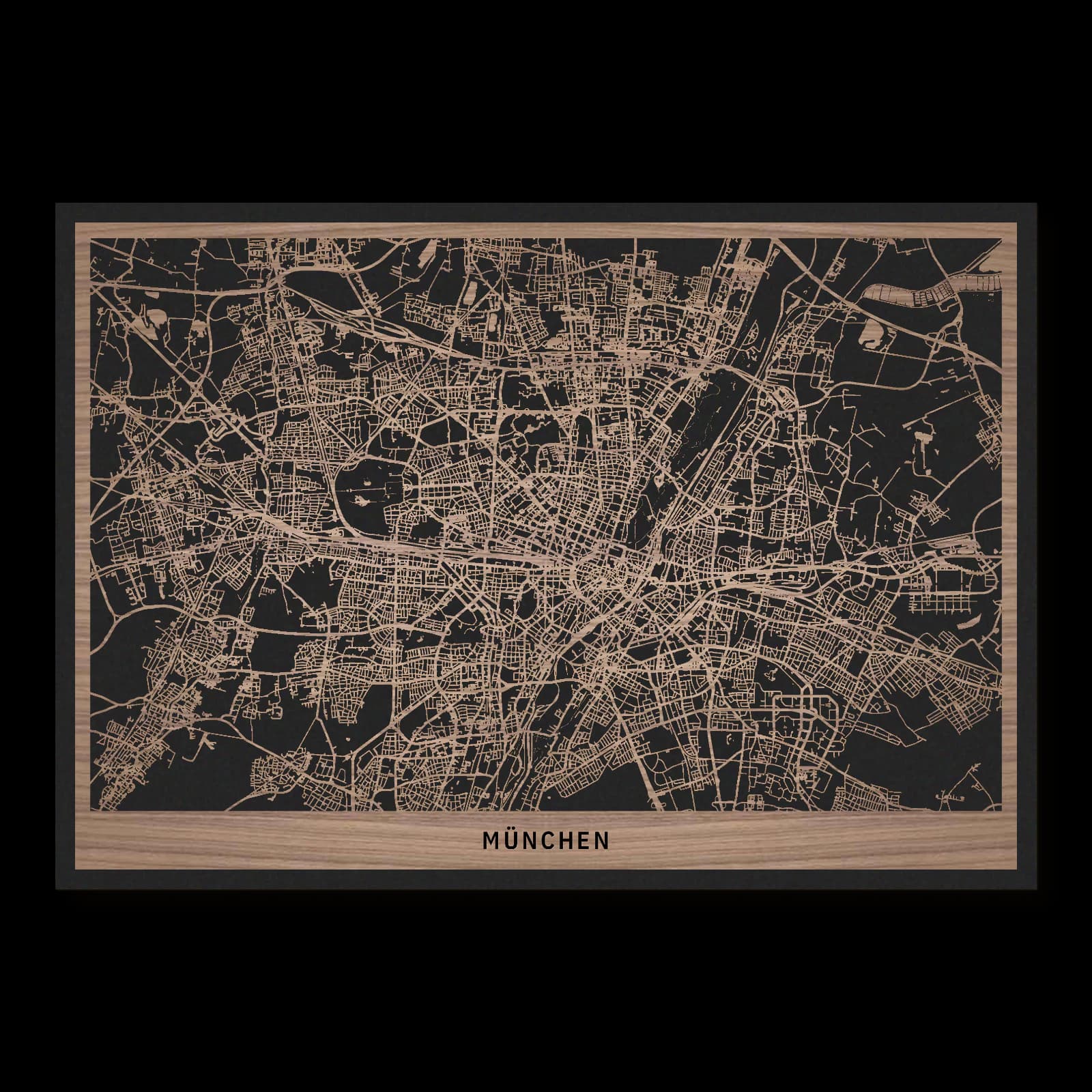
Munich.City overview
A layered wooden map of Munich in landscape format, with oiled walnut veneer on MDF.
About the product
Palace approaches, Olympic parkland and the Isar each lend Munich a different kind of open space. This landscape map brings Nymphenburg into relation with the Olympiapark and the southern Englischer Garten. Museum Island, home to the Deutsches Museum, adds a distinct place within the river. Oiled walnut veneer on MDF introduces the wood’s grain to the city outline. A separate backing panel gives the cut map depth, while the wide format accommodates the connections between the western palace grounds and the riverside neighbourhoods. The result is a layered wooden map shaped by Munich’s parks as much as its streets.
What does the map show?
- Nymphenburg Palace to the west
- Olympiapark north of the centre
- The southern Englischer Garten
- Museum Island and the Deutsches Museum
- Precisely cut and engraved
- Fine laser details with clear depth
- Carefully inspected and securely packed
- Handmade in Germany
Configuration
Shape: Rectangular · Design: Layered · Material: Walnut · Sizes: 20 × 30 cm, 35 × 50 cm, 50 × 70 cm
The configuration shown in the cart and at the time of ordering is authoritative. The preview is not a dimensioned technical drawing.
Availability & production
- Availability
- Made to order
- Production time
- Ships in 3-5 business days
Production starts after successful payment and complete product configuration.
Materials & care
Depending on the variant, lacquered or oiled MDF or oiled real-wood veneer on MDF; optional stainless-steel mounting screws. Acrylic lacquer spray, hard-wax oil and white glue are used in production.
Wood is a natural material. Grain and color may vary slightly from the product images.
Clean with a dry, soft cloth and protect from prolonged moisture and direct heat.
Included & installation
The selected product in the ordered configuration, securely packed and prepared for installation.
- Maximum dimensions 50 × 70 cm and maximum product weight 2 kg.
- Wall-fixing screws and wall plugs are not included. Use fixings suitable for the wall type, substrate and product weight.
- Installation must be carried out by an adult. Keep optional mounting screws and other small parts away from children until installation.
Shipping & returns
Securely packed shipping. Return and cancellation information is available in the legal section.
Shipping costs and delivery options depend on the destination and format. The published cancellation right applies to non-personalised standard goods; it may be excluded for individually made products.
Manufacturer & product identifier
- Manufacturer
- Benjamin Nöst - Lightworks
Rorichmoorer Str. 76
26802 Moormerland, Deutschland
kontakt@lightworks.de - Product identifier
- LW-CAT-4E1F96E6CD1E-S, LW-CAT-4E1F96E6CD1E-M, LW-CAT-4E1F96E6CD1E-L
Together with the order or production batch, the relevant SKU enables traceability. Safety questions and incidents can be reported to the email address shown above.
Product safety
- Decorative product for dry indoor use only; not a toy and not intended for children.
- Protect from moisture, high heat and open flames.
- Do not continue to hang the product after a fall, breakage or visible damage. Keep damaged parts away from children.
Munich through its palace, parks and river
Nymphenburg, the Olympiapark and the Englischer Garten embody different periods and different ideas about open space. Together with the Isar, they explain an important aspect of Munich’s urban character. This wider view follows the relationships between these substantial landscapes and the smaller neighbourhood streets that connect them.
A palace west of the centre
Nymphenburg began as a summer residence for Bavaria’s ruling family. Its foundation followed the birth of the long-awaited heir Max Emanuel in 1662. A relatively compact initial building developed into a much broader ensemble, with a central palace and connected wings expressing a clear desire for an ordered setting.
Its relationship with Munich has changed considerably. The palace originally stood outside the city, whereas its approaches and neighbouring districts now form part of a continuous urban area. That contrast remains instructive. An older institution can preserve its own scale and orientation even as ordinary streets grow around it. The palace frontage still establishes a strong western point of reference.
Public landscapes with different origins
The Olympiapark was created for the 1972 Summer Olympics. Sports buildings and a designed landscape belong to the same large composition. Water, landform and routes between venues matter alongside the structures themselves. Compared with Nymphenburg, the organisation is less about a single ceremonial axis and more about relationships among several places.
The Englischer Garten introduces a third approach. Work began in 1789, and its name refers to the English landscape-garden tradition. In the southern section near the inner city, curved paths and open lawns meet densely built neighbourhoods. The edges are especially revealing: crossing a street can lead from a tightly enclosed urban setting into a much more expansive landscape. Recreation and everyday city life are closely connected here.
Following the Isar
The Isar adds a direction that cannot be explained through a street grid. The Deutsches Museum occupies Museum Island, bringing a major cultural institution into the river’s spatial setting. Banks and bridges help connect the eastern and western parts of the inner city, while the water retains a line of its own.
Southwest of the centre, the Theresienwiese supplies another substantial opening. Its broad, largely unbuilt surface differs from both a landscaped park and palace grounds. Comparing these places makes their individual roles clearer rather than treating all green or open areas as interchangeable.
Munich’s character emerges from the way these larger spaces meet smaller streets. Follow a palace approach towards a residential block, or a park edge towards a crossing, and the change of scale becomes apparent. The overview offers several such relationships at once, showing a city where distinct forms of open space continue to shape movement and orientation.
Sources
- Bayerische Schlösserverwaltung: Nymphenburg Palace — https://www.schloss-nymphenburg.de/englisch/palace/index.htm
- Wikipedia: Olympiapark (Munich) — https://en.wikipedia.org/wiki/Olympiapark_(Munich)
- Wikipedia: Englischer Garten — https://en.wikipedia.org/wiki/Englischer_Garten
- Wikipedia: Deutsches Museum — https://en.wikipedia.org/wiki/Deutsches_Museum
- Wikipedia: Theresienwiese — https://en.wikipedia.org/wiki/Theresienwiese

Still deciding?
Configure your motif in the studio and see how your city map will look in your space.



