
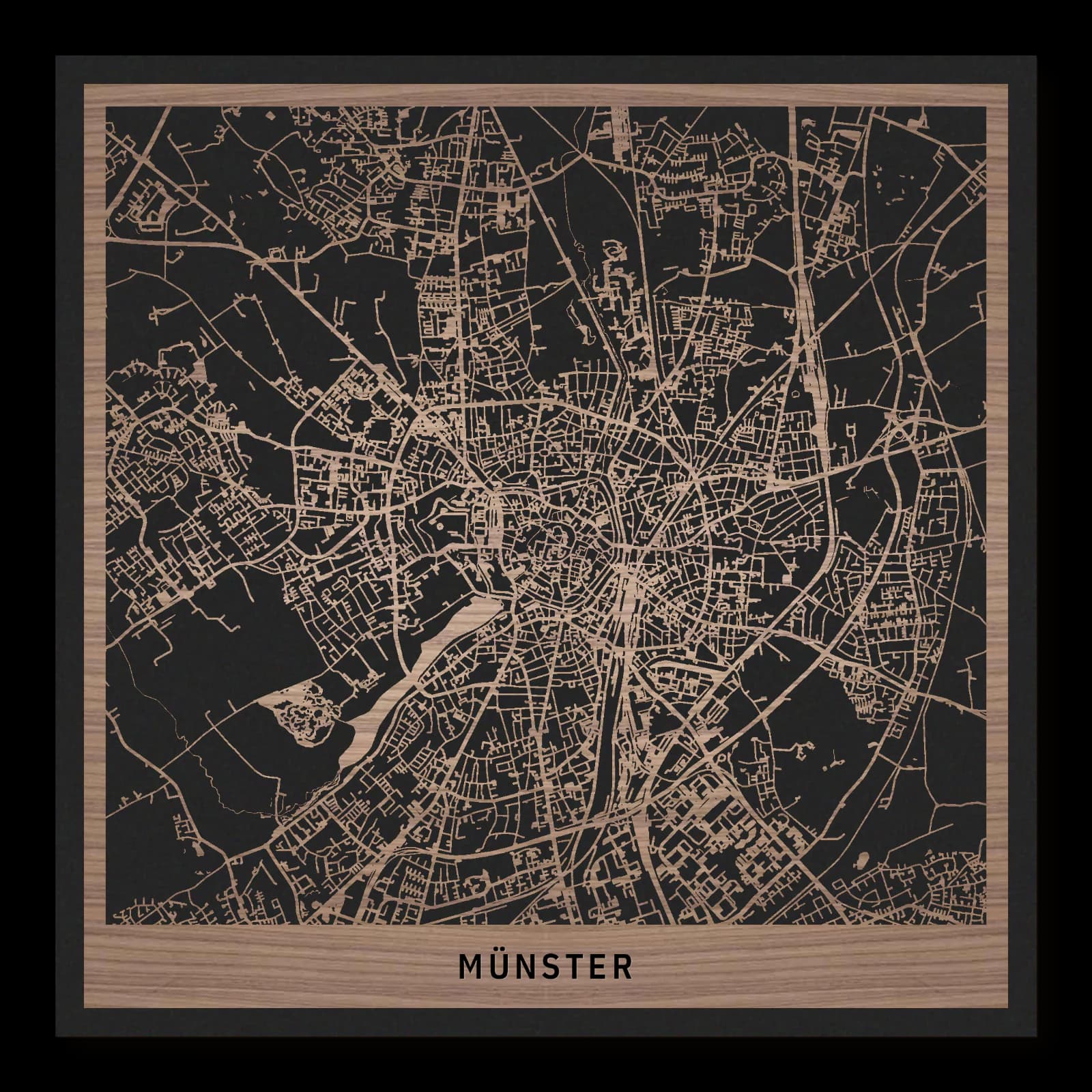
Münster.City overview
Square wooden city map made from oiled walnut – two layers with a black back plate.
About the product
Münster brings compact historic streets into close contact with generous open spaces. The cathedral anchors the centre, the palace creates a western focus, and Lake Aa extends a broad green and blue corridor towards the southwest. The harbour adds a different setting to the southeast, where former transport functions have given way to new public uses. Kinderhaus carries the urban picture northwards into residential neighbourhoods. Together, these places show a city that has developed in several directions while retaining clear relationships between its parts. Historic squares, waterside paths, institutional grounds and housing districts all contribute to a character that reaches far beyond the familiar central gables.
What does the map show?
- Cathedral and palace near the centre
- Lake Aa as a southwestern open space
- City harbour to the southeast
- Precisely cut and engraved
- Fine laser details with clear depth
- Carefully inspected and securely packed
- Handmade in Germany
Configuration
Shape: Square · Design: Layered · Material: Walnut · Sizes: 23 × 23 cm, 35 × 35 cm, 50 × 50 cm
The configuration shown in the cart and at the time of ordering is authoritative. The preview is not a dimensioned technical drawing.
Availability & production
- Availability
- Made to order
- Production time
- Ships in 3-5 business days
Production starts after successful payment and complete product configuration.
Materials & care
Depending on the variant, lacquered or oiled MDF or oiled real-wood veneer on MDF; optional stainless-steel mounting screws. Acrylic lacquer spray, hard-wax oil and white glue are used in production.
Wood is a natural material. Grain and color may vary slightly from the product images.
Clean with a dry, soft cloth and protect from prolonged moisture and direct heat.
Included & installation
The selected product in the ordered configuration, securely packed and prepared for installation.
- Maximum dimensions 50 × 70 cm and maximum product weight 2 kg.
- Wall-fixing screws and wall plugs are not included. Use fixings suitable for the wall type, substrate and product weight.
- Installation must be carried out by an adult. Keep optional mounting screws and other small parts away from children until installation.
Shipping & returns
Securely packed shipping. Return and cancellation information is available in the legal section.
Shipping costs and delivery options depend on the destination and format. The published cancellation right applies to non-personalised standard goods; it may be excluded for individually made products.
Manufacturer & product identifier
- Manufacturer
- Benjamin Nöst - Lightworks
Rorichmoorer Str. 76
26802 Moormerland, Deutschland
kontakt@lightworks.de - Product identifier
- LW-CAT-B7AB661732CB-S, LW-CAT-B7AB661732CB-M, LW-CAT-B7AB661732CB-L
Together with the order or production batch, the relevant SKU enables traceability. Safety questions and incidents can be reported to the email address shown above.
Product safety
- Decorative product for dry indoor use only; not a toy and not intended for children.
- Protect from moisture, high heat and open flames.
- Do not continue to hang the product after a fall, breakage or visible damage. Keep damaged parts away from children.
Münster’s lake, palace and harbour neighbourhoods
Münster’s centre has very different neighbours. The palace and its grounds lie to the west, Lake Aa opens the southwest, and the harbour occupies another waterside setting to the southeast. Residential districts extending towards Kinderhaus complete a broader picture of how historic streets, open space and everyday neighbourhoods fit together.
A compact centre with varied edges
St Paul’s Cathedral provides a historic focus within central Münster. Closely arranged streets and public squares surround it, yet relatively short distances lead to spaces of a different scale. That proximity is characteristic of the city. The older centre remains recognisable while connecting readily with extensive greenery and neighbourhoods shaped by later phases of development.
The palace stands west of the cathedral. Its late Baroque architecture and spacious surroundings differ from the tighter fabric of the old town. Originally associated with the prince-bishops, the building is now linked to the university. Formal architecture and academic life consequently share the same place. This gives the western side of the centre a public focus with a character distinct from the commercial and historic streets farther east.
A long opening towards the southwest
Lake Aa stretches southwest from the central area. Its elongated water surface introduces distance between built districts and accompanies a substantial green corridor. Paths along the shores make the lake itself a place for movement and everyday recreation, rather than merely the setting for one destination. Relationships between water, buildings and open ground change along its length.
This scale matters to the wider city. The lake functions differently from a small square or enclosed garden. It establishes a direction around which neighbourhoods and open spaces can be understood. Its proximity to the centre also places recreation close to ordinary urban routes. The transition between densely built streets and a broad waterside landscape is therefore unusually immediate.
A working harbour finds new uses
Münster’s harbour developed to the southeast as a connection to the Dortmund–Ems Canal. Opened in 1899, it extended the city’s transport and commercial infrastructure. Later changes brought different activities to the waterfront, including cultural and hospitality uses around the Kreativkai. The basin’s physical form still makes its original purpose legible, even as the life around it has changed.
Kinderhaus provides a northern reference within the residential city. Its position is a reminder that Münster extends beyond its celebrated central landmarks. The routes between northern neighbourhoods, palace, lake and harbour hold together a variety of everyday settings. Seen as a whole, the city combines a historic core, an institutional centre, a large recreation landscape and a reused transport site. Their relative closeness allows them to contribute to one urban identity while preserving the particular character of each place.
Sources
- Deutsche Zentrale für Tourismus – Münster — https://www.germany.travel/en/cities-culture/muenster.html
- Wikipedia – Aasee (Münster) — https://de.wikipedia.org/wiki/Aasee_(M%C3%BCnster)
- Wikipedia – Schloss Münster — https://de.wikipedia.org/wiki/Schloss_M%C3%BCnster
- Wikipedia – Hafen Münster — https://de.wikipedia.org/wiki/Hafen_M%C3%BCnster
- Wikipedia – Münster-Kinderhaus — https://de.wikipedia.org/wiki/M%C3%BCnster-Kinderhaus

Still deciding?
Configure your motif in the studio and see how your city map will look in your space.



