
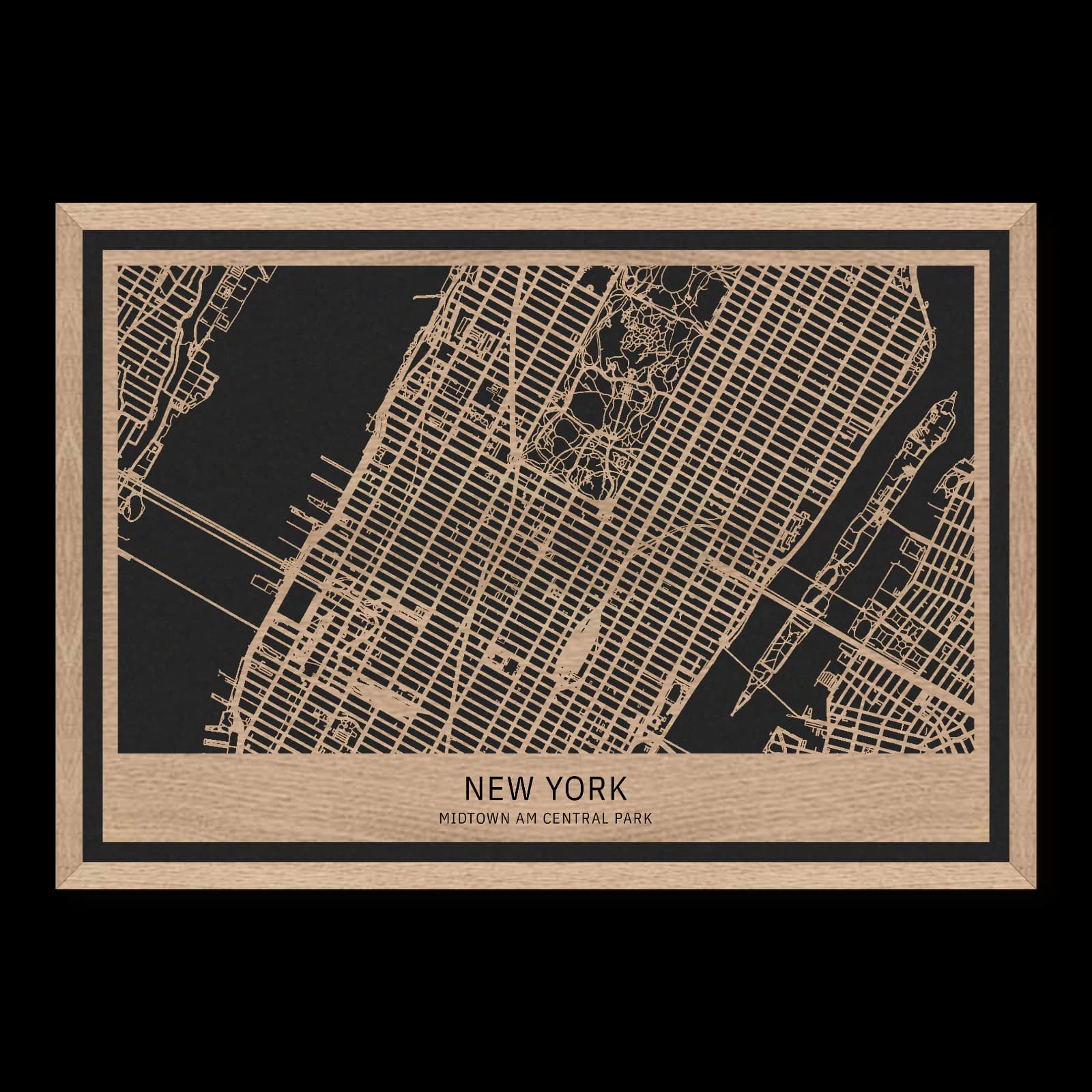
New York.Midtown and Central Park South
Framed wooden city map in oiled oak, landscape format.
About the product
Midtown's density becomes clear between Columbus Circle, the Plaza Hotel, Carnegie Hall and Rockefeller Center. Central Park opens along the northern edge, while streets, major buildings and smaller public spaces interlock to the south. This view recalls the sudden sense of distance beside the park and the return towards music, architecture and art among the blocks. Landscape format puts the park edge beside Midtown. An oiled oak frame encloses the layered map, while the cut streets above a backing panel give depth to the transition from open ground to dense blocks.
What does the map show?
- Columbus Circle
- Plaza Hotel
- Rockefeller Center
- Carnegie Hall
- Precisely cut and engraved
- Fine laser details with clear depth
- Carefully inspected and securely packed
- Handmade in Germany
Configuration
Shape: Rectangular · Design: Framed · Material: Oak · Sizes: 20 × 30 cm, 35 × 50 cm, 50 × 70 cm
The configuration shown in the cart and at the time of ordering is authoritative. The preview is not a dimensioned technical drawing.
Availability & production
- Availability
- Made to order
- Production time
- Ships in 3-5 business days
Production starts after successful payment and complete product configuration.
Materials & care
Depending on the variant, lacquered or oiled MDF or oiled real-wood veneer on MDF; optional stainless-steel mounting screws. Acrylic lacquer spray, hard-wax oil and white glue are used in production.
Wood is a natural material. Grain and color may vary slightly from the product images.
Clean with a dry, soft cloth and protect from prolonged moisture and direct heat.
Included & installation
The selected product in the ordered configuration, securely packed and prepared for installation.
- Maximum dimensions 50 × 70 cm and maximum product weight 2 kg.
- Wall-fixing screws and wall plugs are not included. Use fixings suitable for the wall type, substrate and product weight.
- Installation must be carried out by an adult. Keep optional mounting screws and other small parts away from children until installation.
Shipping & returns
Securely packed shipping. Return and cancellation information is available in the legal section.
Shipping costs and delivery options depend on the destination and format. The published cancellation right applies to non-personalised standard goods; it may be excluded for individually made products.
Manufacturer & product identifier
- Manufacturer
- Benjamin Nöst - Lightworks
Rorichmoorer Str. 76
26802 Moormerland, Deutschland
kontakt@lightworks.de - Product identifier
- LW-CAT-5DA239E973C0-S, LW-CAT-5DA239E973C0-M, LW-CAT-5DA239E973C0-L
Together with the order or production batch, the relevant SKU enables traceability. Safety questions and incidents can be reported to the email address shown above.
Product safety
- Decorative product for dry indoor use only; not a toy and not intended for children.
- Protect from moisture, high heat and open flames.
- Do not continue to hang the product after a fall, breakage or visible damage. Keep damaged parts away from children.
Midtown at Central Park: an urban edge of music and art
Central Park's southern boundary brings two spatial systems together: a dense street grid and a designed landscape. Columbus Circle, the Plaza Hotel, Carnegie Hall and Rockefeller Center reveal different aspects of that meeting. This area connects the park edge with cultural places inside the built city, making approaches and public spaces particularly revealing.
A city facing a designed landscape
The southern edge of Central Park creates an unusually clear seam within New York. Regular streets and densely built blocks meet paths, water and landforms organised according to another design. This is not an accidental encounter between city and untouched nature. The park was conceived as a landscape within a growing metropolis.
Near its southeastern corner, the Pond lies below the adjoining street level. A few steps consequently change the experience of the surroundings. The Central Park Conservancy identifies this immediate transition as part of the park's essential purpose. Buildings remain visible, while movement changes from following a street to entering a carefully arranged landscape.
Columbus Circle marks the southwestern approach. Its circular arrangement departs from the neighbouring grid and turns the park corner into a distinct transport junction. The Plaza Hotel provides a different accent at the southeastern edge: a substantial urban building facing open parkland. Together these places show why the southern boundary is more than a simple line on a plan.
Music and art within the blocks
Carnegie Hall stands south of the park within built-up Midtown. Opened in 1891, it connects Andrew Carnegie's name with an important setting for public musical life. Its location demonstrates that a major cultural institution need not be surrounded by extensive grounds. A recognisable entrance within dense streets can establish an equally strong urban address.
Rockefeller Center has another arrangement. Its towers are connected with smaller open spaces and passages. Art was deliberately incorporated into the architecture through sculpture, reliefs and murals. It therefore participates in public experience between buildings rather than existing only as objects collected indoors.
The difference in scale is particularly instructive. Central Park supplies one very large open area, while Rockefeller Center uses much smaller spaces within a building complex. Both can organise movement and support moments of pause, but they do so at different levels of the urban network.
At the park's southern edge, public space emerges from the immediate meeting of landscape and dense development. Within Rockefeller Center, plazas, passages and artworks perform that role inside a building complex. Carnegie Hall redirects attention towards a cultural interior. Midtown offers no simple boundary between open and enclosed space here. The conditions for stopping and gathering change several times within a few streets, from the expansive park edge to a space among buildings and then a purposeful arrival at a concert hall.
Sources
- Central Park Conservancy: The Pond — https://www.centralparknyc.org/locations/the-pond
- Rockefeller Center: Art & History — https://www.rockefellercenter.com/art-and-history/
- Wikipedia: Carnegie Hall — https://en.wikipedia.org/wiki/Carnegie_Hall
- Wikipedia: Plaza Hotel — https://en.wikipedia.org/wiki/Plaza_Hotel
- Wikipedia: Columbus Circle — https://en.wikipedia.org/wiki/Columbus_Circle

Still deciding?
Configure your motif in the studio and see how your city map will look in your space.



