
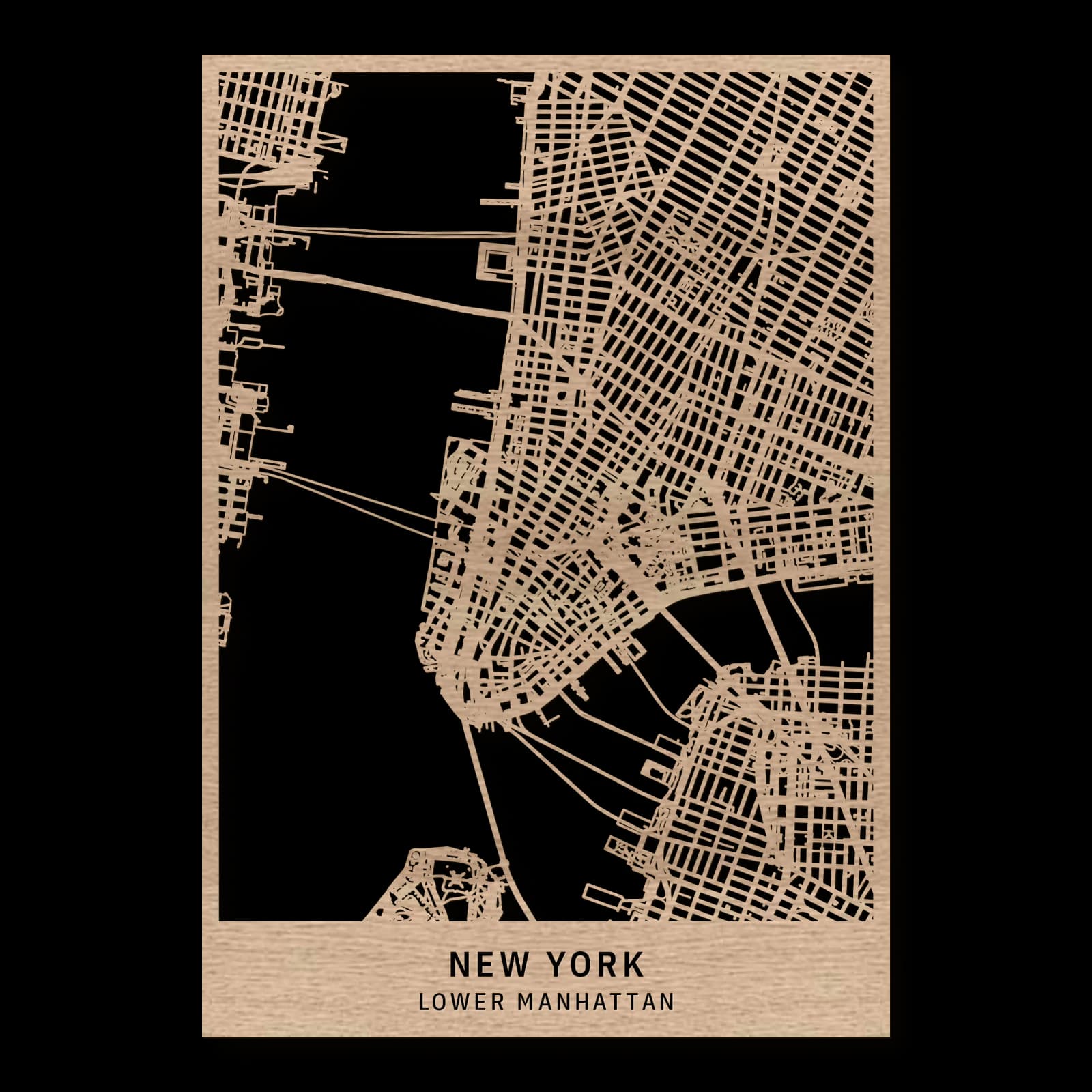
New York.Lower Manhattan
Classic wooden city map in oiled oak, portrait format.
About the product
Lower Manhattan combines closely turning streets with significant public places. Trinity Church, Federal Hall, the 9/11 Memorial and Castle Clinton establish a pattern distinct from the regular grid farther north. This view recalls short journeys between tall buildings, unexpected openings and the nearby harbour. Oiled oak carries this Classic map as a single cut layer. Portrait format follows the short routes between public sites and the harbour, retaining the irregular streets of the island’s southern tip.
What does the map show?
- Trinity Church
- Federal Hall
- 9/11 Memorial
- Castle Clinton
- Precisely cut and engraved
- Fine laser details with clear depth
- Carefully inspected and securely packed
- Handmade in Germany
Configuration
Shape: Rectangular · Design: Classic · Material: Oak · Sizes: 20 × 30 cm, 35 × 50 cm, 50 × 70 cm
The configuration shown in the cart and at the time of ordering is authoritative. The preview is not a dimensioned technical drawing.
Availability & production
- Availability
- Made to order
- Production time
- Ships in 3-5 business days
Production starts after successful payment and complete product configuration.
Materials & care
Depending on the variant, lacquered or oiled MDF or oiled real-wood veneer on MDF; optional stainless-steel mounting screws. Acrylic lacquer spray, hard-wax oil and white glue are used in production.
Wood is a natural material. Grain and color may vary slightly from the product images.
Clean with a dry, soft cloth and protect from prolonged moisture and direct heat.
Included & installation
The selected product in the ordered configuration, securely packed and prepared for installation.
- Maximum dimensions 50 × 70 cm and maximum product weight 2 kg.
- Wall-fixing screws and wall plugs are not included. Use fixings suitable for the wall type, substrate and product weight.
- Installation must be carried out by an adult. Keep optional mounting screws and other small parts away from children until installation.
Shipping & returns
Securely packed shipping. Return and cancellation information is available in the legal section.
Shipping costs and delivery options depend on the destination and format. The published cancellation right applies to non-personalised standard goods; it may be excluded for individually made products.
Manufacturer & product identifier
- Manufacturer
- Benjamin Nöst - Lightworks
Rorichmoorer Str. 76
26802 Moormerland, Deutschland
kontakt@lightworks.de - Product identifier
- LW-CAT-90F1D4E03D1D-S, LW-CAT-90F1D4E03D1D-M, LW-CAT-90F1D4E03D1D-L
Together with the order or production batch, the relevant SKU enables traceability. Safety questions and incidents can be reported to the email address shown above.
Product safety
- Decorative product for dry indoor use only; not a toy and not intended for children.
- Protect from moisture, high heat and open flames.
- Do not continue to hang the product after a fall, breakage or visible damage. Keep damaged parts away from children.
Lower Manhattan: government, harbour and remembrance
The southern end of Manhattan brings early national history, religious life and more recent remembrance into close proximity. Federal Hall, Trinity Church, the 9/11 Memorial and Castle Clinton establish different points of reference. Their neighbourhood does not tell one simple story, but connects places whose purposes changed substantially across several periods of New York's development.
A site of national beginnings
George Washington took the presidential oath at the Federal Hall site in 1789. The surviving building is not the earlier city hall in which that ceremony occurred. It was built later as a customs house and subsequently served other purposes. Distinguishing the historical event from the building now visible is essential to understanding the place.
National history here occupies a dense urban setting. Streets and tall buildings leave comparatively limited open ground. A flight of steps or a small forecourt can consequently acquire a strong public presence. The experience differs from approaching an expansive national monument separated from ordinary city activity.
A church and a harbour fort
Trinity Church provides a religious reference close to Federal Hall. The present Gothic Revival church dates from the nineteenth century, while the parish and its earlier buildings have a longer history. Church and churchyard create a setting with different uses and rhythms within the densely built financial district.
Castle Clinton near Manhattan's southern tip began as a harbour defence. Constructed in the early nineteenth century, it later accommodated very different activities, including entertainment and immigration processing. Its history demonstrates how a building in a strategic waterfront position could change with the city's needs. The present relationship with surrounding land should not be assumed to reproduce its original situation.
A more recent place of remembrance
The 9/11 Memorial occupies the former World Trade Center site. Designed by Michael Arad and Peter Walker, it places two large pools within the footprints of the destroyed towers. The surrounding parapets carry victims' names. The memorial commemorates the attacks of September 11, 2001, and the 1993 World Trade Center bombing.
This setting calls for a different kind of attention from that given to an ordinary visitor attraction. Water and open space relate deliberately to loss and absence. At the same time, the memorial lies within a district that continues to function as part of the city. Remembrance and daily movement remain physically close without becoming equivalent activities.
A route through Lower Manhattan should preserve these distinctions. National beginnings, religious practice, harbour development and remembrance of victims belong to different historical contexts. Streets connect their locations but do not supply one easy explanation. The area is revealing precisely because it contains several periods within a compact setting. It encourages careful attention to the difference between a building's age, its successive uses and the significance attached to its particular location.
Sources
- National Park Service: Federal Hall National Memorial — https://www.nps.gov/feha/
- National Park Service: Castle Clinton – History & Culture — https://www.nps.gov/cacl/learn/historyculture/index.htm
- 9/11 Memorial & Museum: About the Memorial — https://www.911memorial.org/visit/memorial/about-memorial
- Wikipedia: Federal Hall — https://en.wikipedia.org/wiki/Federal_Hall
- Wikipedia: Trinity Church — https://en.wikipedia.org/wiki/Trinity_Church_(Manhattan)

Still deciding?
Configure your motif in the studio and see how your city map will look in your space.