
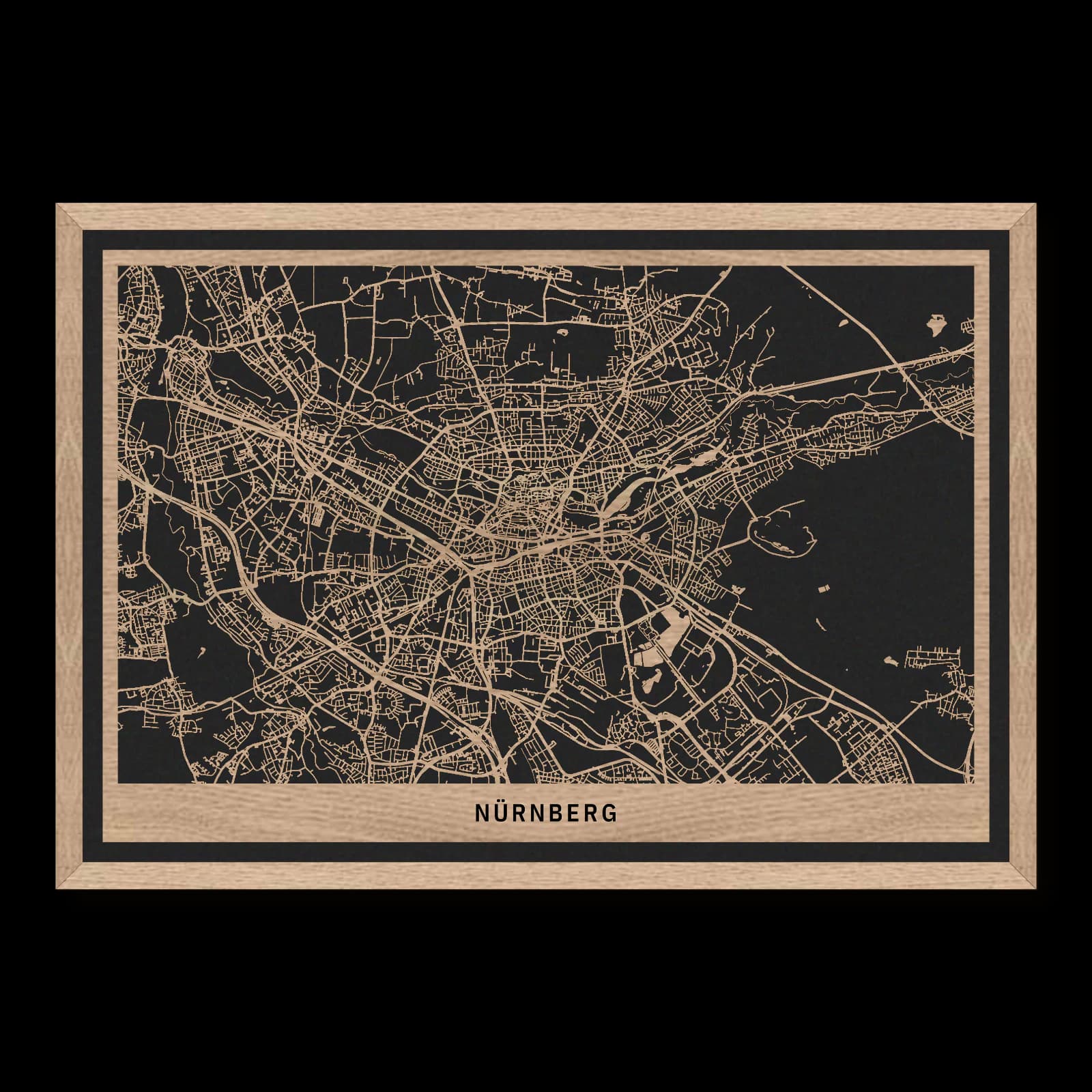
Nuremberg.
Framed wooden city map in oiled oak, landscape format.
About the product
Nuremberg extends from its castle and compact old town into districts shaped by water, transport and major public institutions. The Palace of Justice to the west, Wöhrder See to the east and southeastern sites of remembrance establish a wider frame. Between them, smaller streets meet substantial urban grounds and routes. An oak frame contains this wide landscape view. The cut map sits above a backing panel, linking the close streets of the old town with larger sites to the west and southeast within one coherent city plan.
What does the map show?
- Kaiserburg Nürnberg
- Justizpalast Nürnberg
- Dokumentationszentrum Reichsparteitagsgelände
- Wöhrder See
- Precisely cut and engraved
- Fine laser details with clear depth
- Carefully inspected and securely packed
- Handmade in Germany
Configuration
Shape: Rectangular · Design: Framed · Material: Oak · Sizes: 20 × 30 cm, 35 × 50 cm, 50 × 70 cm
The configuration shown in the cart and at the time of ordering is authoritative. The preview is not a dimensioned technical drawing.
Availability & production
- Availability
- Made to order
- Production time
- Ships in 3-5 business days
Production starts after successful payment and complete product configuration.
Materials & care
Depending on the variant, lacquered or oiled MDF or oiled real-wood veneer on MDF; optional stainless-steel mounting screws. Acrylic lacquer spray, hard-wax oil and white glue are used in production.
Wood is a natural material. Grain and color may vary slightly from the product images.
Clean with a dry, soft cloth and protect from prolonged moisture and direct heat.
Included & installation
The selected product in the ordered configuration, securely packed and prepared for installation.
- Maximum dimensions 50 × 70 cm and maximum product weight 2 kg.
- Wall-fixing screws and wall plugs are not included. Use fixings suitable for the wall type, substrate and product weight.
- Installation must be carried out by an adult. Keep optional mounting screws and other small parts away from children until installation.
Shipping & returns
Securely packed shipping. Return and cancellation information is available in the legal section.
Shipping costs and delivery options depend on the destination and format. The published cancellation right applies to non-personalised standard goods; it may be excluded for individually made products.
Manufacturer & product identifier
- Manufacturer
- Benjamin Nöst - Lightworks
Rorichmoorer Str. 76
26802 Moormerland, Deutschland
kontakt@lightworks.de - Product identifier
- LW-CAT-D75E6F1E88D2-S, LW-CAT-D75E6F1E88D2-M, LW-CAT-D75E6F1E88D2-L
Together with the order or production batch, the relevant SKU enables traceability. Safety questions and incidents can be reported to the email address shown above.
Product safety
- Decorative product for dry indoor use only; not a toy and not intended for children.
- Protect from moisture, high heat and open flames.
- Do not continue to hang the product after a fall, breakage or visible damage. Keep damaged parts away from children.
Nuremberg: the imperial city and its later histories
The castle and old town provide Nuremberg with a strong centre, but the wider city contains other essential reference points. The Palace of Justice, former Nazi Party Rally Grounds, railway landscape and Pegnitz corridor belong to different histories. Considering their positions together offers orientation while preserving the distinctions between their meanings.
Castle and city
Nuremberg Castle stands on a rocky elevation north of the old town. During the Middle Ages it was an important stopping place for rulers travelling through the Holy Roman Empire. Its position makes political authority visible above the city. Nuremberg also developed a strong civic independence, however, and the history of the castle should not simply stand in for the history of its inhabitants.
Seen within a wider area, the old town is less self-contained than it first appears. Roads continue into surrounding districts, the Pegnitz crosses the urban fabric, and railway land follows a different order from older streets. To the east, Wöhrder See creates a broader opening, changing water from a narrow urban course into a substantial landscape within the city.
Transport and changing scale
The Transport Museum south of the historic centre points to Nuremberg's important railway history. Its proximity to railway infrastructure connects the subject of the collection with the surrounding city. Comparing this area with the old town reveals contrasting demands for space: tracks, large buildings and access routes cannot be arranged like traditional residential and commercial streets.
Such differences help explain urban expansion. New functions did more than occupy existing premises; they also created distinct areas. The boundaries where small blocks meet large institutional plots can therefore reveal as much about Nuremberg as its individual monuments.
Different sites of historical responsibility
The Palace of Justice in the west is associated with the Nuremberg trials held after the Second World War. The former Nazi Party Rally Grounds to the southeast, by contrast, were a setting for the regime's mass spectacles. The Documentation Center addresses that history.
These places belong to the same city's past, but represent fundamentally different actions and moments. Showing them together should clarify those differences rather than blur them. Their physical separation also demonstrates how public memory attaches to several specific locations whose relationship requires explanation.
The distance between the castle and the Documentation Center also requires a distinction in how history is understood. Nuremberg's medieval importance and its role under National Socialism cannot be folded into a seamless story of civic greatness. The Palace of Justice demands its own historical context as well. Their separated locations help keep those meanings distinct. The Pegnitz, railway connections and residential districts occupy the space between them, forming the present-day city in which these very different historical places are interpreted.
Sources
- Bayerische Schlösserverwaltung: Kaiserburg – Geschichte — https://www.kaiserburg-nuernberg.de/englisch/castle/index.htm
- Wikipedia: Justizpalast Nürnberg — https://en.wikipedia.org/wiki/Nuremberg_Palace_of_Justice
- Wikipedia: Dokumentationszentrum Reichsparteitagsgelände — https://en.wikipedia.org/wiki/Documentation_Center_Nazi_Party_Rally_Grounds
- Wikipedia: Verkehrsmuseum Nürnberg — https://en.wikipedia.org/wiki/Nuremberg_Transport_Museum
- Wikipedia: Wöhrder See — https://de.wikipedia.org/wiki/Wöhrder_See

Still deciding?
Configure your motif in the studio and see how your city map will look in your space.