
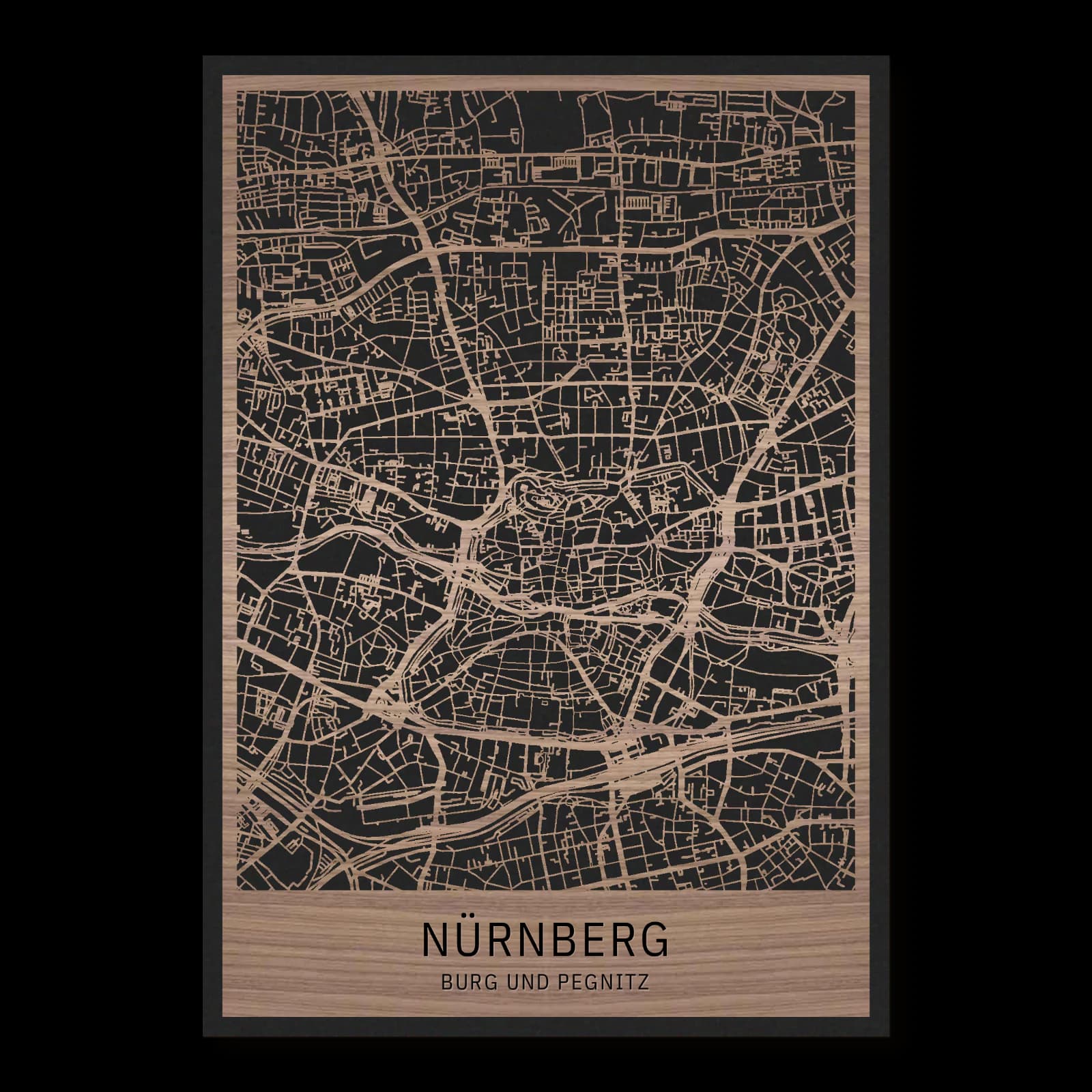
Nuremberg.Castle and Pegnitz
Layered wooden city map in oiled walnut, portrait format.
About the product
Northern Nuremberg brings together the castle, Dürer's house, St Sebaldus and the Holy Spirit Hospital beside the Pegnitz. Streets descend from the elevated fortress into a closely woven district of changing squares and river approaches. This view recalls the experience of moving through that historic setting, where celebrated buildings remain connected by ordinary routes. In portrait format, the streets follow the castle ridge before turning towards the Pegnitz. Oiled walnut forms the cut upper layer, set in front of a backing panel that gives the compact routes physical depth.
What does the map show?
- Kaiserburg Nürnberg
- Albrecht-Dürer-Haus
- St. Sebald
- Heilig-Geist-Spital
- Precisely cut and engraved
- Fine laser details with clear depth
- Carefully inspected and securely packed
- Handmade in Germany
Configuration
Shape: Rectangular · Design: Layered · Material: Walnut · Sizes: 20 × 30 cm, 35 × 50 cm, 50 × 70 cm
The configuration shown in the cart and at the time of ordering is authoritative. The preview is not a dimensioned technical drawing.
Availability & production
- Availability
- Made to order
- Production time
- Ships in 3-5 business days
Production starts after successful payment and complete product configuration.
Materials & care
Depending on the variant, lacquered or oiled MDF or oiled real-wood veneer on MDF; optional stainless-steel mounting screws. Acrylic lacquer spray, hard-wax oil and white glue are used in production.
Wood is a natural material. Grain and color may vary slightly from the product images.
Clean with a dry, soft cloth and protect from prolonged moisture and direct heat.
Included & installation
The selected product in the ordered configuration, securely packed and prepared for installation.
- Maximum dimensions 50 × 70 cm and maximum product weight 2 kg.
- Wall-fixing screws and wall plugs are not included. Use fixings suitable for the wall type, substrate and product weight.
- Installation must be carried out by an adult. Keep optional mounting screws and other small parts away from children until installation.
Shipping & returns
Securely packed shipping. Return and cancellation information is available in the legal section.
Shipping costs and delivery options depend on the destination and format. The published cancellation right applies to non-personalised standard goods; it may be excluded for individually made products.
Manufacturer & product identifier
- Manufacturer
- Benjamin Nöst - Lightworks
Rorichmoorer Str. 76
26802 Moormerland, Deutschland
kontakt@lightworks.de - Product identifier
- LW-CAT-60011AF588E0-S, LW-CAT-60011AF588E0-M, LW-CAT-60011AF588E0-L
Together with the order or production batch, the relevant SKU enables traceability. Safety questions and incidents can be reported to the email address shown above.
Product safety
- Decorative product for dry indoor use only; not a toy and not intended for children.
- Protect from moisture, high heat and open flames.
- Do not continue to hang the product after a fall, breakage or visible damage. Keep damaged parts away from children.
From Nuremberg Castle to the Pegnitz
The northern old town links an elevated castle with streets leading towards the river. Dürer's house, St Sebaldus and the Holy Spirit Hospital introduce civic, artistic and charitable histories alongside imperial power. Their proximity makes this compact area a useful place to understand the different institutions that once shaped urban life.
A castle above the streets
Nuremberg's Imperial Castle occupies elevated ground at the northern edge of the old town. Its significance grew from royal visits and its role within the political structure of the empire. The complex was not a single palace created at one moment: changing responsibilities and later rebuilding form part of its history. Looking towards the streets below reveals its distinct position within the city.
The route towards the Pegnitz crosses a setting of changing levels and building scales. The castle provides an upper reference point, while the river farther south establishes another kind of boundary and connection. Between them stand institutions rooted in civic life, rather than in the travelling imperial court alone.
An artist's house and an urban church
Albrecht Dürer lived and worked in the house beneath the castle from 1509 until his death in 1528. Its position connects a celebrated artist with a specific urban environment. Artistic production was embedded in the buildings and social world of the city, not detached from its ordinary streets.
St Sebaldus introduces a much larger architectural scale. As one of Nuremberg's defining churches, it belongs to a different institutional history from the fortress above. The close relationship between these places makes it possible to compare imperial representation, religious life and the domestic setting of an artist within a short distance.
Charity beside the Pegnitz
The Holy Spirit Hospital originated in a fourteenth-century foundation by Konrad Gross. It represents organised care within the medieval city. Its position beside the Pegnitz, together with later structures extending over the water, makes the complex particularly distinctive. Here the river is part of the building's physical situation rather than merely a scenic background.
A walk from the castle to the hospital therefore encounters several forms of public importance. Political authority, artistic work, religion and charitable provision occupied their own spaces. These institutions contributed to the same city without sharing one function or a single date of origin.
At the Heilig-Geist-Spital, the descent from the castle reaches a building directly engaged with the Pegnitz. Along the way, the castle, Dürer's house and St Sebald have introduced different aspects of the older city: authority, artistic work and communal religious life. The hospital adds care to that sequence. Their proximity should not obscure their separate purposes. Instead, it shows how closely Nuremberg's urban responsibilities could be located even when they belonged to distinct institutions and required very different architectural settings.
Sources
- Bayerische Schlösserverwaltung: Kaiserburg – Geschichte — https://www.kaiserburg-nuernberg.de/englisch/castle/index.htm
- Wikipedia: Albrecht-Dürer-Haus — https://en.wikipedia.org/wiki/Albrecht_Dürer%27s_House
- Wikipedia: St. Sebald — https://en.wikipedia.org/wiki/St._Sebaldus_Church,_Nuremberg
- Wikipedia: Heilig-Geist-Spital — https://de.wikipedia.org/wiki/Heilig-Geist-Spital_(Nürnberg)

Still deciding?
Configure your motif in the studio and see how your city map will look in your space.



