
Oberhausen.Alt-Oberhausen to Sterkrade
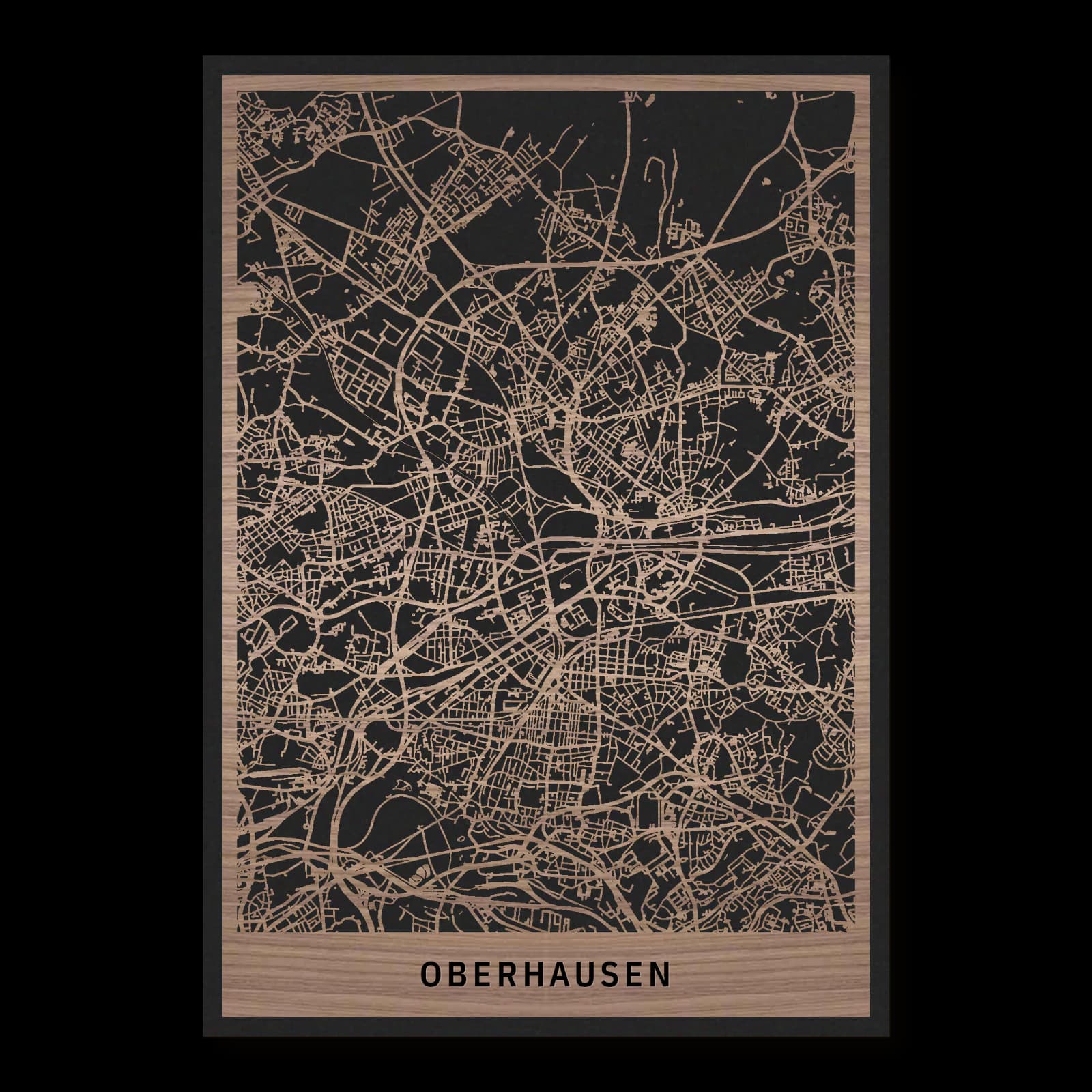
Rectangular wooden city map made from oiled walnut – two layers with a black back plate.
About the product
From Alt-Oberhausen to Sterkrade, older centres meet broad areas reshaped by industrial change. The Gasometer, Oberhausen Castle and Eisenheim workers' settlement mark different chapters among neighbourhoods, railways and waterways. Wood brings a quiet warmth to this extensive city map. Its network of routes reflects a city that grew from several centres, each retaining a place in the wider urban pattern.
What does the map show?
- Alt-Oberhausen and Sterkrade
- Gasometer’s industrial scale
- Historic Eisenheim settlement
- Oberhausen Castle and its grounds
- Precisely cut and engraved
- Fine laser details with clear depth
- Carefully inspected and securely packed
- Handmade in Germany
Configuration
Shape: Rectangular · Design: Layered · Material: Walnut · Sizes: 20 × 30 cm, 35 × 50 cm, 50 × 70 cm
The configuration shown in the cart and at the time of ordering is authoritative. The preview is not a dimensioned technical drawing.
Availability & production
- Availability
- Made to order
- Production time
- Ships in 3-5 business days
Production starts after successful payment and complete product configuration.
Materials & care
Depending on the variant, lacquered or oiled MDF or oiled real-wood veneer on MDF; optional stainless-steel mounting screws. Acrylic lacquer spray, hard-wax oil and white glue are used in production.
Wood is a natural material. Grain and color may vary slightly from the product images.
Clean with a dry, soft cloth and protect from prolonged moisture and direct heat.
Included & installation
The selected product in the ordered configuration, securely packed and prepared for installation.
- Maximum dimensions 50 × 70 cm and maximum product weight 2 kg.
- Wall-fixing screws and wall plugs are not included. Use fixings suitable for the wall type, substrate and product weight.
- Installation must be carried out by an adult. Keep optional mounting screws and other small parts away from children until installation.
Shipping & returns
Securely packed shipping. Return and cancellation information is available in the legal section.
Shipping costs and delivery options depend on the destination and format. The published cancellation right applies to non-personalised standard goods; it may be excluded for individually made products.
Manufacturer & product identifier
- Manufacturer
- Benjamin Nöst - Lightworks
Rorichmoorer Str. 76
26802 Moormerland, Deutschland
kontakt@lightworks.de - Product identifier
- LW-CAT-923A6645D64D-S, LW-CAT-923A6645D64D-M, LW-CAT-923A6645D64D-L
Together with the order or production batch, the relevant SKU enables traceability. Safety questions and incidents can be reported to the email address shown above.
Product safety
- Decorative product for dry indoor use only; not a toy and not intended for children.
- Protect from moisture, high heat and open flames.
- Do not continue to hang the product after a fall, breakage or visible damage. Keep damaged parts away from children.
Oberhausen and its several urban origins
No single centre explains every part of Oberhausen’s development. Railway stations, workers’ housing, a castle and a gas holder represent different origins and purposes. Their relationship between the southern centre and Sterkrade shows how earlier settlements and industrial grounds became one city while retaining separate points of reference and distinct spatial characters.
Railway connections and urban growth
The railway played a fundamental role in Oberhausen’s formation. The station opened in 1847 and provided an important stimulus to development. In the present city, the main station occupies the southern part of this wider urban setting. Its tracks and approach routes differ in scale from neighbouring residential streets. The station is consequently both a transport focus and evidence of a city whose growth was closely associated with new technical and industrial connections. Its position helps organise the southern area and explain its relationship with the centres farther north.
Earlier places within one municipality
The present city emerged in 1929 through the union of Oberhausen, Sterkrade and Osterfeld. This history helps explain the distribution of several centres across the urban area. Sterkrade station marks a northern district whose significance is independent of the southern centre. Neighbourhoods and larger sites with different histories occupy the ground between them. Oberhausen can therefore be understood as a connection of distinct urban areas. Its principal places remain separated by meaningful distances, while roads, railways and continuous settlement bring them into a shared city with several historical points of departure.
Industrial life at Eisenheim
Eisenheim dates from 1846 and is an important example of early workers’ housing in the Ruhr region. It introduces a different scale from the city’s large technical structures. Here, industrial history becomes tangible through homes, plots and neighbourhood relationships. Unlike the Gasometer, the settlement is defined by repeated smaller forms rather than one immense building. Their proximity demonstrates that the story of industrialisation includes both production infrastructure and the places where workers lived. These different environments developed together and contributed jointly to Oberhausen’s distinctive urban structure and historical identity.
Castle and gas holder as contrasting landmarks
Oberhausen Castle and the Gasometer occupy the middle part of the wider composition, although they have very different origins. The former gas holder acquired a cultural role, while the castle supplies an older historical reference. Their open surroundings contrast with the more closely built streets elsewhere. Together with Eisenheim and the two stations, they form a sequence of different urban elements. Oberhausen’s character emerges from this variety: earlier centres and the large-scale traces of industry remain legible even where their functions have changed substantially over time.
Sources
- Stadt Oberhausen: Stadtgeschichte — https://www.oberhausen.de/de/index/leben-in-oberhausen/stadtportrait/stadtgeschichte.php
- Stadt Oberhausen: Stadtportrait — https://www.oberhausen.de/de/index/tourismus-freizeit/stadtportrait.php
- Oberhausen Tourismus: Siedlung Eisenheim — https://www.oberhausen-tourismus.de/poi/siedlung-eisenheim/
- Gasometer Oberhausen: Industriekultur — https://www.gasometer.de/de/der-gasometer/industriekultur

Still deciding?
Configure your motif in the studio and see how your city map will look in your space.



