
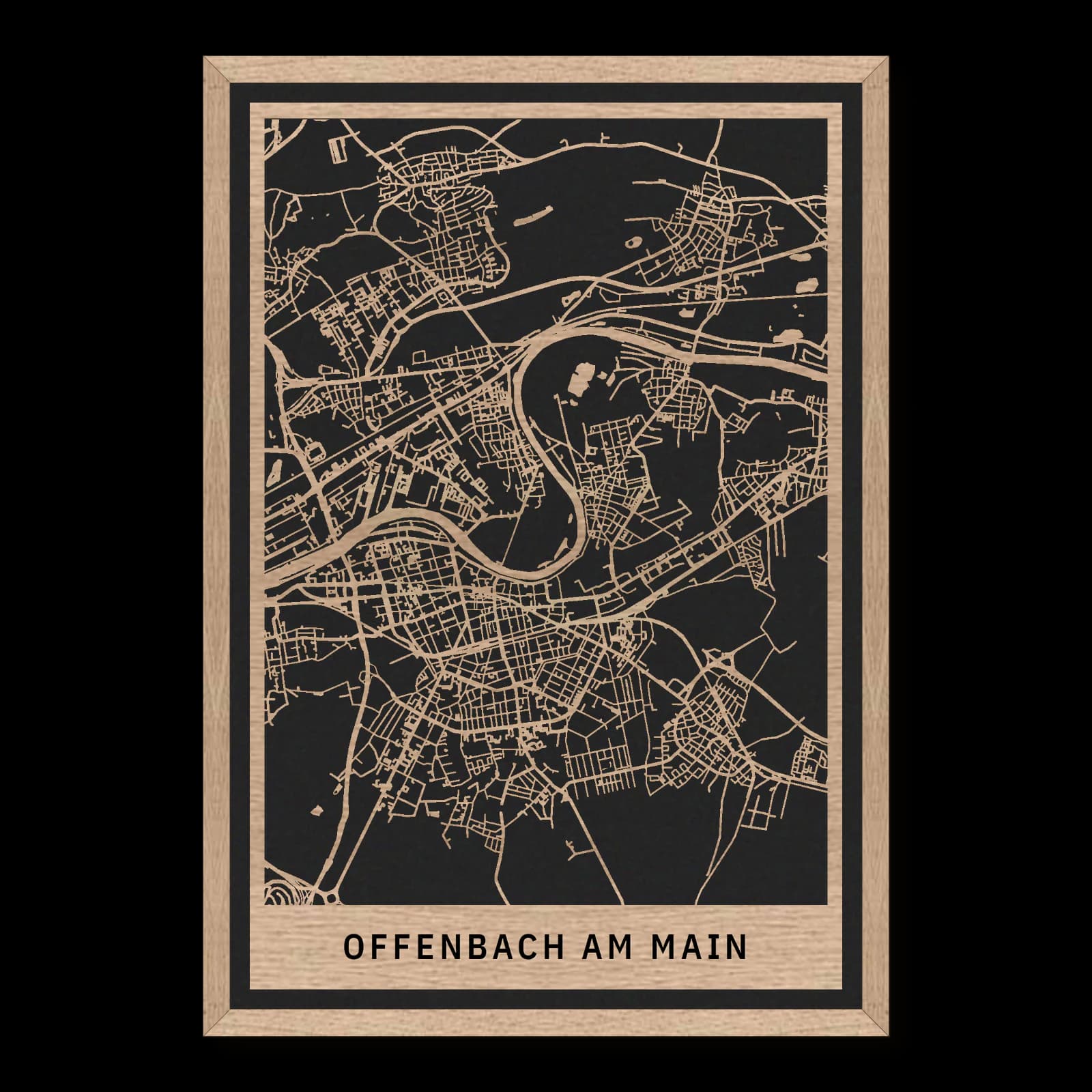
Offenbach am Main.Main waterfront, residences and weather park
Rectangular wooden city map made from oiled oak – two layers with a black back plate and frame.
About the product
Offenbach’s Main setting brings historic residences, public gardens and established neighbourhoods together. Isenburg Palace and Büsing-Palais occupy the central area, Rumpenheim extends the portrait northeastward and the weather park adds a southeastern reference. The wooden map gives these distinct places a calm shared material setting. Their connecting streets reveal a city that follows the river while reaching considerably farther inland.
What does the map show?
- Main waterfront
- Isenburg Palace
- Büsing-Palais
- Rumpenheim Palace
- Weather park
- Precisely cut and engraved
- Fine laser details with clear depth
- Carefully inspected and securely packed
- Handmade in Germany
Configuration
Shape: Rectangular · Design: Framed · Material: Oak · Sizes: 20 × 30 cm, 35 × 50 cm, 50 × 70 cm
The configuration shown in the cart and at the time of ordering is authoritative. The preview is not a dimensioned technical drawing.
Availability & production
- Availability
- Made to order
- Production time
- Ships in 3-5 business days
Production starts after successful payment and complete product configuration.
Materials & care
Depending on the variant, lacquered or oiled MDF or oiled real-wood veneer on MDF; optional stainless-steel mounting screws. Acrylic lacquer spray, hard-wax oil and white glue are used in production.
Wood is a natural material. Grain and color may vary slightly from the product images.
Clean with a dry, soft cloth and protect from prolonged moisture and direct heat.
Included & installation
The selected product in the ordered configuration, securely packed and prepared for installation.
- Maximum dimensions 50 × 70 cm and maximum product weight 2 kg.
- Wall-fixing screws and wall plugs are not included. Use fixings suitable for the wall type, substrate and product weight.
- Installation must be carried out by an adult. Keep optional mounting screws and other small parts away from children until installation.
Shipping & returns
Securely packed shipping. Return and cancellation information is available in the legal section.
Shipping costs and delivery options depend on the destination and format. The published cancellation right applies to non-personalised standard goods; it may be excluded for individually made products.
Manufacturer & product identifier
- Manufacturer
- Benjamin Nöst - Lightworks
Rorichmoorer Str. 76
26802 Moormerland, Deutschland
kontakt@lightworks.de - Product identifier
- LW-CAT-F144D07FCB5B-S, LW-CAT-F144D07FCB5B-M, LW-CAT-F144D07FCB5B-L
Together with the order or production batch, the relevant SKU enables traceability. Safety questions and incidents can be reported to the email address shown above.
Product safety
- Decorative product for dry indoor use only; not a toy and not intended for children.
- Protect from moisture, high heat and open flames.
- Do not continue to hang the product after a fall, breakage or visible damage. Keep damaged parts away from children.
Offenbach’s residences, Main waterfront and places of knowledge
The Main forms Offenbach’s northern landscape edge, while residential areas extend farther south. Isenburg Palace and Büsing-Palais occupy the central city, with Rumpenheim Palace providing a separate northeastern reference. The weather park adds another kind of public place. Streets and intervening neighbourhoods reveal how these distinct areas belong to one wider urban setting.
A palace within the present city
Isenburg Palace stands close to the Main and is one of Offenbach’s recognisable historical buildings. Its Renaissance architecture recalls a period when princely representation influenced particular parts of the settlement. Today it belongs to a substantially larger city. The altered surroundings are part of its interest: an older residence relates to streets, public uses and an expanded central area. Proximity to the river remains an important geographical reference. It does not, however, reduce Offenbach’s history to the waterfront, since the palace is now embedded in a wider network of urban spaces.
Architecture and greenery at Büsing-Palais
Büsing-Palais lies west of Isenburg Palace with an adjoining park. Historical architecture and greenery meet here within the more densely developed central city. The short distance between the two residences should not obscure their separate settings. Büsing-Palais belongs to its own relationship between building and public open space. It therefore adds another way to understand how inherited architecture remains connected with contemporary Offenbach. Green ground is not distant countryside in this setting. It occupies the same central area as streets, public destinations and the everyday movement of the city.
Rumpenheim farther along the Main
Rumpenheim lies northeast of the centre beside the river, with its palace establishing a separate historical reference. The distance between this place and the central residences reveals how older settlements and landmarks are distributed within Offenbach. The Main gives them a shared orientation without making their surroundings identical. Rumpenheim extends the portrait beyond the immediate centre. Residential areas and transport routes occupy the spaces between these places. The city’s shape consequently depends on both earlier local centres and the developed ground that now connects them within a larger urban area.
Weather as a public subject
The weather park southeast of the centre introduces a different theme. Its open grounds address weather and the atmosphere through a visitor centre and educational areas. Knowledge is connected with a public landscape rather than confined to a conventional interior collection. That combination differs from the purposes of the palace sites. Its southern position also adds a direction that the northern river edge cannot explain by itself. Public use and greenery acquire another role here, broadening the city’s cultural picture through a place concerned with natural processes and understanding them.
From the river edge to inland districts
Offenbach’s larger portrait comes from the relationships between these settings. The Main provides a clear geographical line, while the built city continues inland. Central residences, Rumpenheim and the weather park occupy different directions and serve separate purposes. Their connections pass through ordinary residential streets and urban areas. This distribution is as informative as the individual historical façades. It reveals how princely architecture, public gardens and contemporary knowledge coexist within an established Main city, with neighbourhoods between them providing the continuity that links their different stories and spatial forms.
Sources
- Isenburger Schloss | Stadt Offenbach am Main — https://www.offenbach.de/gaeste/sehenswert/veranstaltungen-33/isenburger-schloss.php
- Büsingpalais | Stadt Offenbach am Main — https://www.offenbach.de/gaeste/sehenswert/veranstaltungen-33/buesing-palais.php
- Zu Hause, im Urlaub! Wir machen's uns schön - Stadt Offenbach — https://www.offenbach.de/gaeste/fuehrungen-und-routen/tagestouren/offenbach-main-zuhause-touren.php
- Parks | Stadt Offenbach am Main — https://www.offenbach.de/gaeste/sehenswert/parks/index.php
- Sehenswertes entlang der Regionalschleife Offenbach — https://www.offenbach.de/buerger_innen/bauen-wohnen/gruene_stadt/regionale_routen/apfelweinrute/sehenswertes-entlang-der-regionalschleife-offenbach.php

Still deciding?
Configure your motif in the studio and see how your city map will look in your space.