
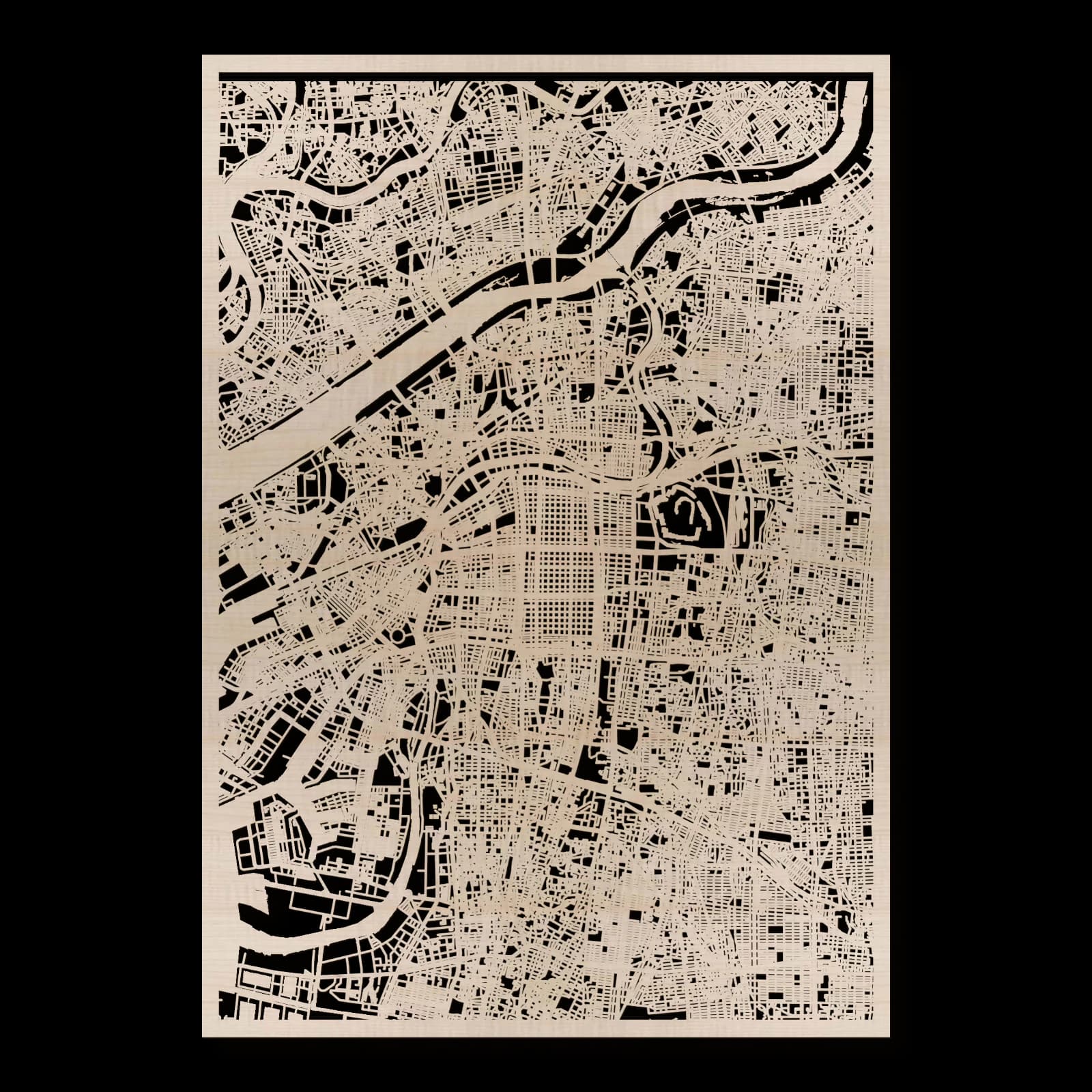
Osaka.City Overview
Rectangular wooden city map made from oiled maple.
About the product
From Osaka Station to the southern temple districts, streets and waterways form a densely connected city. Osaka Castle, Nakanoshima Park and Namba establish different focal points within this broader view. The wooden map brings major transport sites together with open grounds and smaller blocks, revealing an inner city whose distinctive organisation grew from commerce, historic institutions and the many crossings linking its varied neighbourhoods.
What does the map show?
- North-south links between station and temple
- Island landscape at Nakanoshima Park
- Extensive castle grounds east of the centre
- Precisely cut and engraved
- Fine laser details with clear depth
- Carefully inspected and securely packed
- Handmade in Germany
Configuration
Shape: Rectangular · Design: Classic · Material: Maple · Sizes: 20 × 30 cm, 35 × 50 cm, 50 × 70 cm
The configuration shown in the cart and at the time of ordering is authoritative. The preview is not a dimensioned technical drawing.
Availability & production
- Availability
- Made to order
- Production time
- Ships in 3-5 business days
Production starts after successful payment and complete product configuration.
Materials & care
Depending on the variant, lacquered or oiled MDF or oiled real-wood veneer on MDF; optional stainless-steel mounting screws. Acrylic lacquer spray, hard-wax oil and white glue are used in production.
Wood is a natural material. Grain and color may vary slightly from the product images.
Clean with a dry, soft cloth and protect from prolonged moisture and direct heat.
Included & installation
The selected product in the ordered configuration, securely packed and prepared for installation.
- Maximum dimensions 50 × 70 cm and maximum product weight 2 kg.
- Wall-fixing screws and wall plugs are not included. Use fixings suitable for the wall type, substrate and product weight.
- Installation must be carried out by an adult. Keep optional mounting screws and other small parts away from children until installation.
Shipping & returns
Securely packed shipping. Return and cancellation information is available in the legal section.
Shipping costs and delivery options depend on the destination and format. The published cancellation right applies to non-personalised standard goods; it may be excluded for individually made products.
Manufacturer & product identifier
- Manufacturer
- Benjamin Nöst - Lightworks
Rorichmoorer Str. 76
26802 Moormerland, Deutschland
kontakt@lightworks.de - Product identifier
- LW-CAT-A22400C2566F-S, LW-CAT-A22400C2566F-M, LW-CAT-A22400C2566F-L
Together with the order or production batch, the relevant SKU enables traceability. Safety questions and incidents can be reported to the email address shown above.
Product safety
- Decorative product for dry indoor use only; not a toy and not intended for children.
- Protect from moisture, high heat and open flames.
- Do not continue to hang the product after a fall, breakage or visible damage. Keep damaged parts away from children.
Osaka: Stations, river islands and a castle landscape
Osaka combines a long commercial history with major railway centres and substantial historic complexes. Waterways and central islands add further directions to the dense street network. Looking from the northern station district towards Shitennō-ji in the south keeps castle, parks and business areas within a shared and recognisably connected urban setting.
Water creates a different kind of space
Nakanoshima makes the role of waterways particularly clear. Its park occupies an island, creating a long open area within dense development. Bridges and riverside routes incorporate it into the city's movement network. Water therefore produces particular forms of connection and orientation rather than simply separating unrelated banks. The island's narrow shape differs from ordinary city blocks, keeping the course of the waterways legible within the wider view. Osaka's commercial history gains a physical setting here, with inherited relationships to water continuing to shape the contemporary city beyond individual historic buildings.
The castle and its surrounding grounds
Osaka Castle lies east of the principal central transport and commercial areas. Moats, walls and open grounds create a scale different from the surrounding streets. The site's history is associated with political conflict and the consolidation of power in late sixteenth- and early seventeenth-century Japan, while later reconstruction also shaped its present appearance. Both aspects matter. This is a historical place and a currently used urban landscape. The castle is not detached from the metropolis; it provides a substantial open and cultural reference within the continuous developed area.
More than one urban centre
Osaka is not organised around a single destination towards which every route converges. Osaka Station establishes a major transport focus in the north, while Namba plays another important role to the south. Dense neighbourhoods with varied uses occupy the intervening area. This multiple-centre structure is fundamental to the inner city. Stations do more than provide technical stopping points. They influence their surroundings, concentrate movement and create distinct forms of centrality. Following the urban fabric between them reveals a connected metropolis whose different parts retain recognisable local priorities and spatial patterns.
Southern history and western greenery
Shitennō-ji introduces a long Buddhist tradition in the south, adding another historical focus beside the northern stations and eastern castle. Utsubo Park creates a further open space west of the centre. Ordinary streets and neighbourhoods connect temple, park, transport sites and island. Those spaces give the wider portrait its continuity. Osaka emerges as a city where inherited institutions, commerce and modern mobility operate in close proximity. Repeated changes between large grounds, narrow connections and dense blocks create the distinctive rhythm of the inner urban landscape.
Sources
- Osaka Convention and Tourism Bureau: Nakanoshima — https://discover.osaka-info.jp/en/spots/nakanoshima-park
- Osaka Convention and Tourism Bureau: Stadtführer — https://osaka-info.jp/common/img/information/pamphlet/discoverosaka_guidebook.pdf
- Osaka Castle: English guide — https://www.osakacastle.net/pdf/leaflet/english_201904.pdf
- Wikivoyage: Osaka — https://de.wikivoyage.org/wiki/Osaka

Still deciding?
Configure your motif in the studio and see how your city map will look in your space.



